




Medical education
Clinical skills
Volume 206 - Issue 3
Murphy’s sign
Author: Phillip L Jeans
Med J Aust 2017; 206 (3): 115-116. || doi: 10.5694/mja16.00768
Published online: 20 February 2017
Published online: 20 February 2017
A common abdominal examination manoeuvre, but a common understanding is elusive
A common abdominal examination manoeuvre, but a common understanding is elusive
Most of us think that Murphy’s sign consists of the abrupt interruption of deep inspiration when palpating in the right upper quadrant of the abdomen. Its relevance would seem to be its presence in a non-tender abdomen, but is that so? Canvass your colleagues and you will find that a common understanding is as elusive as the Scarlet Pimpernel. The radiological community’s development of a “sonographic” Murphy’s sign has only added to the confusion.
John B Murphy (1857–1916) was a Chicago surgeon practising at the turn of the 20th century. Diagnostic investigations were limited, and the task of differentiating between different abdominal emergencies was difficult. Murphy described several clinical tests to aid in differential diagnosis, but the sign he is best remembered for was first described in 19031 and was further expounded on many occasions in his journal Surgical Clinics of John B. Murphy (a forerunner to Surgical Clinics of North America).
Murphy described two signs for cholecystitis. The one that bears his name he called “deep-grip palpation”; the other, which he considered to be an even better test, was referred to as “hammer-stroke percussion”.2,3
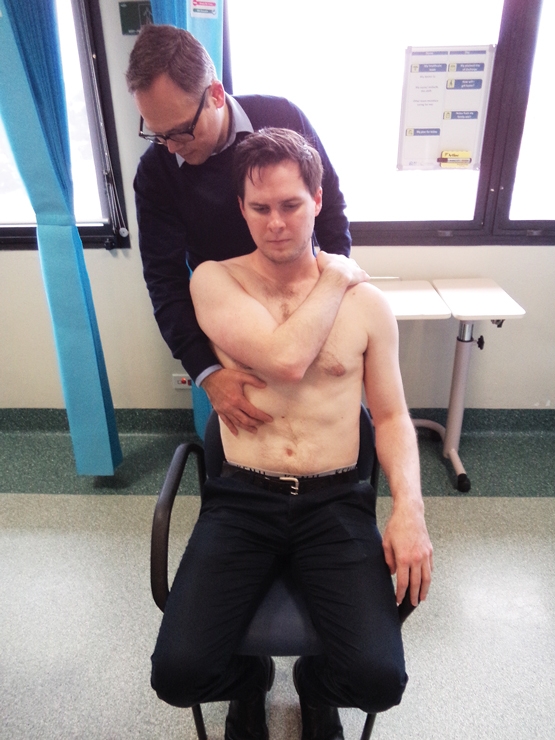
Deep-grip palpation was performed by standing directly behind the seated patient, but if the patient was unable to sit up, “the examiner reaches over the recumbent patient from the head”.2 Murphy’s 1903 description continues:
The most characteristic and constant sign of gall-bladder hypersensitiveness is the inability of the patient to take a full, deep inspiration, when the physician’s fingers are hooked up deep beneath the right costal arch below the hepatic margin. The diaphragm forces the liver down until the sensitive gall-bladder reaches the examining fingers, when the inspiration suddenly ceases as though it had been shut off. I have never found this sign absent in a calculous or infectious case of gall-bladder or duct disease.1
He further elucidated in 1914:
Hook your fingers under the costal arch and ask the patient to take a full inspiration, then with the other hand strike the flexed fingers at the height of inspiration. If pain is elicited, it is a positive sign that the gallbladder is distended. That is not as good a test, however, as the perpendicular finger percussion test. That is the best test of all. Place your middle finger, held straight and rigid, at the tip of the ninth costal cartilage, and ask the patient to take a full inspiration with the eyes closed. When the height of inspiration is reached, strike a sharp blow on the finger. If the gallbladder is distended or the seat of inflammation, the pain elicited is severe.4
Over the years, the percussion test has been forgotten and Murphy’s sign now refers to deep-grip palpation. Today it is not acceptable to unnecessarily cause or exacerbate severe pain, and although it was used by Murphy in cases of acute cholecystitis, the passage of time has seen the sign modified to fit with modern clinical practice. If a patient has tenderness or guarding, he or she has clinical signs warranting investigation so why would we need a special sign? What use would it be and why would we even try to elicit it when we know it will cause further pain?
The surgical community has long recognised that the real usefulness of the sign is in the non-acute patient where there is no tenderness.5,6
How good a predictor is it? A study that looked at this using non-filling of the cystic duct on biliary scintigraphy as a surrogate indicator of acute cholecystitis found that it was both sensitive (97.2%) and highly predictive (93.3%) of a positive result.7 Another group found the test to be not so accurate in older people.8 Both of these studies used the sign in situations where there were likely to be other signs of acute inflammation.
The sonographic Murphy’s sign creates further confusion as it is something totally different from the common interpretations of Murphy’s sign discussed above.9,10 The sonographer asks if the pain is worse than anywhere else when pressing directly over the gall bladder. The technique does not rely on an involuntary reaction, and the patient holds his or her breath. Its only similarity to anything that Murphy described is that it is like his hammer-stroke percussion technique but with the percussion replaced by sound waves. Why Murphy is referred to in this test is puzzling. A simple description that the gall bladder was tender to probe pressure should suffice.
Competing interests
No relevant disclosures.
Series editors
Balakrishnan (Kichu) Nair
Simon O’Connor
Series editors
Balakrishnan (Kichu) Nair
Simon O’Connor
Acknowledgements
I thank my colleagues Roy Hopkins and Joel McVey for the demonstration shown in the Box.
References
- Murphy JB. The diagnosis of gall-stones. Medical News 1903; 82: 825-833.
- Dowdall GG. Five diagnostic methods of John B. Murphy of Chicago. Arch Diagnosis 1910; 3: 18-21 (reprinted in Surg Clin John B. Murphy 1912; 1: 459-466).
- Aldea PA, Meehan JP, Sternbach G. The acute abdomen and Murphy’s signs. J Emerg Med 1986; 4: 57-63.
- Murphy JB. Cholelithiasis; pericholecystitis; stones in the cystic duct; cholecystectomy. Surg Clin John B. Murphy 1914; 3: 237-245.
- Maingot R. Types of cholecystitis: the management of acute and chronic calculous cholecystitis. In: Maingot R, editor. Abdominal operations. 7th ed. New York: Appleton-Century-Crofts, 1980.
- Strasberg SM. Acute calculous cholecystitis. N Engl J Med 2008; 358: 2804-2811.
- Singer AJ, McCracken G, Henry MC, et al. Correlation among clinical, laboratory, and hepatobiliary scanning findings in patients with suspected acute cholecystitis. Ann Emerg Med 1996; 28: 267-272.
- Adedeji OA, McAdam WA. Murphy’s sign, acute cholecystitis and elderly people. J R Coll Surg Edinb 1996; 41: 88-89.
- Sherman M, Ralls PW, Quinn M, et al. Intravenous cholangiography and sonography in acute cholecystitis: prospective evaluation. AJR 1980; 135: 311-313.
- Ralls PW, Halls J, Lapin SA, et al. Prospective evaluation of the sonographic Murphy sign in suspected acute cholecystitis. J Clin Ultrasound 1982; 10: 113-115.
Provenance: Commissioned; externally peer reviewed.
Prisoner of war pathology in Changi, 1942–1945
Kate Ariotti, Elizabeth Roberts‐Pedersen
Should medical eponyms continue to be used in everyday practice?
Leya Nedumannil, Diana Lewis
100 years on: the first use of insulin in Australia
Sophie Templer
Reflections on the life and career of Professor Dame Valerie Beral AC DBE FRS FRCOG FMedSci (1943–2022)
Karen Canfell, Bette Liu, Emily Banks
The Honourable Dr Donald James Grimes AO
Michael Kirby, Patti Warn
From wipeout to drill out: a history of exostosis management and Australian surfing
Alon Taylor, Hannah North, Narinder P Singh, Paul A Fagan