




Volume 206 - Issue 2
Cardiovascular disease in patients with schizophrenia
Authors: Leonard Kritharides, Vincent Chow and Tim JR Lambert
Med J Aust 2017; 206 (2): 91-95. || doi: 10.5694/mja16.00650
Published online: 6 February 2017
Published online: 6 February 2017
The physical health of patients with schizophrenia requires serious national attention
Summary
- Patients with schizophrenia die on average 25 years earlier than the general population, and this gap appears to be increasing.
- Most of the excess mortality is due to premature cardiovascular deaths rather than suicide.
- Many psychotropic agents are orexigenic and can increase weight and promote dyslipidaemia.
- Traditional cardiac risk factors are undertreated among patients with schizophrenia, and they are less likely to receive cardiac revascularisation than those without a mental illness.
- Clozapine is an atypical antipsychotic medication effective for treatment of refractory schizophrenia, but is associated with the risk of myocarditis and cardiomyopathy.
- Established protocols in Australia screen for myocarditis for patients who are initiating clozapine therapy and for long term monitoring for cardiomyopathy with echocardiography.
- Coordinated care between tertiary providers, general practitioners and primary health care professionals should monitor the physical health of people with psychosis or schizophrenia at least annually and treatment should be offered accordingly.
Schizophrenia is a chronic, heterogeneous neuropsychiatric illness that is among the world’s top 20 causes of long term disability.1 In Australia, the lifetime prevalence has been estimated to be 0.75–1.0%.2 Patients with schizophrenia have significant morbidity and premature mortality with an average life expectancy of about 80–85% of that of the general population.3 Schizophrenia has been estimated to account for approximately 2.0–2.8% of the Australian health budget (Treatment Refractory Schizophrenia Consensus Statement 2010, http://www.trsconsensus.com.au/).
For this narrative review, we searched PubMed and MEDLINE for original and review articles from 2000 to 2016, as well as specialist national and international publications and guidelines. We provide an evidence-based overview of national and international data on the prevalence and risk factors for cardiovascular disease (CVD), the contributory effects of antipsychotic drugs to cardiovascular risk, and the potential cardiotoxicity associated with clozapine treatment. We present local experiences with a shared model of care, and discuss the potential of such models to reduce the cardiovascular risk burden in patients with schizophrenia.
Patients with serious mental illness, including schizophrenia, die on average 25 years earlier than the general population, and this gap appears to be increasing.4 Most excess mortality is due to premature death from pathological illnesses rather than suicide.4 One in three illness-related deaths were due to CVD and of these, over half were due to ischaemic heart disease.5 Patients with schizophrenia have between 1.2- and 3.6-fold increased risk of coronary artery disease,6-8 and up to 3-fold increased risk for sudden cardiac death compared with the general population.9
In a post mortem analysis study of patients with schizophrenia conducted in Sydney from 2003 to 2012, the mean age at death was 51 years. Cardiovascular causes accounted for 23% of deaths, while suicide and drug toxicities accounted for 20% and 17% of deaths respectively.10 These proportions are much higher than in the general Australian population, where CVD, suicide and drug toxicity account for 14.6%, 1.5% and 0.7% of deaths respectively.10
Risk factors for CVD in patients with schizophrenia
In the second Australian national survey of psychosis in 2010, 18% of subjects with psychosis had an established CVD, 46.4% of participants were obese (body mass index [BMI] ≥ 30 kg/m2), 19.8% had hypertension, 20.8% had diabetes, 31% had hyperlipidaemia, and 54.8% met the criteria for metabolic syndrome.11 Obesity, diabetes and smoking are very important contributors to the development of CVD and the premature mortality of patients with schizophrenia.
About 66–76% of Australian patients with schizophrenia smoke. Smoking is an independent risk factor for insulin resistance, type 2 diabetes (T2D), increased plasma triglyceride (TG) levels, low high-density lipoprotein (HDL)-cholesterol (HDL-C) levels, and CVD.12 Moreover, sleep and circadian disorders, which are highly prevalent in schizophrenia,13 are associated with a variety of metabolic disturbances, including dyslipidaemia.14 People with schizophrenia are at increased risk of developing T2D if there is a family history of diabetes or if they are taking antipsychotic drugs.15 Thus, the cardiovascular risk factors should not be considered as independent entities, but rather as a set of interacting risks that need to be managed concurrently. In terms of relative risk and lifetime risk, cardiovascular risk factors may be even more important in the young than in the old. In young patients, where a 5-year absolute risk of cardiovascular events is low, preoccupation with short term risk underestimates the long term loss of life associated with risk factors in young adulthood or middle age.16 There are also gender disparities in the patterns of risk development at different stages of the illness and treatment.17,18
Dyslipidaemia associated with the illness
There is an increased incidence of metabolic syndrome in antipsychotic-naive patients with schizophrenia and their siblings compared with healthy controls,19 and a predisposition to T2D of first-degree relatives of patients with schizophrenia.20,21 Genetic studies have suggested a linkage between schizophrenia and hypertriglyceridaemia and lower HDL-C levels.22 In first episode psychosis, a low HDL-C level is found before the introduction of antipsychotics.19 Other studies found that in first-degree relatives, there was increased insulin resistance.23 However, there are some discrepant findings in this area of research, as there is evidence to suggest that the cardiometabolic profiles of treated first episode psychosis in children and adolescents (treatment-naive or up to 16 weeks of treatment) do not differ significantly from those of healthy controls.24 In established illness, alterations in low-density lipoprotein (LDL)-cholesterol (LDL-C) levels have been associated with childhood trauma,25 suggesting environmental effects on a vulnerability to dyslipidaemia, as is the case with psychosis itself.
Schizophrenia is a complex phenotype with many clinical subtypes. The schizoaffective disorder subtype appears to have a higher rate of metabolic comorbidity compared with core schizophrenia and non-affective psychoses.26 Other psychotic illnesses share a vulnerability to enhanced cardiovascular risk. There is a high prevalence of abnormalities in mood disorders as well as in schizophrenia.27
Antipsychotic-associated dyslipidaemia
The association between antipsychotics and dyslipidaemia is well described.28 Psychotropic polypharmacy is very common in schizophrenia management29 and many coprescribed agents are orexigenic (eg, valproate, lithium and selected antidepressants) and can increase weight,30 and in turn promote dyslipidaemia.31 As there is little supportive evidence for the effectiveness of such polypharmacy, it requires particularly careful review in patients with increased cardiovascular risk and dyslipidaemia.
Dyslipidaemia may arise very soon after instigation of antipsychotics in a drug-naive first episode population.32 It may occur as a consequence of obesity and as a result of a direct effect of the drug itself as in the case of olanzapine, clozapine and quetiapine in particular.33 Antipsychotics of any type increase the risk of dyslipidaemia 2- to 3-fold,28 with some agents, such as olanzapine, increasing the risk 5-fold (Box 1).34
Elevated TG levels are among the most common causes of dyslipidaemia associated with antipsychotics and are a risk factor for CVD and all-cause mortality.35 Some of the common associations with low HDL-C levels, such as T2D, obesity, lack of exercise and smoking are endemic in patients with schizophrenia;36 consequently, their correction may improve the metabolic profile. For raised LDL-C levels, statin therapy is a successful strategy in schizophrenia.37 However, in cases of metabolic syndrome and in patients with diabetes, there remains a very high residual macrovascular risk that is at least in part predicted by TG, non-HDL-C and HDL-C levels.38 The Residual Risk Reduction Initiative targets the residual atheromatous risk in those with diabetes.39 Given the results of the subgroup analyses in the Fenofibrate Intervention and Event Lowering in Diabetes (FIELD) and Action to Control Cardiovascular Risk in Diabetes (ACCORD) trials,40,41 future studies may need to consider the role of fibrates in this population. In these trials, analyses of secondary outcomes in the FIELD study reported significant reductions in the progression of diabetic retinopathy and limb amputations, while the ACCORD lipid trial reported a significant reduction in the progression of diabetic retinopathy with fibrate therapy. These studies were not specific to patients with schizophrenia, but may be relevant to patients with this mental illness and warrant further research. In patients with psychosis, the residual atherogenic risk may also be relevant with respect to reducing silent brain infarcts.42 Standard CVD risk algorithms may inaccurately estimate the CVD risk in schizophrenia,43,44 and models specific to this mental illness have recently been developed.45 Other factors which may contribute to cardiovascular risk, but which are less well understood, include the clear evidence of systemic inflammation in schizophrenia,46 and the fact that patients with schizophrenia are prothrombotic.47 The former may have relevance for the development of schizophrenia itself and for the association with lipoprotein abnormalities; the latter is likely relevant for cardiovascular events and for venous thromboembolic disease, both of which are increased in schizophrenia.
Undertreatment of cardiovascular risk factors in patients with schizophrenia
In Australia, there has been no change in the prevalence of smoking among people with schizophrenia between 1999 and 2010,48 indicating that general population measures — such as media advertisements and telephone support lines — have been ineffective for this group. Banham and colleagues49 reported that treating tobacco dependence is effective in the short term in patients with severe mental illness without worsening the mental state. The rates of untreated dyslipidaemia and hypertension in schizophrenia have been reported to be up to 88% and 62% of patients respectively.50 Patients with schizophrenia are 47% less likely to receive cardiac intervention — such as angioplasty or coronary artery bypass grafting — than those without mental illness.51,52
Clozapine-induced myocardial injury
Myocarditis
Clozapine is an atypical antipsychotic drug used in the treatment of refractory schizophrenia and for patients who are intolerant of other agents.53 It has been associated with significant organ-specific toxicity affecting the haematological, neurological, gastrointestinal, metabolic and cardiovascular systems, the last of these including potentially fatal myocarditis and cardiomyopathy.54 In Australia, there are established protocols to screen for cardiac complications, especially myocarditis, for patients who are initiating clozapine therapy.55
Clozapine-induced myocarditis has a reported incidence of 0.2–1.2%, with a median of 15 days from therapy commencement to the onset of symptoms, and a reported mortality of 10–51%.54,56 It has been postulated to arise via an IgE-mediated hypersensitivity reaction with associated cardiac and peripheral blood eosinophilia,56 via a direct myotoxic effect,57 or both.
Myocarditis is difficult to diagnose clinically, and transthoracic echocardiography is invaluable in identifying cardiac dysfunction.58 Endomyocardial biopsy — traditionally considered the gold standard for diagnosing myocarditis — is invasive and can be associated with potentially serious complications, including cardiac perforation and tamponade.59 Cardiac magnetic resonance imaging is safe and non-invasive, with a reported pooled sensitivity and specificity of 67% and 91% in the diagnosis of myocarditis. It can also assess functional and morphological abnormalities of myocarditis — including intracellular and interstitial oedema, necrosis and fibrosis — via late gadolinium enhancement.59
The mainstay of treatment for clozapine-induced myocarditis is early cessation of clozapine and provision of supportive care, including haemodynamic monitoring, treatment of left ventricular impairment with angiotensin-converting enzyme (ACE) inhibitors, diuretics, β-blockers and possibly aldosterone antagonists. Inotropic agents may be required to provide haemodynamic support in the case of fulminant myocarditis. Corticosteroids may worsen psychiatric symptoms, and their routine use to treat clozapine-induced myocarditis is currently not recommended.58
Cardiomyopathy
Clozapine-induced cardiomyopathy has a reported incidence of 51.5 cases per 100 000 patient-years; the risk of developing cardiomyopathy is up to five times higher in patients on clozapine therapy compared with the general population.56 The mean clinical onset is 12 months (range, 2–36 months) after commencement of clozapine.60 Clozapine may cause direct cardiotoxicity similar to anthracycline-based chemotherapy.54 Raised serum creatine kinase levels — indicative of muscle damage — have been reported in 14–78% of patients on clozapine treatment, independent of dose.57,61 Clozapine may induce free radical-mediated myocardial injury, thus leading to dilated cardiomyopathy.54 We have recently identified that clozapine is commonly associated with subclinical cardiomyopathy affecting up to 9% of patients who are receiving long term treatment.62
Treatment of non-fulminant clozapine-related cardiotoxicity may involve discontinuing the clozapine therapy and provision of supportive care. If clozapine is continued, review of clozapine dose, introduction of cardioprotective agents (ACE inhibitors and β-blockers) and close cardiac monitoring with serial echocardiography are recommended.58 To date, there are no randomised control trials assessing whether the use of conventional congestive heart failure therapies — such as β-blockers and ACE inhibitors — provide the same benefits in patients with clozapine-induced cardiac dysfunction, as they do with other pathologies.63 However, there are case reports of successful clozapine rechallenge, after clozapine-induced myocarditis and cardiomyopathy, using cardioprotective bisoprolol and ramipril before rechallenge with a slowly escalating clozapine dosing regimen.62
Models of care
Deficits in the provision of standard medical care are likely to contribute to cardiovascular morbidity in patients with schizophrenia as a result of the irregular assessment or treatment of cardiovascular risk factors,64 the economic costs of medical care and the complexity of negotiating medical referral pathways.
Models of care should be constructed to manage chronicity, complexity and comorbidity. Most models and working guidelines are geared towards short term outcomes (reducing ostensible and easily measured cardiovascular risks), and deal with acute responses to chronic diseases. Long term outcomes, particularly prolonged morbidity and premature mortality, are the ultimate goal, but are harder to measure and assess and costly to achieve.65
Multidisciplinary clinic model
The 2016 Royal Australian and New Zealand College of Psychiatrists guidelines advocate mandatory screening and intervention for cardiometabolic problems in people with schizophrenia from the first episode of psychosis.2 In a recent Cochrane review, Barbui and colleagues66 reported that there were small positive changes in psychiatric practice achieved through the implementation of intervention- and guideline-driven strategies. Despite this, screening per se has not yet been found to influence long term outcomes.65
De Hert and colleagues67 recommend monitoring blood pressure, BMI, hip circumference, waist circumference, fasting triglycerides, fasting cholesterol, HDL-C and LDL-C ratio, fasting glucose, and diabetes history. This is similar to the parameters suggested by the New South Wales Therapeutic Advisory Group Quality Use of Medicines guideline 7.4 (http://www.ciap.health.nsw.gov.au/nswtag/pages/indicators-set-7.html). At a more intermediate level, the United Kingdom National Institute for Health and Care Excellence recommends routine screening for cardiovascular risk factors for people with schizophrenia and bipolar disorder, in line with recognised CVD risk prediction models such as the 10-year Framingham risk score.68 Individual risk factors combined with a person’s age and sex in a CVD risk model are more powerful predictors of future CVD than individual risk factors.
The recognition that multiple interacting risk factors should be assessed leads to a more complex model of care, such as the Collaborative Centre for Cardiometabolic Health in Psychosis (ccCHiP) based in NSW (Box 2). The components comprising the screening model are in accord with a Delphi-driven expert consensus from Australian clinicians, consumers and carers. This structure facilitates the management and monitoring of the physical health of people with an enduring psychotic illness, and allows for adaptation to varying clinical environments and their resources.69
The introduction of screening is not synonymous with improving outcomes.70 Screening for cardiovascular risk factors must be followed by review, interpretation of data and formulation of an appropriate multidisciplinary intervention plan constructed especially for high-risk patients. Moreover, it requires regular monitoring in order to ensure that the interventions are implemented, that their effect is quantified, and that an iterative approach is taken to implement flexible interventions. A model of care that encompasses all levels is costly and may help explain why there appear to be few integrated services, despite most guidelines and public health strategic documents calling for such approaches. This is the basis of a shared model of care, such as the Living Well, Living Longer initiative in the Sydney Local Health District, which delineates roles for primary and post-primary service providers, and targets the practical barriers to good medical care stemming from services, the illness and patient factors. Most importantly, it integrates medical and allied health disciplines, often in a single session, thereby facilitating patient access to care.
The model of care involves multiple medical and allied health specialists providing a discipline-specific assessment of the patient’s cardiovascular risk. A cardiovascular history is obtained and a 5- and 10-year cardiovascular risk profile is automatically calculated using a number of risk calculators, which in turn dynamically sets individualised targets for risks such as lipid levels. A live web-based graphical database system provides full access to patient data in the clinic, and facilitates the provision of verbal and graphical feedback about the team’s findings to the patient before they leave the clinic. Given that poor informational feedback to patients is associated with poorer outcomes, it is important that patients receive feedback before leaving the clinic.71 At the conclusion of the session, the whole team discusses each patient and a treatment plan is synthesised and disseminated to the referring (usually primary care) clinician.
Effectiveness of interventions
Baxter and colleagues’65 meta-review of 16 studies, which examined the treatment of chronic disease in schizophrenic mental illness, evaluated four broad intervention categories. Mental health interventions via medications were considered equivocal to slightly positive in terms of alleviating premature mortality. These effects may be through reduction in suicidality (clozapine), or through symptom improvement leading to better health behaviours and increased engagement in seeking physical health care services. Integrative community care was unable to show an effect in reducing premature mortality with a short (18-month) follow-up. Longer follow-up periods, approaching a decade, have shown that case manager and general practitioner partnerships reduce premature mortality in those with depression, but the literature with respect to those with schizophrenia is lacking. Interventions for lifestyle factors demonstrate variable short term improvement in cardiovascular risk factor profiles, but there are insufficient longer term data to comment on the effect on long term morbidity or mortality. Improved longer term outcomes are more likely in the presence of an assertive and proactive follow-up strategy by case managers and other key health providers, rather than with the use of passive or informational approaches. However, screening and monitoring of health parameters do not necessarily result in improved outcomes, as short term improvements in cardiovascular risk may quickly revert to former unhealthy profiles without sustained follow-up. This may change by supporting longer term cohort and interventional studies that span at least 8–10 years. Whether integrated models of care, such as the ccCHiP clinic, will provide evidence of long term benefit will need to be determined.
Conclusion
The physical health of patients with schizophrenia requires serious national attention. Coordinated care between tertiary providers, GPs and other primary health care professionals should monitor the physical health of people with psychosis or schizophrenia at least annually. Studies investigating the feasibility and efficacy of adopting multidisciplinary physical health interventions in mental health services are needed.
Box 1 – Relationship of dyslipidaemia to some common antipsychotics
Medication |
TG |
HDL-C∗ |
LDL-C |
TC |
TG/HDL-C ratio |
||||||||||
Olanzapine |
++++ |
--- |
0 |
+ |
++ |
||||||||||
Clozapine |
++++ |
--- |
0 |
0 |
++ |
||||||||||
Quetiapine |
+++ |
-- |
0 |
+ |
++ |
||||||||||
Risperidone |
++ |
- |
0 |
0 |
+ |
||||||||||
Ziprasidone |
+/++ |
- |
0 |
± |
+ |
||||||||||
FGAs† |
+ |
- |
U |
U |
U |
||||||||||
Aripiprazole |
0 or - |
0 |
0 |
- |
- |
||||||||||
0 = no change, + = mild increase, ++ = moderate increase, +++ = marked increase, ++++ = highest increase, - = mild decrease, -- = moderate decrease, --- = marked decrease, FGA = first-generation antipsychotics, HDL-C = high-density lipoprotein cholesterol, LDL-C = low-density lipoprotein cholesterol, TC = total cholesterol, TG = triglycerides, U = unknown because of insufficient data. * HDL-C level lower after treatment (-) compared with no antipsychotic treatment. † There is evidence that most antipsychotics are associated with increased risk of hyperlipidaemia, including FGAs (eg, Olfson M, Marcus SC, Corey-Lisle P, et al. Hyperlipidemia following treatment with antipsychotic medications. Am J Psychiatry 2006; 163: 1821-1825), but it is difficult to obtain a breakdown for individual agents. We have therefore replaced haloperidol with FGA and given an overall rating for the class of drugs. | |||||||||||||||
Box 2 – A multidisciplinary model of care for patients with schizophrenia*
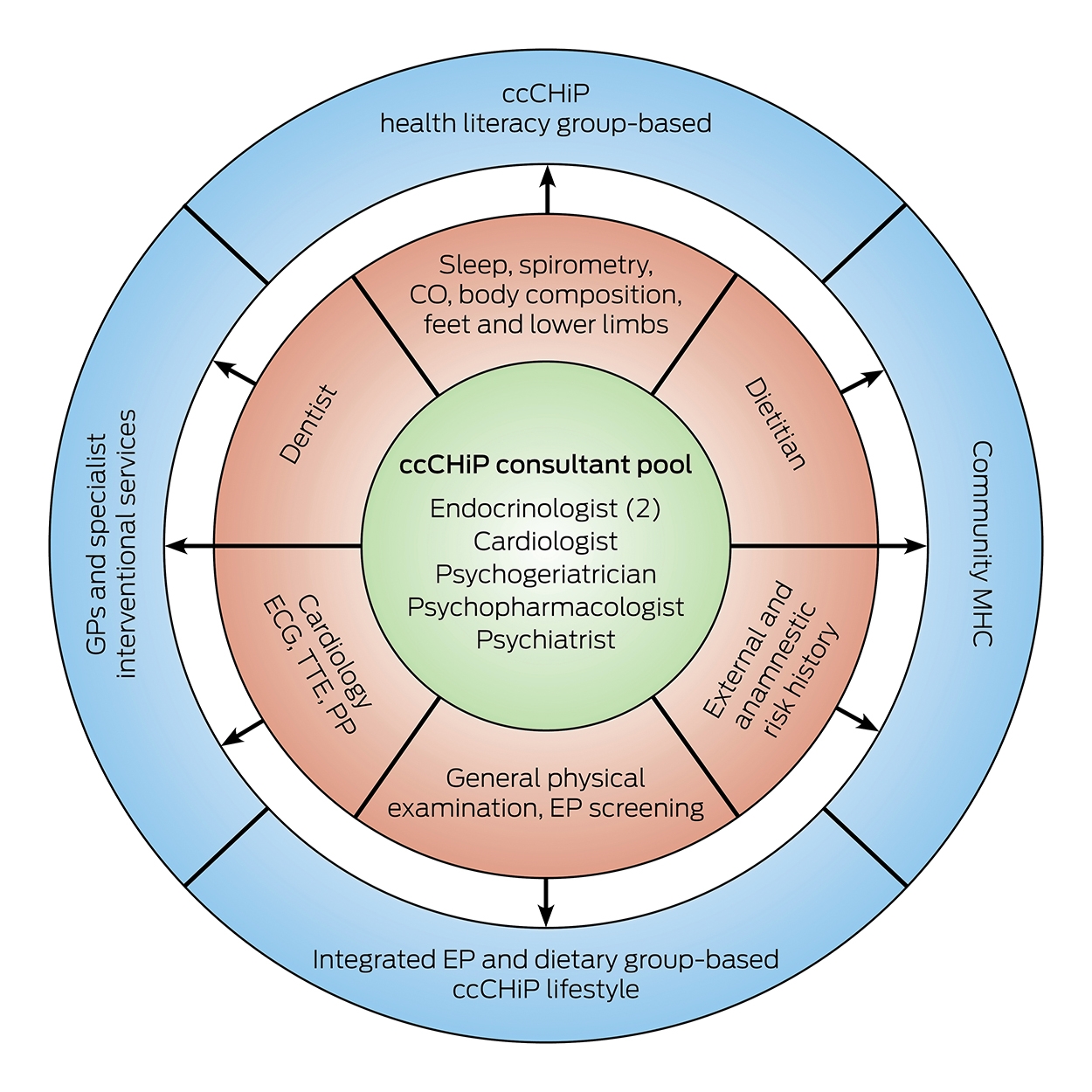
ccCHiP = Collaborative Centre for Cardiometabolic Health in Psychosis, CO = carbon monoxide breath test, ECG = electrocardiogram, EP = exercise physiologist, GP = general practitioner, MHC = mental health clinic, PP = peripheral pulse, TTE = transthoracic echocardiogram. * Multidisciplinary model of care as practiced by ccCHiP in New South Wales. The inner circle represents all the clinicians and services involved in reviewing the patient in a single session (all team members are serially consulted). The outer circle represents forward referrals to partner interventional services in the community.
Competing interests
No relevant disclosures.
References
- Global Burden of Disease Study 2013 Collaborators. Global, regional, and national incidence, prevalence, and years lived with disability for 301 acute and chronic diseases and injuries in 188 countries, 1990-2013: a systematic analysis for the Global Burden of Disease Study 2013. Lancet 2015; 386: 743-800.
- Galletly C, Castle D, Dark F, et al. Royal Australian and New Zealand College of Psychiatrists clinical practice guidelines for the management of schizophrenia and related disorders. Aust N Z J Psychiatry 2016; 50: 410-472.
- Weinmann S, Read J, Aderhold V. Influence of antipsychotics on mortality in schizophrenia: systematic review. Schizophr Res 2009; 113: 1-11.
- Laursen TM, Munk-Olsen T, Vestergaard M. Life expectancy and cardiovascular mortality in persons with schizophrenia. Curr Opin Psychiatry 2012; 25: 83-88.
- Olfson M, Gerhard T, Huang C, et al. Premature mortality among adults with schizophrenia in the United States. JAMA Psychiatry 2015; 72: 1172-1181.
- Goff DC, Sullivan LM, McEvoy JP, et al. A comparison of ten-year cardiac risk estimates in schizophrenia patients from the CATIE study and matched controls. Schizophr Res 2005; 80: 45-53.
- Gale CR, Batty GD, Osborn DP, et al. Mental disorders across the adult life course and future coronary heart disease: evidence for general susceptibility. Circulation 2014; 129: 186-193.
- Hennekens CH, Hennekens AR, Hollar D, Casey DE. Schizophrenia and increased risks of cardiovascular disease. Am Heart J 2005; 150: 1115-1121.
- Ruschena D, Mullen PE, Burgess P, et al. Sudden death in psychiatric patients. Br J Psychiatry 1998; 172: 331-336.
- Sweeting J, Duflou J, Semsarian C. Postmortem analysis of cardiovascular deaths in schizophrenia: a 10-year review. Schizophr Res 2013; 150: 398-403.
- Cooper J, Mancuso SG, Borland R, et al. Tobacco smoking among people living with a psychotic illness: the second Australian Survey of Psychosis. Aust N Z J Psychiatry 2012; 46: 851-863.
- Bergman BC, Perreault L, Hunerdosse D, et al. Novel and reversible mechanisms of smoking-induced insulin resistance in humans. Diabetes 2012; 61: 3156-3166.
- Wulff K, Dijk DJ, Middleton B, et al. Sleep and circadian rhythm disruption in schizophrenia. Br J Psychiatry 2012; 200: 308-316.
- Robillard R, Rogers NL, Whitwell BG, Lambert T. Are cardiometabolic and endocrine abnormalities linked to sleep difficulties in schizophrenia? A hypothesis driven review. Clin Psychopharmacol Neurosci 2012; 10: 1-12.
- Foley DL, Mackinnon A, Morgan VA, et al. Effect of age, family history of diabetes, and antipsychotic drug treatment on risk of diabetes in people with psychosis: a population-based cross-sectional study. Lancet Psychiatry 2015; 2: 1092-1098.
- Lloyd-Jones DM, Leip EP, Larson MG, et al. Prediction of lifetime risk for cardiovascular disease by risk factor burden at 50 years of age. Circulation 2006; 113: 791-798.
- Chen S, Broqueres-You D, Yang G, et al. Male sex may be associated with higher metabolic risk in first-episode schizophrenia patients: A preliminary study. Asian J Psychiatr 2016; 21: 25-30.
- Wu RR, Zhao JP, Zhai JG, et al. Sex difference in effects of typical and atypical antipsychotics on glucose-insulin homeostasis and lipid metabolism in first-episode schizophrenia. J Clin Psychopharmacol 2007; 27: 374-379.
- Enez Darcin A, Yalcin Cavus S, Dilbaz N, et al. Metabolic syndrome in drug-naïve and drug-free patients with schizophrenia and in their siblings. Schizophr Res 2015; 166: 201-206.
- Ryan MC, Collins P, Thakore JH. Impaired fasting glucose tolerance in first-episode, drug-naive patients with schizophrenia. Am J Psychiatry 2003; 160: 284-289.
- Mukherjee S, Schnur DB, Reddy R. Family history of type 2 diabetes in schizophrenic patients. Lancet 1989; 1: 495.
- Andreassen OA, Djurovic S, Thompson WK, et al. Improved detection of common variants associated with schizophrenia by leveraging pleiotropy with cardiovascular-disease risk factors. Am J Hum Genet 2013; 92: 197-209.
- Dasgupta A, Singh OP, Rout JK, et al. Insulin resistance and metabolic profile in antipsychotic naive schizophrenia patients. Prog Neuropsychopharmacol Biol Psychiatry 2010; 34: 1202-1207.
- Correll CU, Manu P, Olshanskiy V, et al. Cardiometabolic risk of second-generation antipsychotic medications during first-time use in children and adolescents. JAMA 2009; 302: 1765-1773.
- Misiak B, Kiejna A, Frydecka D. The history of childhood trauma is associated with lipid disturbances and blood pressure in adult first-episode schizophrenia patients. Gen Hosp Psychiatry 2015; 37: 365-367.
- Bartoli F, Crocamo C, Caslini M, et al. Schizoaffective disorder and metabolic syndrome: A meta-analytic comparison with schizophrenia and other non-affective psychoses. J Psychiatr Res 2015; 66–67: 127-134.
- Wysokinski A, Strzelecki D, Kloszewska I. Levels of triglycerides, cholesterol, LDL, HDL and glucose in patients with schizophrenia, unipolar depression and bipolar disorder. Diabetes Metab Syndr 2015; 9: 168-176.
- Saari K, Koponen H, Laitinen J, et al. Hyperlipidemia in persons using antipsychotic medication: a general population-based birth cohort study. J Clin Psychiatry 2004; 65: 547-550.
- Ballon J, Stroup T. Polypharmacy for schizophrenia. Curr Opin Psychiatry 2013; 26: 208-213.
- Vincenzi B, Greene C, Ulloa M, et al. Lithium or valproate adjunctive therapy to second-generation antipsychotics and metabolic variables in patients with schizophrenia or schizoaffective disorder. J Psychiatr Pract 2016; 22: 175-182.
- Correll CU, Detraux J, De Lepeleire J, de Hert M. Effects of antipsychotics, antidepressants and mood stabilizers on risk for physical diseases in people with schizophrenia, depression and bipolar disorder. World Psychiatry 2015; 14: 119-136.
- Qiao Y, Zhang L, He S, et al. Plasma metabonomics study of first-episode schizophrenia treated with olanzapine in female patients. Neurosci Lett 2016; 617: 270-276.
- de Leon J, Susce M, Johnson M, et al. A clinical study of the association of antipsychotics with hyperlipidemia. Schizophr Res 2007; 92: 95-102.
- Koro CE, Fedder DO, L’Italien GJ, et al. An assessment of the independent effects of olanzapine and risperidone exposure on the risk of hyperlipidemia in schizophrenic patients. Arch Gen Psychiatry 2002; 59: 1021-1026.
- Nordestgaard BG, Varbo A. Triglycerides and cardiovascular disease. Lancet 2014; 384: 626-635.
- Barter P. HDL-C: role as a risk modifier. Atheroscler Suppl 2011; 12: 267-270.
- De Hert M, Kalnicka D, van Winkel R, et al. Treatment with rosuvastatin for severe dyslipidemia in patients with schizophrenia and schizoaffective disorder. Journal Clin Psychiatry 2006; 67: 1889-1896.
- Reith C, Armitage J. Management of residual risk after statin therapy. Atherosclerosis 2016; 245: 161-170.
- Fruchart JC, Sacks F, Hermans MP, et al. The Residual Risk Reduction Initiative: a call to action to reduce residual vascular risk in patients with dyslipidemia. Am J Cardiol 2008; 102: 1K-34K.
- Keech A, Simes RJ, Barter P, et al. Effects of long-term fenofibrate therapy on cardiovascular events in 9795 people with type 2 diabetes mellitus (the FIELD study): randomised controlled trial. Lancet 2005; 366: 1849-1861.
- Ginsberg HN, Elam MB, Lovato LC, et al. Effects of combination lipid therapy in type 2 diabetes mellitus. N Engl J Med 2010; 362: 1563-1574.
- Kanzaki T, Uju Y, Sekine K, et al. Increased silent brain infarction accompanied with high prevalence of diabetes and dyslipidemia in psychiatric inpatients. Prim Care Companion CNS Disord 2015; 17.
- McLean G, Martin JL, Martin DJ, et al. Standard cardiovascular disease risk algorithms underestimate the risk of cardiovascular disease in schizophrenia: evidence from a national primary care database. Schizophr Res 2014; 159: 176-181.
- Foley DL, Mackinnon A, Morgan VA, et al. Cardiovascular risk factor associations in adults with psychosis and adults in a national comparator sample. Aust N Z J Psychiatry 2015; 49: 714-723.
- Osborn DP, Hardoon S, Omar RZ, et al. Cardiovascular risk prediction models for people with severe mental illness: results from the prediction and management of cardiovascular risk in people with severe mental illnesses (PRIMROSE) research program. JAMA Psychiatry 2015; 72: 143-151.
- Henderson DC, Vincenzi B, Andrea NV, et al. Pathophysiological mechanisms of increased cardiometabolic risk in people with schizophrenia and other severe mental illnesses. Lancet Psychiatry 2015; 2: 452-464.
- Chow V, Reddel C, Pennings G, et al. Global hypercoagulability in patients with schizophrenia receiving long-term antipsychotic therapy. Schizophr Res 2015; 162: 175-182.
- Galletly CA, Foley DL, Waterreus A, et al. Cardiometabolic risk factors in people with psychotic disorders: The second Australian national survey of psychosis. Aust N Z J Psychiatry 2012; 46: 753-761.
- Banham L, Gilbody S. Smoking cessation in severe mental illness: what works? Addiction 2010; 105: 1176-1189.
- De Hert M, Correll CU, Bobes J, et al. Physical illness in patients with severe mental disorders. I. Prevalence, impact of medications and disparities in health care. World Psychiatry 2011; 10: 52-77.
- Brown S, Kim M, Mitchell C, Inskip H. Twenty-five year mortality of a community cohort with schizophrenia. Br J Psychiatry 2010; 196: 116-121.
- Mitchell AJ, Lawrence D. Revascularisation and mortality rates following acute coronary syndromes in people with severe mental illness: comparative meta-analysis. Br J Psychiatry 2011; 198: 434-441.
- McEvoy JP, Lieberman JA, Stroup TS, et al. Effectiveness of clozapine versus olanzapine, quetiapine, and risperidone in patients with chronic schizophrenia who did not respond to prior atypical antipsychotic treatment. Am J Psychiatry 2006; 163: 600-610.
- Merrill DB, Dec GW, Goff DC. Adverse cardiac effects associated with clozapine. J Clin Psychopharmacol 2005; 25: 32-41.
- Ronaldson KJ, Fitzgerald PB, Taylor AJ, et al. A new monitoring protocol for clozapine-induced myocarditis based on an analysis of 75 cases and 94 controls. Aust N Z J Psychiatry 2011; 45: 458-465.
- Kilian JG, Kerr K, Lawrence C, Celermajer DS. Myocarditis and cardiomyopathy associated with clozapine. Lancet 1999; 354: 1841-1845.
- Scelsa SN, Simpson DM, McQuistion HL, et al. Clozapine-induced myotoxicity in patients with chronic psychotic disorders. Neurology- 1996; 47: 1518-1523.
- Layland JJ, Liew D, Prior DL. Clozapine-induced cardiotoxicity: a clinical update. Med J Aust 2009; 190: 190-192.
- Friedrich MG, Sechtem U, Schulz-Menger J, et al. Cardiovascular magnetic resonance in myocarditis: A JACC White Paper. J Am Coll Cardiol 2009; 53: 1475-1487.
- La Grenade L, Graham D, Trontell A. Myocarditis and cardiomyopathy associated with clozapine use in the United States. N Engl J Med 2001; 345: 224-225.
- Reznik I, Volchek L, Mester R, et al. Myotoxicity and neurotoxicity during clozapine treatment. Clin Neuropharmacol- 2000; 23: 276-280.
- Chow V, Feijo I, Trieu J, et al. Successful rechallenge of clozapine therapy following previous clozapine-induced myocarditis confirmed on cardiac MRI. J Child Adolesc Psychopharmacol 2014; 24: 99-101.
- Yancy CW, Jessup M, Bozkurt B, et al. 2013 ACCF/AHA guideline for the management of heart failure: a report of the American College of Cardiology Foundation/American Heart Association Task Force on practice guidelines. Circulation 2013; 128: e240-327.
- Laugharne J, Waterreus AJ, Castle DJ, Dragovic M. Screening for the metabolic syndrome in Australia: a national survey of psychiatrists’ attitudes and reported practice in patients prescribed antipsychotic drugs. Australas Psychiatry 2016; 24: 62-66.
- Baxter AJ, Harris MG, Khatib Y, et al. Reducing excess mortality due to chronic disease in people with severe mental illness: meta-review of health interventions. Br J Psychiatry 2016; 208: 322-329.
- Barbui C, Girlanda F, Ay E, et al. Implementation of treatment guidelines for specialist mental health care. Cochrane Database Syst Rev 2014; 1: CD009780.
- De Hert M, Vancampfort D, Correll CU, et al. Guidelines for screening and monitoring of cardiometabolic risk in schizophrenia: systematic evaluation. Br J Psychiatry 2011; 199: 99-105.
- National Institute for Health and Care Excellence. Psychosis and schizophrenia in adults: prevention and management. Clinical guideline. London: NICE; 2014. https://www.nice.org.uk/guidance/cg178 (accessed May 2016).
- Oakley Browne M, Lambert T, Reavley N, Jorm A. Physical health care of people with enduring psychotic illness. Aust N Z J Psychiatry 2015; 49 Suppl 1: 24.
- Mitchell AJ, Delaffon V, Vancampfort D, et al. Guideline concordant monitoring of metabolic risk in people treated with antipsychotic medication: systematic review and meta-analysis of screening practices. Psychol Med 2012; 42: 125-147.
- Casalino LP, Dunham D, Chin MH, et al. Frequency of failure to inform patients of clinically significant outpatient test results. Arch Intern Med 2009; 169: 1123-1129.
Provenance: Commissioned; externally peer reviewed.
Fatty Liver Disease in Australia: A Narrative Review on the Epidemiology, Natural History, Prognostication and Management in People With Metabolic Dysfunction
Karl Vaz, Daniel Clayton-Chubb, William W. Kemp, Stuart K. Roberts, Ammar Majeed
Sex Differences in Management and Outcomes of People With ST-Elevation Myocardial Infarction, New South Wales, 2011–2020: A Retrospective Cohort Study
Adam C. Livori, Jedidiah I. Morton, Dianna J. Magliano, Jonathan E. Shaw
Rethinking Rheumatic Fever Diagnosis: Progress, Pitfalls and the Path Towards a Definitive Test
Anna P. Ralph, Rachel Webb, Tom Parks, Nicole J. Moreland, Asha C. Bowen, Benjamin Jones, Emma Ndagire, Andrea Z. Beaton
Sex Differences in Management and Outcomes of People With ST-Elevation Myocardial Infarction, New South Wales, 2011–2020: A Retrospective Cohort Study
Samia Kazi, Simone Marschner, Clara K. Chow
Distribution of Cardiovascular Disease Risk Based on the Updated 2023 Guideline-Recommended Australian Cardiovascular Disease Risk Algorithm and Comparison With the 2012 Algorithm: An Observational Study
Nina Lazarevic, Meghana Bhat, Grace Joshy, Danielle C. Butler, Mark Woodward, Anushka Patel, Rod T. Jackson, Garry Jennings, Rosemary Wyber, Ellie Paige, Emily Banks
They Brought the Hospital to Me
Hugh N. Burrill