




Reflections
Medical history
Volume 205 - Issue 11
The Roman fever: observations on the understanding of malaria in the ancient Roman world
Author: Milton J Micallef
Med J Aust 2016; 205 (11): 501-503. || doi: 10.5694/mja16.00206
Published online: 12 December 2016
Published online: 12 December 2016
Ancient Roman hypotheses about the transmission of malaria were ahead of their time
Ancient Roman hypotheses about the transmission of malaria were ahead of their time
The modern understanding of malaria dates to the late 19th century, encompassing the description of malarial parasites by French physician Alphonse Laveran in 1880, the explanation of how the parasite enters an organism by Briton Sir Ronald Ross in 1897, and the germ theory of disease expounded by Louis Pasteur and Robert Koch.1 These developments quashed the hitherto prevalent notions of “telluric” (soil-related) or “miasmatic” (airborne) factors in transmitting malaria; nevertheless, the name “malaria” — from the Italian for “bad air” — has persisted since its first use in 1560/61.2
The modern medical audience may not be familiar with how the mosquito–malaria link was appreciated in a rudimentary form by the ancient Romans, as evidenced in a number of ancient authors. The scholar Varro (116–27 BC) linked fevers with marshy areas, expounded a theory of invisible disease-causing microorganisms, and recommended ventilation to blow away invisible “animalcules”; the architect and civil engineer Vitruvius (1st century bc) reinforced Varro’s idea; and the agriculturalist Columella (AD 4–c 70) believed that stinging creatures which bred in marshes could cause disease.
It is important to note that, due to the absence of a consistent terminology and approach to diagnosis before the modern era, references to malaria in ancient texts are inferred from the mention of specifically periodic fevers (“quotidian”, “tertian” and “quartan” fevers: pathognomonic of specific malarial parasite infections) and of physical signs such as splenomegaly. This concept of retrospective diagnosis based on symptomatology is generally regarded as a sine qua non compromise in medical historiography.3
Case studies in ancient Roman malariology
The Romans widely believed that marshlands were generally unhealthy places to inhabit or visit, and the major agricultural writers of the time attested to this view.
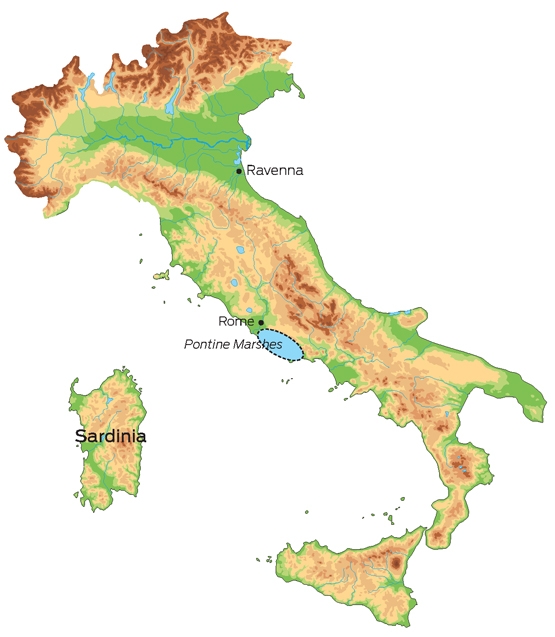
The Pontine Marshes (Box)
The fertile marshlands south of Rome were popular for farming, but were known to be unhealthy, especially during the summer months. Horace (65–8 BC), traversing them by boat at night, complained that the mosquitoes interfered with sleep (Satirae 1.5.14–15), and the poet and orator Silius Italicus (c 28–c 103) described them as “pestifera” (disease-breeding; Punica, 8.379).
It is probable that natural drainage was impaired by roads that “cut through hills” (Pliny, Naturalis historia 36.125) and filled in hollows, creating new breeding sites for insects. The major highway passing through this area, the Appian Way (Via Appia), may thus have exacerbated the mosquito problem.
Throughout history, numerous attempts were made to drain the Pontine Marshes, including by Julius Caesar, various Popes, Napoleon, and Mussolini (who finally achieved this aim in the 1930s). These efforts foreshadowed those to rid Italy of malaria, with an intensive mosquito eradication program beginning in 1947, and in 1970 the World Health Organization declared Italy free of the disease.4
Sardinia
The Mediterranean island of Sardinia, ideal for agriculture, was renowned for its unhealthy climate. One of the most important sources of grain for the Romans, it was the most malaria-ridden region of Italy, of “epidemic proportions at the time of the Roman conquest”,1 and continued to be so until modern times, with higher rates of morbidity and mortality than elsewhere in Italy.1
Cicero referred to the unhealthy nature of Sardinia in a letter dated August 45 BC (Epistulae ad familiares 7.24). The Greek geographer Strabo (c 63 BC–c AD 23) explained that its fertile regions were particularly unhealthy in summer, and it was unprofitable to maintain permanent military camps on the island because of the large numbers of Roman soldiers who died from malaria contracted there (Geographica 5.2.7).
Because Sardinia was so important a source of Rome’s grain, it has been suggested that malaria may have been transported from there to Latium (the region surrounding Rome) and to other parts of mainland Italy by grain traders, as well as by the army. This would exemplify the spread of disease endemicity as a result of population movement; even individuals have the potential to cause a significant transfer of malaria, “endangering areas which had until then been little affected by the disease or protected through effective malaria control”.5
Ravenna
During antiquity, the Adriatic town of Ravenna suffered multitudes of mosquitoes, but there was no evidence of malaria, conflicting with the general view that marshy areas were unhealthy. Whereas the Pontine Marshes were landlocked, the marshlands of Ravenna were connected to the sea and regularly flooded by seawater. Vitruvius clearly knew this phenomenon well (De architectura 1.4.11–12):
When violently agitated by storms, the risen seawaters run up the sewers and mix with the waters of the marsh, preventing the reproduction of marshy insects (bestiarum palustrium) … However, when the marshes are stagnant and have no means of drainage by rivers or channels, as in the Pontine Marshes, they stagnate, grow putrid, and emit serious and pestilential vapours (umores graves et pestilentes).
Strabo made a similar observation, and he too detailed how the city was coursed by rivers, and that a great influx of tidal waters from the sea helped to clear the filth and foul air. Moreover, the city was chosen for a gladiatorial school, signifying how healthy it was perceived to be (Geographica 5.1.7).
It has been proposed that the anomaly of Ravenna explains why the Romans failed to explicitly recognise the mosquito–malaria link: that the situation in Ravenna did not correspond with general expectations that marshy localities brought disease would have baffled ancient minds, as it did modern.6 With time, however, changes in environmental conditions led to the rise of malaria in the region; the local Anopheles species may have been supplanted by a vector species with a greater tolerance for saline conditions.
The mosquito–malaria link and primary prevention in ancient Rome
Integrating the advice of Varro and Columella, one could almost arrive at the combined conclusions of Laveran, Pasteur and Ross: that germs cause disease, and that periodic fevers are spread by insects; or, more specifically, that mosquitoes are the vectors for malaria.
Columella, giving advice on choosing sites suitable for human habitation, warned in De re rustica (1.5.6):
Dwellings should not be built in the vicinity of marshes nor alongside military highways, because the former cause harmful stenches to arise in hot weather, and breed stinging insects which come at us in thick swarms, and then even bring about plagues of swimming and slithering creatures … from which mysterious diseases are often caught, the causes of which not even physicians are able to determine.
It is notable that Columella proposed a link between insects and disease; namely, the vector theory of transmission. He clearly understood that marshes were natural habitats for such insects, whether in the water, on the ground, or in the air. This essentially foreshadows Ross’s insect vector hypothesis, and, as is often the case with ancient authors, Columella simply stated his opinions as a fact, based on lived experience. Further, while medical men may have failed to recognise the role of insects in malaria transmission, it is likely that agriculturalists would not.
In a passage about the optimal positioning of a villa, Varro advised in Res rusticae (1.12.2–3):
Precautions must also be taken in marshy locales … because in such places certain minute creatures (animalia quaedam minuta) arise, which cannot be seen by the eye, and which through the air enter the body by the mouth and nose, causing troublesome diseases …
[A villa], on account of being exposed to the sun all day long, is healthier, because animalcules (bestiolae), bred nearby and carried in, either get blown away or perish quickly from the dryness.
This passage, the basis of the animalcular hypothesis of disease, shows thoughtful insight into transmission processes. For instance, Varro notes that animalcules (which we now might call “microbes”) are quickly killed if they are blown away or removed from a humid location, and that exposure to sunlight is healthy. Humidity is now known to encourage the growth of bacteria, whereas sunlight is known to hasten the demise of some pathogens in the absence of a host. The major difference between Varro’s hypothesis and the miasma theory is that, for Varro, the pathogen is “animal” in nature and alive. It is unlikely that he had mosquitoes in mind, however, because he could have used the term culex. It is therefore probable that he was postulating the existence of microscopic pathogens.
Despite the observations of the ancients, early modern science continued to favour the miasma theory of malaria. The first reference in print to a potential mosquito–malaria link was by Giovanni Maria Lancisi (1654–1720), papal physician and professor at the Sapienza in Rome, in his treatise De noxiis paludum effluviis eorumque remediis (1717). But it was not until Ross proved this aetiology nearly two centuries later that the miasma theory was finally abandoned.
In summary, we can conclude from the available evidence that swampy locations were inextricably linked by Roman authors with mosquitoes; that those locations were associated with manifestations of malarial fevers and the conjectured presence of animalcules; and that these views together point towards a pre-scientific, empirical understanding by the ancient Romans of how mosquitoes and malaria are linked by the common factor of marshy localities.
Competing interests
No relevant disclosures.
References
- Bruce-Chwatt LJ, de Zulueta J. The rise and fall of malaria in Europe: a historico-epidemiological study. Oxford: Oxford University Press, 1980.
- Jarcho S. A cartographic and literary study of the word malaria. J Hist Med Allied Sci 1970; 25: 31-39.
- Grmek MD. Les maladies à l’aube de la civilisation occidentale: recherches sur la réalité pathologique dans le monde grec préhistorique, archaïque, et classique. Paris: Payot, 1983.
- Baldari M, Tamburro A, Sabatinelli G, et al. Malaria in Maremma, Italy. Lancet 1998; 351: 1246-1247.
- Wernsdorfer G, Wernsdorfer WH. Social and economic aspects of malaria and its control. In: Wernsdorfer WH, McGregor IA, editors. Malaria: principles and practice of malariology. Vol. 2. Edinburgh: Churchill Livingstone, 1988: pp 1421-1471.
- Sallares R. Malaria and Rome: a history of malaria in ancient Italy. Oxford: Oxford University Press, 2002.
Provenance: Not commissioned; externally peer reviewed.
Prisoner of war pathology in Changi, 1942–1945
Kate Ariotti, Elizabeth Roberts‐Pedersen
Should medical eponyms continue to be used in everyday practice?
Leya Nedumannil, Diana Lewis
100 years on: the first use of insulin in Australia
Sophie Templer
Reflections on the life and career of Professor Dame Valerie Beral AC DBE FRS FRCOG FMedSci (1943–2022)
Karen Canfell, Bette Liu, Emily Banks
The Honourable Dr Donald James Grimes AO
Michael Kirby, Patti Warn
From wipeout to drill out: a history of exostosis management and Australian surfing
Alon Taylor, Hannah North, Narinder P Singh, Paul A Fagan