




Volume 203 - Issue 8
Toilet bowl palsy from prolonged prayer posture
Authors: Gregory J Wilson and George T John
Med J Aust 2015; 203 (8): 323. || doi: 10.5694/mja15.00578
Published online: 19 October 2015
Published online: 19 October 2015
This case highlights the severe and often irreversible nerve damage arising from toilet bowl palsy
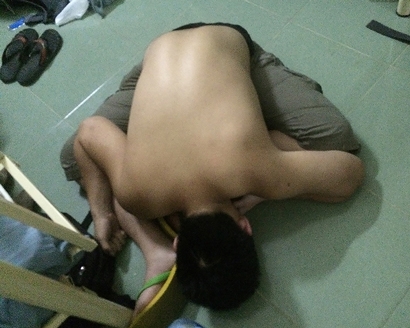
An 18-year-old man was admitted to a Cambodian hospital with severe bilateral lower leg weakness and an acute kidney injury requiring renal replacement therapy. Three days before his hospitalisation, he had consumed tramadol hydrochloride and codeine phosphate, and injected heroin. While intoxicated in his hostel, he adopted a prayer posture (Box) and subsequently lost consciousness, remaining in this position for 8 hours on a tiled floor. Upon regaining consciousness, he was unable to stand due to a profound weakness in both legs that persisted for 3 days. During this time his urine changed to a cola colour although it was of normal volume. On the fourth day of ongoing symptoms, the patient sought medical care and was found to be in acute renal failure. He received two sessions of haemodialysis.
After his discharge from the intensive care unit, the patient’s mother escorted him to an Australian hospital. On presentation to the emergency department, he was oriented to time and place, but had persisting weakness, loss of sensation in his lower limbs and an ulnar nerve paresis. An isolated patch of paraesthesia over the forehead was noted at the site of contact with the ground. He had no features of uraemia. He was anuric and tests showed a creatinine level of 1040 μmol/L (reference interval [RI], 73–108 μmol/L) and a markedly elevated creatine kinase level of 123 000 U/L (RI, 46–171 U/L). Urine was positive for urine myoglobin of 2850 μg/L (RI, < 10 μg/L). A diagnosis of acute renal failure secondary to rhabdomyolysis was made.
The patient received haemodialysis for 5 hours on alternate days until Day 17, when his renal function had sufficiently improved. Despite daily physiotherapy the patient made minimal gains in his lower limb power, with ankle power of 0/5 bilaterally. Neurologists diagnosed the patient with bilateral sciatic nerve compression due to “toilet bowl palsy”. This was thought to be secondary to direct compression of the nerve, a posterior thigh compartment syndrome and a stretch radiculopathy. He was transferred to a rehabilitation unit for further care. Upon review at 2 months, he had improvement of proximal muscle power but bilateral foot drop persisted.
Toilet bowl palsy is a rare condition characterised by bilateral sciatic nerve palsy from maintaining a prolonged abnormal posture. It arises from a period of immobility while sitting on a hard surface and is often associated with substance abuse. It can be iatrogenic (positioning in surgery) or can occur spontaneously, usually from toilet seat entrapment,1-3 yoga positioning,1 overstretching1 or, as in this case, maintaining a prayer posture for a prolonged period of time. This case highlights the severe and often irreversible nerve damage arising from toilet bowl palsy.
Competing interests
No relevant disclosures.
References
- Walker M, Meekins G, Hu SC. Yoga neuropathy: a snoozer. Neurologist 2005; 11: 176-179.
- Dubil EA, Dahle JM, Owens MD. Bilateral sciatic nerve palsy: a new presentation of toilet bowl neuropathy. J Emerg Med 2012; 43: 622-624.
- O’Ferrall EK, Busche K, Dickhoff P, et al. A patient with bilateral sciatic neuropathies. Can J Neurol Sci 2007; 34: 365-367.
The first Australian evidence‐based guidelines on male infertility
Darren J Katz, Liza O’Donnell, Robert I McLachlan, Tim J Moss, Clare V Boothroyd, Veena Jayadev, Sarah R Catford
The epidemiology of haemodialysis catheter infections in Australia, 2016–20: a prospective cohort study
Benjamin Lazarus, Kevan R Polkinghorne, Martin P Gallagher, Jayson Catiwa, Nicholas A Gray, Sarah Coggan, Kathryn R Higgins, Girish Talaulikar, Stephen P McDonald AM, Sradha Kotwal
Am I on the list? Clinician‐reported factors for kidney transplantation non‐waitlisting among Aboriginal and Torres Strait Islander people with kidney failure: a cross‐sectional study
Stephen P McDonald AM, Katie Cundale, Christopher E Davies, Kelli Karrikarringka Owen (Kaurna, Nharangga, and Ngarrindjeri), Kerry Dole, Feruza Kholmurodova, Matilda D’Antoine (Paakantyi), Jaquelyne T Hughes (Wagadagam)
Hyperkalaemic cardiac arrest due to cream of tartar ingestion
Daniel Yee Lee Ng, Laksmi Govindasamy, Andrew Hughes, Hwee Min Lee
Dialysis care in Australia: a call for reform and innovation
Dharshana Sabanayagam, Angela Makris, Frederika Sciberras, Nicole J Scholes‐Robertson, Germaine Wong
Closing the gap in kidney disease: validating the reporting of Aboriginal and/or Torres Strait Islander identification in a clinical quality registry using linked data
Heather J Baldwin, Nicole De La Mata, Grant Sara, Faye McMillan, Brett Biles, Jianyun Wu, Paul Lawton, Stephen McDonald, Angela C Webster