




Volume 203 - Issue 6
Sudden sensorineural hearing loss secondary to metronidazole ototoxicity
Authors: Anthony Rotman, Philip Michael, Michael Tykocinski and Stephen J O’Leary
Med J Aust 2015; 203 (6): 253. || doi: 10.5694/mja15.00222
Published online: 21 September 2015
Published online: 21 September 2015
Metronidazole is a known neurotoxic antibiotic that can be ototoxic, if only rarely
A 30-year-old Indian gentleman presented to the emergency department of the Royal Victorian Eye and Ear Hospital, Melbourne, with a history of bilateral profound deafness, tinnitus and headache associated with upper- and lower-limb paraesthesia and myalgia. He had been taking metronidazole (400 mg tds) and amoxycillin (500 mg tds) over the preceding 4 days to treat gingivitis. Further questioning revealed that his maternal uncle had experienced identical symptoms while taking metronidazole. Consequently, his metronidazole was immediately discontinued.
After 2 days, he was able to hear faint sounds, and audiography revealed a symmetrical moderate-to-profound sensorineural hearing loss (SNHL) (Box, A). As per our hospital protocol for SNHL management, oral prednisolone was administered (50 mg daily), followed by a slow wean over 3 weeks.
After 8 days, subjective hearing and paraesthesia had improved, and his headache had abated. Audiometry indicated moderate SNHL up to 2000 Hz, with persisting severe high-frequency SNHL (Box, B).
At 6 weeks, repeat audiogram indicated that hearing was normal up to 2000 Hz, but severe-to-profound high-frequency SNHL persisted (Box, C).
Metronidazole is a nitroimidazole antibiotic widely used in various medical specialties. Common side effects include nausea, diarrhoea and abdominal discomfort. Patients receiving high or intravenous doses may experience neurotoxicity, but it is uncommon to suffer ototoxicity.
The first documented case of metronidazole-induced ototoxicity was reported in 1984.1 Since then there have been infrequent but typical reports of SNHL associated with metronidazole. In 1999, two cases of SNHL following about 2 days of treatment with metronidazole for dental sepsis were described.2 More recently, sudden bilateral SNHL after 4 days of metronidazole treatment for diarrhoea has been reported.3
We can only speculate about the mechanism of metronidazole-induced ototoxicity. The clear familial link in our case suggests a potential genetic susceptibility, similar with other ototoxic agents, such as susceptibility for the ototoxic effects of aminoglycosides associated with the mitochondrial A1555G deletion.
Several neurotoxic effects of metronidazole have been hypothesised, including toxic excitation of NMDA receptors leading to production of free radicals and cell death, as well as effects on GABAergic transmission and direct RNA-binding effects.4 Whether or not there is a genetic susceptibility for its effects has not yet been investigated, but it is reported that the onset of neurotoxicity is more rapid and occurs at lower doses in patients of Indian descent than in those of European origin.5
In conclusion, metronidazole is a known neurotoxic antibiotic that can be ototoxic, if only rarely. These adverse effects are reversible after withdrawing the drug. Given its widespread use, it is important that prescribers are aware of these severe adverse reactions.
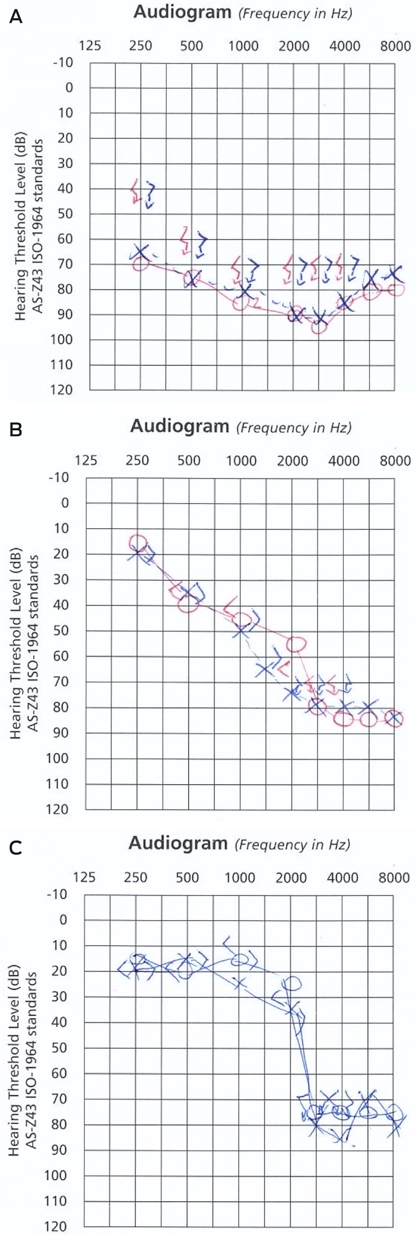
A: Initial audiogram, showing profound bilateral sensorineural deafness. B: Audiogram, 8 days after cessation of metronidazole, showing improvement in pure tone audiometry at frequencies up to 2000 Hz. C: Audiogram, 6 weeks after cessation of metronidazole, showing near-normal hearing at frequencies up to 2000 Hz, with severe high-frequency hearing loss.
Competing interests
No relevant disclosures.
References
- Hibberd AD, Nicoll RJ, Macbeth WA. Ototoxicity of metronidazole. N Z Med J 1984; 97: 275.
- Iqbal SM, Murthy JG, Banerjee PK, Vishwanathan KA. Metronidazole ototoxicity – report of two cases. J Laryngol Otol 1999; 113: 355-357.
- Jafari G, Hosseini SM, Akhondzadeh S. Sudden hearing loss subsequent to diarrhea: what is the missing link? DARU J Pharm Sci 2014; 22: 15-17.
- Rao DN, Mason RP. Generation of nitro radical anions of some 5-nitrofurans 2- and 5-nitroimidazoles by norepinephrine, dopamine and serotonin. A possible mechanism for neurotoxicity caused by nitroheterocyclic drugs. J Biol Chem 1987; 262: 11731-11736.
- Kapoor K, Chandra M, Nag D, et al. Evaluation of metronidazole toxicity: a prospective study. Int J Clin Pharmacol Res 1999; 19: 83-88.
Watchful Waiting Compared With Immediate Antibiotics for Urban Aboriginal and Torres Strait Islander Children With Uncomplicated Acute Otitis Media (WATCH): A Non-Inferiority Randomised Controlled Trial
Jennifer S. Reath, Hasantha Gunasekera, Sanja Lujic, Amanda J. Leach, Letitia Campbell, Robyn Walsh, Tim Usherwood, Geoffrey K. Spurling, Claudette A. Tyson, Deborah A. Askew, Kelvin Kong, Chelsea J. Watego, Peter Morris, Wendy Hu, Penelope A. Abbott
Climate and environmental crisis: effects on ear and hearing health in Australia and for Aboriginal and Torres Strait Islander peoples
Georgia M Tongs (Wiradjuri), Isabella Ludbrook, Jennifer H Martin, Robert Eisenberg, Kelvin M Kong (Worimi)
The New South Wales Pharmacy Trial for herpes zoster: on the nose?
Christian P Pappas, Timothy R Holmes, Minas T Coroneo
Antibiotics or watchful waiting for acute otitis media in urban Aboriginal and Torres Strait Islander children?
Valerie M Swift, Christopher G Brennan‐Jones
The views of parents and carers on managing acute otitis media in urban Aboriginal and Torres Strait Islander children: a qualitative study
Jennifer S Reath, Sarah O'Brien, Letitia Campbell, Hasantha Gunasekera, Claudette A Tyson, Deborah A Askew, Wendy Hu, Tim Usherwood, Kelvin Kong, Peter Morris, Amanda J Leach, Robyn Walsh, Penelope A Abbott
Routine ear health and hearing checks for Aboriginal and Torres Strait Islander children aged under 6 years attending primary care: a national consensus statement
Samantha Harkus, Vivienne Marnane, Isabel O'Keeffe, Carmen Kung, Meagan Ward, Neil Orr, John Skinner, Kelvin Kong, Lose Fonua, Michelle Kennedy, Mary Belfrage