




Volume 203 - Issue 3
Effectiveness of a care bundle to reduce central line-associated bloodstream infections
Authors: Philip G Reasbeck and Sue Flockhart
Med J Aust 2015; 203 (3): 138. || doi: 10.5694/mja15.00381
Published online: 3 August 2015
Published online: 3 August 2015
The reduction in infection rate observed by Entesari-Tatafi et al may have been due to a variation of the Hawthorne effect
To the Editor:
Entesari-Tatafi and colleagues are to be commended for their attempts to reduce the incidence of central line-associated bloodstream infections (CLABSIs).1 However, they fail to consider whether revisions to the Victorian Healthcare Associated Infection Surveillance System (VICNISS) definition of CLABSI may have contributed to the apparent reduction in incidence that they observed after introduction of their care bundle. In 2008, VICNISS revised its definition of CLABSI to maintain consistency with the methods of the National Healthcare Safety Network in the United States, by deleting criterion 2b (the culture of a common skin contaminant from at least one blood culture from a patient with an intravascular line and appropriate antimicrobial therapy instituted by a physician). The main rationale for this revision was to reduce overreporting of coagulase-negative staphylococcal infections, and the overall effect was to lower reported infection rates.2 Because this change took place 2 years before the reduction in infection rates reported by Entesari-Tatafi and colleagues, it seems unlikely that it contributed to that phenomenon. However, as the authors indicate in Appendix 2, there was a further change in the VICNISS definition of CLABSI in October 2011, and they have not considered whether this might have contributed to the reduction in infection rates.
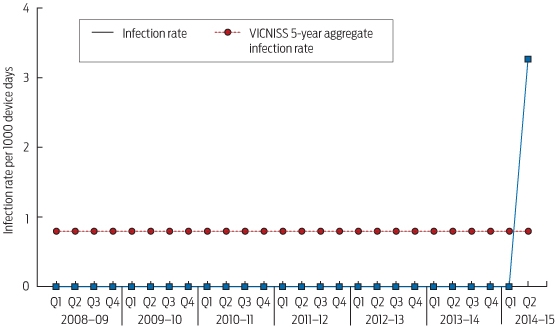
The authors also state: “To our knowledge, this is the first time that a zero CLABSI rate has been achieved and sustained in an Australian ICU”. This is incorrect, a fact readily ascertainable from regular VICNISS reports. The Ballarat Health Services intensive care unit has sustained a zero CLABSI rate since the 2008–09 financial year (Box), using a care bundle that differs from that implemented by Entesari-Tatafi et al.
At Ballarat Health Services, we use a coated rather than an uncoated central venous catheter, with a chlorhexidine-impregnated Tegaderm (3M) securement rather than a Biopatch (Johnson and Johnson) dressing. We also omit the use of a Luer lock syringe to prevent “bounce back”, and the daily 2% chlorhexidine body wash. This raises the possibility that the reduction in infection rate observed by the authors may have been due to a variation of the Hawthorne effect3 — increased attention to aseptic technique — rather than by any detailed features of the care pack used.
Competing interests
No relevant disclosures.
References
- Entesari-Tatafi D, Orford N, Bailey MJ, et al. Effectiveness of a care bundle to reduce central line-associated infections. Med J Aust 2015; 202: 247-249.
- Victorian Healthcare Associated Infection Surveillance Coordinating Centre; . VICNISS hospital acquired infection surveillance annual report 2008–09. Melbourne: Victorian Government Department of Health, 2010. http://www.vicniss.org.au/Resources/VICNISSAnnualReport2008-09.pdf (accessed Jun 2015)
- Landsberger HA. Hawthorne revisited: management and the worker: its critics, and developments in human relations in industry. Ithaca, NY: Cornell University Press, 1958.
Capturing the Benefits of Clinical Quality Registries
Taryn Bessen, Stephen McDonald
Medical Colleges Have an Obligation to Ensure Full Participation in Clinical Quality Registries
Thomas J. Hugh
Getting on the Same Page: Why Australia Needs a National Maternity Early Warning System (MEWS) Chart
Briony A. Cutts, Lucy Bowyer, Nisha Khot, Sandra Lowe, Stefan C. Kane
Data for Equity: Can Linked Administrative Data Inform Pathways to More Equitable Child Health?
Sarah Gray, Shuaijun Guo, Meredith O'Connor, Elodie O'Connor, Katrina Williams, Hannah Badland, Susan Woolfenden, Josie Dickerson, Gerry Redmond, Marnie Downes, Sharon R. Goldfeld
Specialty College Selection: Why Change is Critical to Support a Future Rural Workforce
Matthew R. McGrail, Jenny May AM, Katherine Logan
Differentiated and simplified oral HIV pre‐exposure prophylaxis (PrEP) models hold the key to virtually eliminating HIV transmission in Australia by 2030
Tyson Arapali, Sarah Warzywoda, Anthony K J Smith, Curtis Chan, Timothy R Broady, Erin Sullivan, Catherine MacPhail, Mohamed A Hammoud, Alexander Dowell‐Day, Benjamin R Bavinton