




Volume 202 - Issue 5
Primary abdominal tuberculosis presenting as chronic dyspepsia
Authors: Rekha Pai Mangalore, Vivian Liang and Kalyani Tharmarajah
Med J Aust 2015; 202 (5): 237-238. || doi: 10.5694/mja14.01313
Published online: 16 March 2015
Published online: 16 March 2015
Gastroduodenal tuberculosis is rare and is often misdiagnosed as peptic ulcer disease
To the Editor: Tuberculosis (TB) continues to be a leading cause of preventable morbidity and mortality worldwide. Although Australia has the lowest rates in the world, more recently there has been a spike secondary to increased international travel and migration.1
TB can affect virtually any organ system in the body and can present with atypical or non-specific symptoms. A population-based study in America found that classical symptoms of cough and fever of > 2 weeks' duration and weight loss were variably present and were insensitive predictors for TB.2
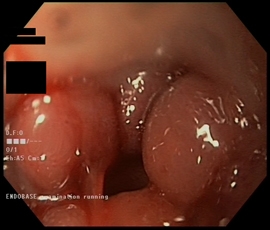
A 51-year-old immunocompetent man who had migrated from Somalia 18 years previously presented with a 6-year history of being treated with proton pump inhibitors for chronic duodenal ulcers. Repeated gastroscopies showed oedematous thickened duodenum. He had a 6-month history of anorexia, nausea, vomiting and weight loss, and was referred for diagnostic laparoscopy for suspected gastrointestinal malignancy.
A computed tomography scan of the abdomen showed small coeliac axis lymph nodes and oedematous thickened duodenum (Box). Gastroscopic biopsy samples over the past 6 years had shown chronic inflammation but no granulomas. Laparoscopy showed florid peritoneal nodules suggestive of miliary TB. A biopsy sample was positive for polymerase chain reaction (Xpert MTB/RIF, Cepheid) and cultures for Mycobacterium tuberculosis. The patient was diagnosed with gastrointestinal TB. He responded well to antitubercular treatment.
Gastrointestinal TB is difficult to diagnose. From a review of 23 patients in India, the most common symptoms of duodenal TB were vomiting (14 patients), epigastric pain (13), and weight loss and anorexia (7).3 Patients with extrapulmonary TB may or may not have concomitant pulmonary TB.2
The ileocaecal region is most commonly involved, followed by the colon, jejunum, appendix, duodenum, stomach, sigmoid colon and rectum.4 Gastroduodenal TB is rare and is often misdiagnosed as peptic ulcer disease. Preoperative endoscopic biopsies have rarely shown underlying aetiology.3
Abdominal TB, although uncommon in developed nations, should be suspected in immunocompromised patients or people from highly endemic areas presenting with longstanding non-specific symptoms that do not resolve with standard therapy. Delayed diagnosis can lead to complications such as peritonitis, and intestinal obstruction and perforation. Therefore, early diagnosis and treatment improves patient outcomes without the need for surgical intervention.
Competing interests
No relevant disclosures.
Acknowledgements
We are grateful to Tuck Yong for reviewing our manuscript and Simon Glance of The Northern Hospital for his support and advice during the writing of this manuscript.
References
- Lavender CJ, Globan M, Kelly H, et al. Epidemiology and control of tuberculosis in Victoria, a low-burden state in south-eastern Australia, 2005-2010. Int J Tuberc Lung Dis 2013; 17: 752-758. 1
- Miller LG, Asch SM, Yu EI, et al. A population-based survey of tuberculosis symptoms: how atypical are atypical presentations? Clin Infect Dis 2000; 30: 293-299. 2
- Gorbach S. Tuberculosis of the gastrointestinal tract. In: Sleisenger M, Fordtran J, editors. Gastrointestinal diseases. Vol. 2. 4th ed. Philadelphia: WB Saunders, 1989: 363-372. 3
- Rao YG, Pande GK, Sahni P, Chattopadhyay TK. Gastroduodenal tuberculosis management guidelines, based on a large experience and a review of the literature. Can J Surg 2004; 47: 364-368. lefthere
Costs of Delivering the Hep B PAST Model of Care in Remote Australia: A Retrospective Pre–Post Study
Hoa Nguyen, Anh Le Tuan Nguyen, Paula Binks, Melita McKinnon, Emily Vintour-Cesar, Karen Wills, Nicola Stephens, Benjamin Cowie, Joshua S. Davis, Yuejen Zhao, Peter Nihill, Julie A. Campbell, Andrew J. Palmer, Jane Davies, Barbara de Graaff
Buruli Ulcer Acquired From Ringtail Possum Rescue
Daniel P. O'Brien, Naomi Clarke, Sara Bonnici, Mohammad A. Hussain
Q Fever Visceral Abscesses After Contact With Native Australian Marsupials
Samantha J. Laws, Enzo Binotto, James Stewart, Jennifer Ho, Trent Yarwood, Josh Hanson, Simon Smith
Hospital-Admitted Injection-Related Infections Among Incarcerated People Who Inject Drugs in Australia: A Retrospective Cohort Study
Andrew Palmer, Matthew Carter, Jeremy Yeo, Cecilia Shim, Jason Connor, Jeremy Hayllar, Gerald Holtmann, Naomi Moy, Elliott G. Playford, Naomi Runnegar, Paul J. Clark
The Live Attenuated Influenza Vaccine in Australia: An Additional Tool for Influenza Prevention
Cyra Patel, Alexis Pillsbury, Tran Nguyen, Xia Wang, Helen E. Quinn, Clayton K. Chiu, Allen C. Cheng, Katie L. Flanagan, Zhicheng Wang
Reflex Testing for Hepatitis D Infection: A Unique Opportunity to Reduce Hepatitis D-Related Chronic Liver Disease Deaths in Australia
Jessica Howell, Lauren Andersson, Miriam T. Levy, James O'Beirne, Leon Adams, Katharine Irvine, Avik Majumdar, Golo Ahlenstiel, Kathy Jackson, Krispin Hajkowicz, Joseph Doyle, Jane Davies, Sarah Cherian, Wayne Dimech, Alexander J. Thompson