




Volume 201 - Issue 2
Severe alkali burns from beer line cleaners warrant mandatory safety guidelines
Authors: Chameen Samarawickrama, John Leaney and Stephanie Watson
Med J Aust 2014; 201 (2): 90. || doi: 10.5694/mja13.00064
Published online: 21 July 2014
Published online: 21 July 2014
Too much alcohol is not the only hazard at the pub
To the Editor: Two patients at our tertiary referral eye hospital had received severe alkali burns to the face and eyes while cleaning beer lines. In hotels, pubs and clubs, beer lines are cleaned weekly using strong alkaline solutions at high pressure. In an accident, alkali released under high pressure can produce blinding damage.
Our patients were young, typical of workers at these venues, and their injuries have had major impacts on their lives. One incident involved the face (60%–80% of facial skin) and both eyes (grade IV1) of a 23-year-old man (Box) using a commercially available beer line cleaner (potassium hydroxide; pH, 14). His eyes were immediately irrigated with water. His initial visual acuity was hand movements in the right eye and light perception in the left eye. He had bilateral corneal opacification and ocular ischaemia with hypotony in the left eye. He was treated according to burns protocol,1 but a non-healing right corneal ulcer developed, requiring multiple operations. Bilateral reconstructive eyelid surgery was also needed.2 His vision is currently light perception and no light perception with hypotony, respectively, in his right and left eyes. He requires further surgery to preserve his remaining vision, as well as ongoing psychological and social support.
The second patient received a grade IV injury to her left eye in 2006. Multiple operations were needed to heal the ocular surface, along with psychological and social support. After 4 years of treatment, her final visual acuity was light perception. She returned to limited work late in 2010.
Alkali injuries to the eye are devastating as they cause liquefactive necrosis and pass rapidly through the cornea to the eye's internal structures.3 Damage to the stem cells of the ocular surface and intraocular structures produces permanent, difficult-to-treat and often blinding ocular disease. First aid should include copious ocular irrigation with water before referral to an emergency department.
Neither patient was wearing safety glasses. We found there are no mandatory safety guidelines in Australia (http://www.safeworkaustralia.gov.au), the United Kingdom (http://www.hse.gov.uk) or the United States (http://www.osha.gov), and perhaps worldwide, for beer line cleaning. Although the product information recommends use of safety equipment, this is not enforced and the equipment is usually not sufficient. Most workplaces provide safety glasses, but these offer suboptimal protection from a splash injury. Non-vented safety goggles are needed for adequate protection and should be worn throughout the cleaning procedure, from set-up to clean-up. We suggest that mandatory guidelines are indicated, as although such injuries are uncommon, they are severe and debilitating in the working-age group, with significant costs to the individual, health system and society.
Severe facial and ocular burns soon after injury
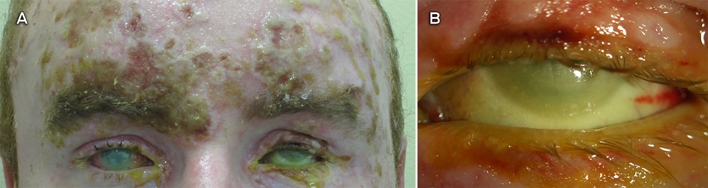
A: Image shows the limbal and scleral ischaemia of the left eye and bilateral opaque corneas. The sunken appearance of the left eye, indicative of hypotony, is a very poor prognostic sign. B: A close-up view of the left eye, showing the cloudy cornea and limbal ischaemia.
Competing interests
No relevant disclosures.
References
- Roper-Hall MJ. Thermal and chemical burns. Trans Ophthalmol Soc U K 1965; 85: 631-653. _ENREF_2
- Tuft SJ, Shortt AJ. Surgical rehabilitation following severe ocular burns. Eye (Lond) 2009; 23: 1966-1971. _ENREF_3
- Cotsarelis G, Cheng SZ, Dong G, et al. Existence of slow-cycling limbal epithelial basal cells that can be preferentially stimulated to proliferate: implications on epithelial stem cells. Cell 1989; 57: 201-209. lefthere
‘Once Bitten’: A Case of Tetanus Following Snakebite in Australia
Adrian A. S. Doherty, Naomi N. E. Clarke, Sarah Fletcher, Sarah Huffam, Camille V. Awburn, Eugene Athan
Epidemiology and Quality of Care for Aboriginal and Torres Strait Islander Peoples Treated by Emergency Medical Services for Stroke in Victoria, Australia: Retrospective Analysis of Linked Data
Candice Menezes, Ziad Nehme, Luke J. Burchill, Tegwyn McManamny, Angela Dos Santos, Michelle Crilly, Luke P. Dawson, Benjamin Clissold, David Anderson, Emily Nehme
Intranasal Adrenaline Use for the Management of Insect Venom-Induced Anaphylaxis
Thomas J. Young, Wilhelmina R. F. Johnson, Braydon L. Pennington, Troy Wanandy, Wun Y. Lau, Thanh-Thao A. Le
Gabapentinoid Poisoning Presentations to Victorian Emergency Departments: A 15-Year Trend Analysis
Bishaal Tej Gurung, Amy McNeilage, Angus Skeen, Tina Lam, Joanna F. Dipnall, Jane Hayman, Suzanne Nielsen, Ting Xia
They Brought the Hospital to Me
Hugh N. Burrill
Predictors of Ambulance Transport to Hospital for Older People Living in Tasmanian Aged Care Facilities: A Retrospective Cohort Study
Sharon Andrews, Pieter F. Fouche, Belinda Flanagan, Michael McDermott, Melanie Greenwood