




Reflections
History
Volume 201 - Issue 11
Remembering Vesalius
Author: Goran Štrkalj
Med J Aust 2014; 201 (11): 690-692. || doi: 10.5694/mja14.00381
Published online: 15 December 2014
Published online: 15 December 2014
This year marks the 500th anniversary of the birth of the founder of modern anatomy
This year marks the 500th anniversary of the birth of the founder of modern anatomy
It is generally held that Andreas Vesalius, anatomist, surgeon and a physician to the emperor Charles V, was born in Brussels on 31 December 1514. However, the exact date of Vesalius's birth is not certain, as there are indications that he might have been born not on the last day of December but in the early hours of the next day. While this is only one of the many uncertainties about Vesalius's life, it is beyond any doubt that this remarkable 16th century scholar profoundly and positively transformed the knowledge of human anatomy as well as the way it was studied and taught. Vesalius's masterpiece, the book entitled De humani corporis fabrica (On the fabric of the human body) and published in 1543, the same year as Copernicus's De revolutionibus orbium coelestium (On the revolutions of the heavenly spheres), marks the beginning of a new era not only in anatomy, but in medicine and science in general. Indeed, both modern evidence-based medicine and modern empirical and experimental sciences can trace some of their roots to Vesalius's work.
Vesalius and his opus can be fully understood only within the context of the 16th century social and cultural frameworks in Europe, personal idiosyncrasies and transforming medical discourse. As one would expect, Vesalian scholarship is considerable and represented by a large number of insightful publications. Among those particularly valuable for English-speaking readers are the classical biography by Charles O'Malley,1 an annotated collection of illustrations from Vesalius's publications (edited by O'Malley and John Saunders)2 and the monumental annotated translation of the Fabrica into English (translated by Daniel Garrison and Malcom Hast, introduced by Vivian Nutton and Nancy Siraisi).3 Because of the importance and complexities of his opus, Vesalius will present a challenge for historical analysis for generations to come. In this article, I provide a glimpse into the life and times of Vesalius and his relevance to present-day medicine and science.
The life of a scholar and physician
Vesalius was born into a family of prominent medical men that included university professors and court physicians — his father was an apothecary to Charles V. Vesalius's talents and hard work, together with his social status and connections, enabled him to enrol in the best universities and later led him into a successful career in academia and in medical practice. Educated at the universities of Louvain and Paris, Vesalius obtained his MD degree at the University of Padua in 1537, where he was, immediately after graduation, recruited to teach anatomy and surgery. At Padua, Vesalius carried out his most important work, which would peak in his magnum opus — the Fabrica.
Vesalius based his research and teaching of anatomy primarily on dissection of human cadavers which, in contrast to most of his contemporaries, he carried out himself. These were supplemented by dissection of animals, experiments and re-reading of classical texts. When dissecting for medical students, Vesalius united in one person a role previously held by three: a professor (who would read and explain a classical anatomical text), dissector (usually a lowly ranked barber–surgeon) and ostensor or demonstrator (who would point out the structure the professor was discussing).
Due to cultural constraints, dissection of human cadavers was rare in antiquity and thrived only briefly in Alexandria during the Hellenistic period. It was revived by the late 13th century Italian scholars. However, for a lengthy period of time, dissections were carried out only to confirm what was written in the classical medical texts, primarily those of Galen. As Charles Singer noted, dissections were performed not as research tools, but mainly to memorise the work of classical authors, “much as a student nowadays dissects to memorize his textbook, not to enlarge knowledge nor to make discoveries”.4 While mistakes in classical works were generally acknowledged, they were held to be minor. Further, many anatomists believed that these mistakes will be best corrected through more accurate translations of the original texts.
Vesalius's novel approach and its results were presented in the Fabrica, a monumental book in more ways than one. The book expounded Vesalius's method and presented in-depth insight into all systems of the human body. Its innovative content was based on a text perfectly coupled with high-quality illustrations. Technically, it was superbly executed even when judged against the high standard of contemporary printing. Vesalius boldly noted many mistakes in Galen's anatomy, which resulted from Galen's reliance on animal dissections. In spite of strong opposition and criticism from many influential anatomists (including Vesalius's Paris mentors), Fabrica was an immediate success and its core ideas became the essence of the new anatomy marked by empirical and experimental approaches. The Fabrica was hailed by many and copied and plagiarised even by Vesalius's opponents. The same applies to the Epitome (De humani corporis fabrica librorum epitome), a simultaneously published shorter version of the Fabrica, containing less text with an emphasis on illustrations, prepared mainly for medical students.
While Vesalius made a considerable contribution towards the birth of modern empirical sciences, emancipated from the medieval scholasticism and renaissance humanism, he still had strong connections with the tradition. It should not be forgotten that Vesalius, his scholarly output and their reception were quite complex. Vesalius was educated in the Galenic tradition and profoundly influenced by the humanistic tradition, for which his professors in Paris were well known. Vesalius's work still had some features of Galenism and he retained a number of Galen's ideas, particularly in terms of function. Ironically, it seems that following Galen's own methodological dictum — “if anyone wishes to observe the works of Nature, he should put his trust not in books on anatomy but in his own eyes”5 — led Vesalius to overthrow Galen's anatomy.
Vesalius left academia soon after the publication of Fabrica and took a prestigious position as a court physician. As he took the new position, he burnt all his papers, an act he would regret later in life as he rekindled his interest in anatomy. The decision to leave academia was complex and probably influenced by a number of factors, among them his feeling that he was primarily a physician and his desire to prove himself as a clinician. He did, however, dissect occasionally (these were mainly autopsies), kept abreast of developments in medicine and prepared the improved second edition of the Fabrica published in 1555. The recent discovery of a copy of the second edition of the Fabrica with extensive annotations by Vesalius strongly suggests that he was preparing a new, third edition, which was never published.6 After the abdication of Charles V, Vesalius served his son and successor Philip II in Spain. In 1564, Vesalius, for reasons not completely revealed, went on a pilgrimage to the Holy Land. He never returned from this voyage, dying the same year of causes still unknown on the Mediterranean island of Zante (Zakynthos).
Vesalius today
Across the half-millennial historical gap, Vesalius still sends strong messages to modern medics and scientists. Innovator and iconoclast, bold enough to challenge instead of unquestioningly follow what was generally accepted by authorities, he is still a role model for medical and scientific researchers. Vesalius did not only transform the research in human anatomy, but equally profoundly the teaching of the subject, showing that the most important feature of an educational program is its ability to constantly develop, enhanced by cutting-edge research.
In developing and promoting new anatomy, Vesalius capitalised on the technological advancements of the day such as the printing press, but he was also wary of their limits. While, for example, he was a pioneer of modern anatomical illustration, which he used heavily in teaching, he saw this only as an aid to learning and teaching, not meant to overtake or substitute the prime mode of instruction — inspection of the human body through dissection. In today's world, transformed and often overwhelmed by technological advances, Vesalius's balanced approach is instructive.
Vesalius's career also sends a warning. Throughout history, dissections of human cadavers have been a double-edged sword of anatomy. On the one hand, they enabled insights into human anatomy, but on the other, the procurement of cadavers has always been surrounded by controversy. Vesalius lived in an era of loose regulations and paucity of cadavers for research and teaching. Most of the bodies he dissected were those of executed criminals and obtained legally. However, Vesalius was also involved in illicit activities (common at the time) in order to obtain human tissue, including grave robbing and stealing human remains from the gallows. The morally dubious and even illegal procurements of cadavers plagued anatomy deep into the 20th century and, in some countries, up until the present day. History sends a strong message on the necessity of comprehensive regulations and, indeed, responsible behaviour of anatomists and the medical community in general.
Just as in his own day, Vesalius and his work represent a stimulus, challenge and provocation for students and practitioners of medicine and science. His Fabrica, revived this year in its full English translation,3 remains one of the most remarkable intellectual achievements in human history.
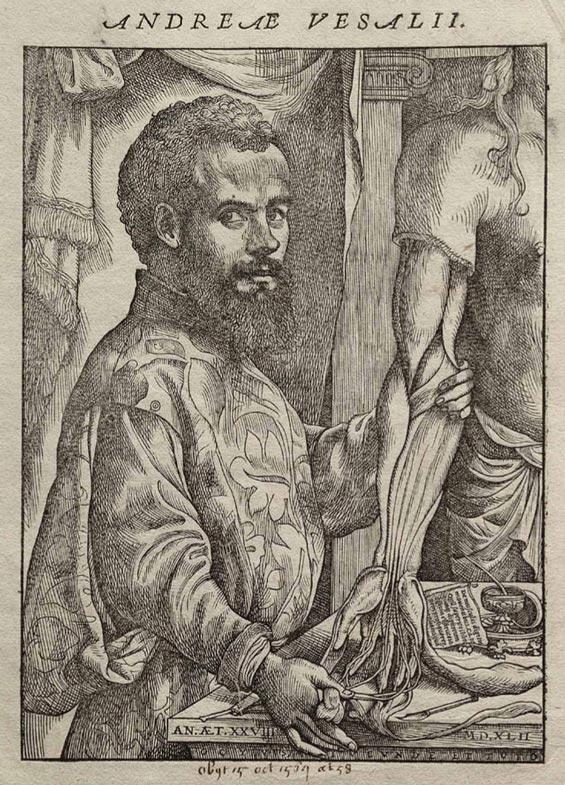
Andreas Vesalius (1514–1564). Image source: Wellcome Library, London CC BY 4.0
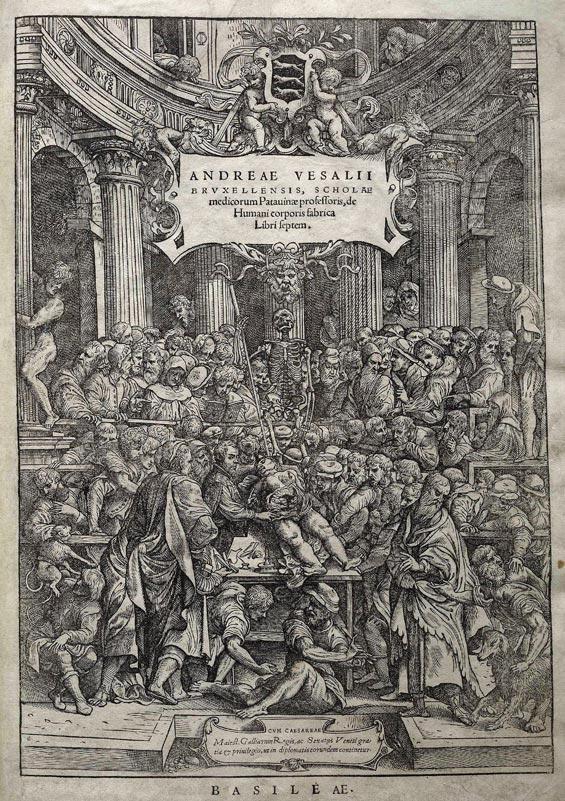
The frontispiece of De humani corporis fabrica. Image source: Wellcome Library, London CC BY 4.0
Competing interests
No relevant disclosures.
References
- O'Malley CD. Andreas Vesalius of Brussels, 1514–1564. Berkeley: University of California Press, 1964. 1
- Saunders JB deCM, O'Malley CD. The illustrations from the works of Andreas Vesalius of Brussels. New York: Dover, 1973. 2
- Vesalius A. The fabric of the human body. Trans. Garrison DH, Hast MH. Basel: Karger, 2014. 3
- Singer C. A short history of anatomy and physiology from the Greeks to Harvey. New York: Dover, 1957. 4
- Galen. On the usefulness of the parts of the body. Trans. Tallmadge M. Ithaca, NY: Cornell University Press, 1968. 5
- Nutton V. Vesalius revised. His annotations to the 1555 Fabrica. Med Hist 2012; 56: 415-443. lefthere
Provenance: Not commissioned; not externally peer reviewed.
Prisoner of war pathology in Changi, 1942–1945
Kate Ariotti, Elizabeth Roberts‐Pedersen
Should medical eponyms continue to be used in everyday practice?
Leya Nedumannil, Diana Lewis
100 years on: the first use of insulin in Australia
Sophie Templer
Reflections on the life and career of Professor Dame Valerie Beral AC DBE FRS FRCOG FMedSci (1943–2022)
Karen Canfell, Bette Liu, Emily Banks
The Honourable Dr Donald James Grimes AO
Michael Kirby, Patti Warn
From wipeout to drill out: a history of exostosis management and Australian surfing
Alon Taylor, Hannah North, Narinder P Singh, Paul A Fagan