




Volume 200 - Issue 6
Use of unlicensed black salve for cutaneous malignancy
Authors: Natalie C Ong, Eric Sham and Brandon M Adams
Med J Aust 2014; 200 (6): 314. || doi: 10.5694/mja14.00041
Published online: 7 April 2014
Published online: 7 April 2014
Natural therapies may be neither natural nor therapeutic
To the Editor: The most frequently diagnosed cancers in Australia are non-melanoma skin cancers.1 Recommended treatments include surgical excision, radiotherapy and topical chemotherapy for in-situ lesions.2 There has been an increase in sales of lotions and salves that claim to eradicate skin lesions and promote removal of skin cancers. In 2012, the Therapeutic Goods Administration issued a public warning strongly advising patients against the use of red and black salves.3 We report a recent case illustrating the complications resulting from use of these unlicensed products.
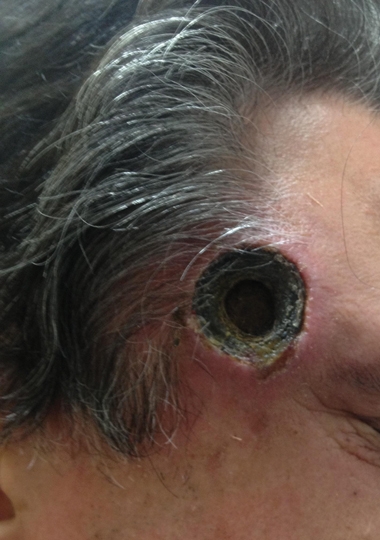
A 55-year-old man presented to the emergency department at Princess Alexandra Hospital, Brisbane, with a tissue defect on his right temple (Box). The patient had applied black salve to a lesion, which he believed to be cancerous, over the previous 4 months.
Before the Therapeutic Goods Administration warning, topical preparations such as black and red salves were being sold online to Australians as an alternative treatment for skin cancer. These products contain sanguinarine, a benzylisoquinolone alkaloid derived from bloodroot (Sanguinaria canadensis).3 This compound is hypothesised to induce tissue necrosis by blocking the sodium–potassium pump, inhibiting nuclear factor-κB or impeding cell cycle progression.4
Zinc chloride has also been identified in salve preparations. Sanguinarine and zinc chloride may cause significant tissue necrosis of both cancerous and healthy tissue, leading to significant scarring and disfigurement.5 In the absence of a biopsy, some patients may commence alternative treatment before attaining a diagnosis of skin cancer, and a very real risk of recurrence and metastasis remains.4 As a consequence, there may be delays in diagnosis, and it may be difficult to identify the primary site of malignancy.
It is imperative for health professionals to recognise that these unlicensed products may lead to adverse outcomes, and for consumers to realise that alternative therapies that have been described as natural are not necessarily safe or, by any standard, risk-free.
Competing interests
No relevant disclosures.
References
- Australian Institute of Health and Welfare. Cancer in Australia 2010: an overview. Canberra: AIHW, 2010. (AIHW Cat. No. 56; Cancer Series No. 60.) https://www.aihw.gov.au/publication-detail/ ?id=6442472459 (accessed Feb 2014).
- Cancer Council Australia; Australian Cancer Network. Basal cell carcinoma, squamous cell carcinoma (and related lesions) — a guide to clinical management in Australia. Sydney: CCA, ACN, 2008. http://www.cancer.org.au/content/pdf/HealthProfessionals/ClinicalGuidelines/Basal_cell_carcinoma_Squamous_cell_carcinoma_Guide_Nov_2008-Final_with_Corrigendums.pdf (accessed Mar 2014).
- Australian Government Department of Health Therapeutic Goods Administration. Black and red salves in treating cancer. 19 March 2012. http://www.tga.gov.au/safety/alerts-medicine-black-salve-120203.htm (accessed Sep 2013).
- Jellinek N, Maloney ME. Escharotic and other botanical agents for the treatment of skin cancer: a review. J Am Acad Dermatol 2005; 53: 487-495. i1142886
- Eastman KL, McFarland LV, Raugi GJ. Buyer beware: a black salve caution. J Am Acad Dermatol 2011; 65: e154-e155. i1142889
Country revealing the way: evaluating Elder‐governed cultural therapy for Aboriginal and Torres Strait Islander young people with mental health conditions
Alasdair Vance, Janet McGaw, Jo Winther, Naomi Tootell, Herb Patten, Sandra Eades
No silver lining with health misinformation: argyria caused by intentional silver consumption
Luke Collins, Logesh Palanikumar, Stephen Bacchi
Hyperkalaemic cardiac arrest due to cream of tartar ingestion
Daniel Yee Lee Ng, Laksmi Govindasamy, Andrew Hughes, Hwee Min Lee
From talk to action: Indigenous Reference Groups drive practice change in kidney transplantation care
Kelli J Owen, Katie Cundale, Jaquelyne T Hughes, Stephen P McDonald, Matilda D'Antoine, Shilpanjali Jesudason
The not‐so‐natural herb: a case of exogenous Cushing syndrome
Yi‐An Pan, David Roberts, Yi‐An Pan, David Roberts
Lead poisoning outbreak from consumption of contaminated Ayurvedic medication
Mark J Ferson, Sinead Flanigan, Toni Cains