




Volume 200 - Issue 4
Renal sympathetic denervation for resistant hypertension in a patient with a single kidney
Authors: Bo Xu and Robert J Whitbourn
Med J Aust 2014; 200 (4): 206-207. || doi: 10.5694/mja13.00003
Published online: 3 March 2014
Published online: 3 March 2014
An effective and well-tolerated treatment for resistant hypertension
To the Editor: We report a case of successful renal sympathetic denervation (RSD) treatment for resistant hypertension in a patient with a single kidney.1-3 RSD is performed via femoral arterial access, using a radiofrequency ablation catheter to deliver energy to the renal artery wall. When delivering RSD to a single kidney, potential renal artery vascular complications can have a significant negative impact on a patient’s renal function, compared with patients with two functioning kidneys.
Our patient was a 71-year-old man with resistant hypertension for many years. He had a congenitally absent left kidney. He was on five antihypertensive agents: candesartan/hydrochlorothiazide 32/12.5 mg daily, lercanidipine 20 mg daily, atenolol 50 mg daily, moxonidine 0.4 mg daily and prazosin 0.5 mg twice daily. Despite this, his blood pressure was poorly controlled, with systolic blood pressure readings frequently above 200 mmHg. Renal ultrasound demonstrated a normal right kidney with normal renal artery, and the left kidney could not be identified. A computed tomography renal angiogram confirmed a single right renal artery with no plaque or stenosis. Other secondary causes of hypertension had been excluded. Given refractory hypertension on medical therapy and suitable anatomy on imaging, the patient underwent RSD treatment to his right renal artery in 2012. Because of its exceptional length, 12 ablations were delivered along the artery.
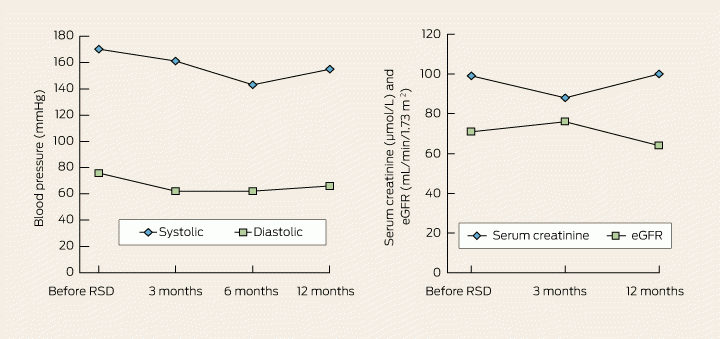
On the day of the procedure, the patient’s sitting blood pressure was 180/76 mmHg. At 1-year follow-up, his sitting blood pressure was 155/66 mmHg. To date, our patient has benefited from sustained blood pressure reduction after RSD, with maintenance of his renal function (Box). He has continued on the same oral antihypertensive regimen.
To our knowledge, this is the second report of RSD for resistant hypertension in a patient with a single kidney.4 The previous report was limited by a follow-up period of only 3 months.4 The success of our case demonstrates the role of RSD as an effective and well tolerated treatment for resistant hypertension, with an enduring result up to 12 months, even in patients with a single kidney, when it is performed at an expert centre.

Competing interests
Robert Whitbourn has received institutional grants and honoraria from Medtronic.
References
- Krum H, Schlaich M, Whitbourn R, et al. Catheter-based renal sympathetic denervation for resistant hypertension: a multi-centre safety and proof-of-principle cohort study. Lancet 2009; 373: 1275-1281. CBBBFCBI
- Symplicity HTN-2 Investigators. Renal sympathetic denervation in patients with treatment-resistant hypertension (the Symplicity HTN-2 Trial): a randomised controlled trial. Lancet 2010; 376: 1903-1909.
- Palmer SC, Judkins C, Williams PD, Whitbourn RJ. Renal sympathetic nerve denervation for the treatment of resistant hypertension. Med J Aust 2013; 199: 160-162. CBBGGJFC
- Dorr O, Hamm C, Nef HM. Single-side renal sympathetic denervation in a hypertensive patient with a single kidney. Am J Kidney Dis 2013; 61: 1042-1043. CBBDEADB
Fatty Liver Disease in Australia: A Narrative Review on the Epidemiology, Natural History, Prognostication and Management in People With Metabolic Dysfunction
Karl Vaz, Daniel Clayton-Chubb, William W. Kemp, Stuart K. Roberts, Ammar Majeed
Sex Differences in Management and Outcomes of People With ST-Elevation Myocardial Infarction, New South Wales, 2011–2020: A Retrospective Cohort Study
Adam C. Livori, Jedidiah I. Morton, Dianna J. Magliano, Jonathan E. Shaw
Rethinking Rheumatic Fever Diagnosis: Progress, Pitfalls and the Path Towards a Definitive Test
Anna P. Ralph, Rachel Webb, Tom Parks, Nicole J. Moreland, Asha C. Bowen, Benjamin Jones, Emma Ndagire, Andrea Z. Beaton
Sex Differences in Management and Outcomes of People With ST-Elevation Myocardial Infarction, New South Wales, 2011–2020: A Retrospective Cohort Study
Samia Kazi, Simone Marschner, Clara K. Chow
Distribution of Cardiovascular Disease Risk Based on the Updated 2023 Guideline-Recommended Australian Cardiovascular Disease Risk Algorithm and Comparison With the 2012 Algorithm: An Observational Study
Nina Lazarevic, Meghana Bhat, Grace Joshy, Danielle C. Butler, Mark Woodward, Anushka Patel, Rod T. Jackson, Garry Jennings, Rosemary Wyber, Ellie Paige, Emily Banks
They Brought the Hospital to Me
Hugh N. Burrill