




Volume 200 - Issue 1
Fortnightly emergency department case-file audit for timely detection of missed cases of suspicious injury
Authors: Amanda Gwee, Benjamin Coghlan, Cate Rayner, Anne Smith and David Krieser
Med J Aust 2014; 200 (1): 23. || doi: 10.5694/mja13.10303
Published online: 20 January 2014
Published online: 20 January 2014
Finding missed cases of possible child abuse is a positive outcome from fortnightly review of ED case files for children
To the Editor: A key role of emergency department (ED) doctors who assess injured children is to determine if abuse or neglect could have caused or exacerbated an injury. Physically abused children have a median of one to two ED presentations before non-accidental injury is diagnosed.1 Better identification may be life-saving, as repeat injury occurs in up to 70% of cases.2 We assessed the impact of a fortnightly review of the case files of young children who presented to the ED with injury on the detection of cases of possible non-accidental injury.
Every fortnight over 12 weeks (31 August to 22 November 2011), we retrospectively identified all children aged 0–3 years who attended our hospital ED with an injury. Case files were reviewed in two stages: (1) a paediatric registrar and paediatric emergency physician reviewed each case file and classified the child’s injury as “suspicious” or “not suspicious” for non-accidental injury based on predefined criteria developed from the literature; and (2) a paediatric forensic expert reviewed the files of cases suspicious for non-accidental injury that had not already been identified and appropriately managed by ED staff, and advised on follow-up for the child. This included evaluation by the Victorian Forensic Paediatric Medical Service (VFPMS), referral to the statutory child protection service (CPS), or voluntary referral to social support (Child FIRST). Ethics approval was obtained from the Melbourne Health and Western Health Human Research Ethics Committees (HREC 2011.135).
Our findings are summarised in the Box. During the study period, 176 children aged 0–3 years presented with a physical injury; 23 cases (13%) were classified as highly suspicious for non-accidental injury after Stage 1; and in Stage 2, seven of 15 highly suspicious cases not initially referred to forensic services were followed up with evaluation by VFPMS (four children), referral to ChildFIRST (one) or referral to the CPS (two).
Our case-file review identified missed cases of non-accidental injury, allowing protective intervention to be initiated. Checklists and flow charts have been shown to improve detection of suspected cases of non-accidental injury,3 but these tools require staff compliance and training.4 While our process avoids these requirements, it is still dependent on the quality of injury documentation. Also, confidentiality issues meant that we do not know if suspicious cases were confirmed.
Our study was designed to ensure universal case-file review of every injured child aged less than 3 years to allow prompt referral to the CPS. Ideally, this review process should be carried out more frequently, but intervention delayed by a maximum of 2 weeks is preferable to no intervention. This approach does not replace the need to improve education and training of clinicians, but could be a useful adjunct to improve the detection of non-accidental injury in EDs.
Summary of a fortnightly ED case-file audit from 31 August to 22 November 2011 to identify cases suspicious for non-accidental injury in children aged 0–3 years
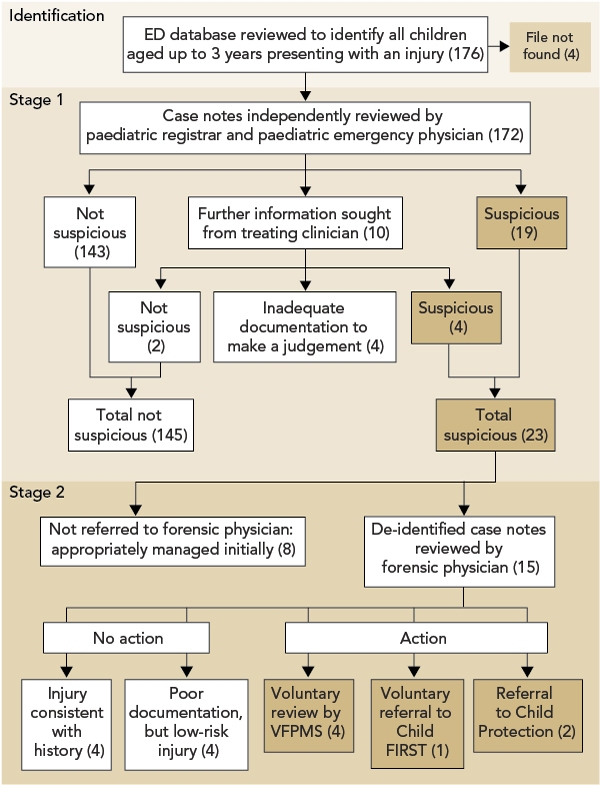
Child FIRST = Child and Family Information, Referral and Support Teams. ED = emergency department. VFPMS = Victorian Forensic Paediatric Medical Service.
Competing interests
No relevant disclosures.
Acknowledgements
We thank the Windermere foundation for providing the funding for this study.
References
- Guenther E, Knight S, Olson LM, et al. Prediction of child abuse risk from emergency department use. J Pediatr 2009; 154: 272-277.
- Maguire S, Moynihan S, Mann M, et al. A systematic review of the features that indicate intentional scalds in children. Burns 2008; 34: 1072-1081. 0_i1142868
- Louwers EC, Affourtit MJ, Moll HA, et al. Screening for child abuse at emergency departments: a systematic review. Arch Dis Child 2010; 95: 214-218. 0_i1142872
- Louwers EC, Korfage IJ, Affourtit MJ, et al. Detection of child abuse in emergency departments: a multi-centre study. Arch Dis Child 2011; 96: 422-425. 0_CBBJGFEB
‘Once Bitten’: A Case of Tetanus Following Snakebite in Australia
Adrian A. S. Doherty, Naomi N. E. Clarke, Sarah Fletcher, Sarah Huffam, Camille V. Awburn, Eugene Athan
Epidemiology and Quality of Care for Aboriginal and Torres Strait Islander Peoples Treated by Emergency Medical Services for Stroke in Victoria, Australia: Retrospective Analysis of Linked Data
Candice Menezes, Ziad Nehme, Luke J. Burchill, Tegwyn McManamny, Angela Dos Santos, Michelle Crilly, Luke P. Dawson, Benjamin Clissold, David Anderson, Emily Nehme
Intranasal Adrenaline Use for the Management of Insect Venom-Induced Anaphylaxis
Thomas J. Young, Wilhelmina R. F. Johnson, Braydon L. Pennington, Troy Wanandy, Wun Y. Lau, Thanh-Thao A. Le
Gabapentinoid Poisoning Presentations to Victorian Emergency Departments: A 15-Year Trend Analysis
Bishaal Tej Gurung, Amy McNeilage, Angus Skeen, Tina Lam, Joanna F. Dipnall, Jane Hayman, Suzanne Nielsen, Ting Xia
They Brought the Hospital to Me
Hugh N. Burrill
Predictors of Ambulance Transport to Hospital for Older People Living in Tasmanian Aged Care Facilities: A Retrospective Cohort Study
Sharon Andrews, Pieter F. Fouche, Belinda Flanagan, Michael McDermott, Melanie Greenwood