




Volume 199 - Issue 5
Paediatric osteomyelitis after exposure to toxic Ochrogaster lunifer moth
Authors: John J van Bockxmeer and Jennifer Green
Med J Aust 2013; 199 (5): 331-332. || doi: 10.5694/mja13.10077
Published online: 2 September 2013
Published online: 2 September 2013
A young boy’s painful encounter with a moth playing possum.
To the Editor: We wish to alert our colleagues to an unusual case of culture-negative paediatric osteomyelitis after exposure to a toxic Australian moth. A previously well 5-year-old boy presented to a remote hospital emergency department with inflammation and urticarial rash of the left third finger and left fifth toe after playing with a “dead” moth. His mother had removed numerous small filaments at the time, and he had no other significant history, exposure to toxins, or trauma.
The inflammation failed to abate despite multiple courses of antibiotics, antihistamines and steroids. Twenty-one days after exposure, his toe was grossly swollen, tender and erythematous, with a bloody exudate. Results of biochemical and haematological investigations were normal, and an x-ray demonstrated changes consistent with osteomyelitis. The toe was debrided, and chronic inflammatory tissue with destruction of tendon and bone was found. A foreign body and middle phalanx were removed. Histopathological analysis of the bone fragment demonstrated a neutrophilic exudate with new bone formation and associated granulation tissue consistent with acute on chronic osteomyelitis. The patient completed 12 weeks of oral ciprofloxacin treatment, and the toe completely healed with return to normal function.
Although the moth the boy had played with was not available for identification, the boy’s mother provided photographs of subsequently observed specimens. Using these images, entomologists at the Western Australian Museum identified the moth as the Ochrogaster lunifer species (Box),1 and it was assumed to be the causative agent. This moth is a pale colour with a variable appearance and is widely distributed throughout Australia. The processionary caterpillars have been associated with outbreaks of paediatric dermatitis, conjunctivitis and respiratory illness.2,3
O. lunifer moths have barbed, hairy filaments (setae) that are known to cause an urticarial rash, corneal inflammation and facial oedema.4 The moths envenomate after contact with an irritant produced by a gland at the base of setae on their feet.2 When agitated, they appear to be dead by curling their abdomen and lying immobilised on one side, making them a target of children’s attention. Moth avoidance protocols have been published to try to reduce moth urticaria.5
O. lunifer is an underrecognised hazard to Australian communities. Physical variability and an unknown aetiology make moth urticaria a diagnostic and management dilemma. Caterpillars and moths can cause inflammatory digital swelling in children, so particular care is needed to ensure all filaments are removed. In patients who do not respond to conventional antibiotics and antihistamines, early surgical evacuation of filaments may be required to prevent progression to osteomyelitis.
North-western Australian Ochrogaster lunifer*
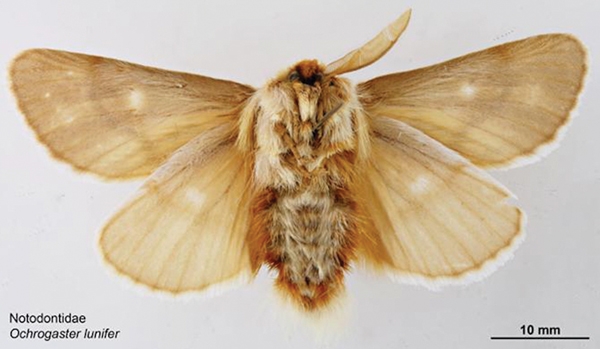
* Specimen collected by McCaffrey and Gibson in the Pilbara region of Western Australia, 2006.1 Image used with permission under the terms of the Creative Commons Attribution 3.0 Australia license.
Competing interests
No relevant disclosures.
Acknowledgements
We acknowledge the CSIRO (Commonwealth Scientific and Industrial Research Organisation) and the Western Australian Museum for assistance with identifying the moth.
References
- McCaffrey S, Gibson L. PaDIL. Ochrogaster lunifer. Updated September 2009. http://www.padil. gov.au/barrow-island/Pest/Main/137892 (accessed Oct 2012).
- Gottschling S, Meyer S, Dill-Mueller D, et al. Outbreak report of airborne caterpillar dermatitis in a kindergarten. Dermatology 2007; 215: 5-9. 0_i1142880
- Maier H, Spiegel W, Kinaciyan T, Hönigsmann H. Caterpillar dermatitis in two siblings due to the larvae of Thaumetopoea processionea L, the oak processionary caterpillar. Dermatology 2004; 208: 70-73. 0_i1142882
- Inal A, Altinta DU, Güvenmez HK, et al. Life-threatening facial edema due to pine caterpillar mimicking an allergic event. Allergol Immunopathol (Madr) 2006; 34: 171-173. 0_pgfId-2853489
- Medical Entomology Centre for Disease Control, Northern Territory Department of Health and Families. Stinging and itchy caterpillars in the Top End of the Northern Territory. February 2010. http://health.nt.gov.au/Medical_Entomology/Insects_of_Medical_Importance/index.aspx (accessed Aug 2013).
Patterns of Osteoporosis Treatment Initiation Following Low-Trauma Fracture: A Population-Based Retrospective Cohort Study in New South Wales, Australia, Using Linked Administrative Health Data
Mike Lin, Huy Nguyen, Thach Tran, Robert D. Blank, Dana Bliuc, Jacqueline R. Center
Rapid Growth in Diagnostic CT Knee Imaging in Australia: Implications for Imaging Stewardship
Hanwen Chen, Rachelle Buchbinder, Sean Docking, Ian A Harris
Spinal cord stimulation patterns of care, re‐interventions, and costs for private health insurers, Australia, 2011–22: a retrospective observational study
Caitlin MP Jones, Christopher G Maher, Rachelle Buchbinder, Ian A Harris, Chung‐Wei Christine Lin, Christopher Hayes, Alexandra Gorelik
The incidence of and risk factors for hospitalisations and amputations for people with diabetes‐related foot ulcers in Queensland, 2011–19: an observational cohort study
Yuqi Zhang, Susanna M Cramb, Steven M McPhail, Rosana Pacella, Jaap J Netten, Ewan M Kinnear, Peter A Lazzarini
Bone health perspectives among Indigenous people: a qualitative study
Troy Walker (Yorta Yorta), Karan P Singh, Vanessa Gan, Brooke Conley (Ngiyampaa), Jessica Bravo, Nigel Smith (Weilwan), April Clarke (Eastern Maar, Kirrae Whurrung, Djap Wurrung), Jackson Baker, Louise J Maple‐Brown, Robin M Daly, Jennifer Browne, Jesse Zanker, Cat Shore‐Lorenti, David Scott, Peter R Ebeling, Ayse Zengin
I am a Civil War
Jennifer G Mowbray