




Volume 199 - Issue 11
Inadvertent dispensing of Coumadin instead of Coversyl
Authors: Duncan P Carradice and Ellen L Maxwell
Med J Aust 2013; 199 (11): 750. || doi: 10.5694/mja13.10500
Published online: 16 December 2013
Published online: 16 December 2013
the Editor: In August 2012, a
43-year-old woman presented to her general practitioner with extensive spontaneous bruising. Her only medications were Coversyl (perindopril) 5 mg daily for hypertension and Rhodiola rosea extract. Laboratory testing revealed prolonged coagulation times (Box 1). Mixing studies (50 : 50 patient and normal plasma) showed complete correction of the activated partial thromboplastin time and international normalised ratio (INR) and no evidence of a ...
the Editor: In August 2012, a 43-year-old woman presented to her general practitioner with extensive spontaneous bruising. Her only medications were Coversyl (perindopril) 5 mg daily for hypertension and Rhodiola rosea extract. Laboratory testing revealed prolonged coagulation times (Box 1). Mixing studies (50 : 50 patient and normal plasma) showed complete correction of the activated partial thromboplastin time and international normalised ratio (INR) and no evidence of a factor inhibitor on prolonged incubation. Results of liver function and lupus anticoagulant tests were normal. Plasma levels of vitamin K-dependent factors were reduced, consistent with vitamin K deficiency or inhibition (Box 1). The patient was administered 2 mg vitamin K orally; 48 hours later, her INR had fallen to 1.4. She denied taking warfarin or the structurally related brodifacoum (eg, Fast Action Ratsak), surreptitious administration of such compounds was not suspected, and she did not have a history of psychiatric illness.
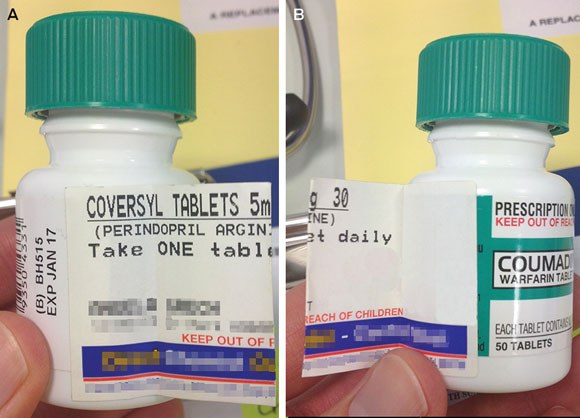
The patient was referred to a haematologist for further evaluation. Visual assessment of the “Coversyl” bottle revealed that in fact Coumadin (5 mg warfarin tablets) had been dispensed 3 weeks before she initially presented to her GP (Box 2). She was advised to cease taking the medication immediately and the pharmacy was advised of the error.
In 2010, Melbourne Pathology had reported to the Therapeutic Goods Administration a series of incidents where Coversyl was inadvertently dispensed instead of Coumadin, leading to subtherapeutic INR results. Subsequently, the Coversyl bottle was produced with a white, rather than green, cap. The issue and the potential for adverse patient outcomes were communicated to pharmacies by the Therapeutic Goods Administration and Pharmacy Guild of Australia.1,2 Despite the modification and education, a further five patients across Melbourne, including this patient, were identified by Melbourne Pathology as having had Coumadin dispensed instead of Coversyl; these incidents were reported to the Australian Health Practitioner Regulation Agency by one of us (E L M) in August 2012.
Potential for confusion still exists, due to the alphabetical storage of medications on community pharmacy shelves (COUmadin is adjacent to COVersyl). Changes to pharmacy working practices, including mandatory scanning of bottle barcodes at the time of dispensing, and moving Coumadin to a different alphabetical storage area (under W for Warfarin) have been suggested. Practitioners should be vigilant in maintaining awareness of the possibility of warfarin being inadvertently dispensed instead of Coversyl or other medications if results of laboratory testing suggest vitamin K deficiency or inhibition.
1 Results of coagulation tests for the index patient
Test |
Result |
Reference interval |
|||||||||||||
Activated partial thromboplastin time |
47 seconds |
23–40 seconds |
|||||||||||||
Prothrombin time |
52 seconds |
10–14 seconds |
|||||||||||||
International normalised ratio |
4.4 |
0.8–1.2 |
|||||||||||||
Plasma levels of coagulation factors and related substances |
|
|
|||||||||||||
Factor II |
9% |
50%–150% |
|||||||||||||
Factor VII |
23% |
50%–150% |
|||||||||||||
Factor IX |
12% |
50%–150% |
|||||||||||||
Factor X |
12% |
50%–150% |
|||||||||||||
Factor V |
128% |
50%–150% |
|||||||||||||
Protein C |
35% |
70%–200% |
|||||||||||||
Protein S |
25% |
55%–200% |
|||||||||||||
References
Intranasal Adrenaline Use for the Management of Insect Venom-Induced Anaphylaxis
Thomas J. Young, Wilhelmina R. F. Johnson, Braydon L. Pennington, Troy Wanandy, Wun Y. Lau, Thanh-Thao A. Le
Gabapentinoid Poisoning Presentations to Victorian Emergency Departments: A 15-Year Trend Analysis
Bishaal Tej Gurung, Amy McNeilage, Angus Skeen, Tina Lam, Joanna F. Dipnall, Jane Hayman, Suzanne Nielsen, Ting Xia
Still Treating Yesterday's Risk? Reconsidering Antiviral Use for Mild-to-Moderate COVID-19 Cases in a Broadly Immune Population
Hadar Mudrik-Zohar, Tim Cutfield, Susan Morpeth, Thomas Hills, Eamon Duffy, Laura J. Edwards, Allen C. Cheng, Steven Y. C. Tong
Birth prevalence, clinical sequelae, and management of congenital cytomegalovirus infections in Australia, 1999–2023: a national prospective study
Ece Egilmezer, Suzy M Teutsch, Carlos Nunez, Stuart T Hamilton, Adam W Bartlett, Pamela Palasanthiran, Elizabeth J Elliott, William D Rawlinson
Medication delivery and dispensing interval preferences of people who use antihypertensive medications in Australia: a survey study
Carissa Bonner, Michael A Fajardo, Rachael M Keast, Emily Atkins, Niamh Chapman, Kristie R Weir, Anthony Rodgers, Aletta E Schutte
Concurrent use of hormonal long‐acting reversible contraception by women of reproductive age dispensed teratogenic medications, Australia, 2013–2021
Michelle KY Chen, Adrian Lim, Deshan F Sebaratnam