




Volume 199 - Issue 10
The Angelina Jolie effect
Authors: Paul A James, Gillian Mitchell, Michael Bogwitz and Geoffrey J Lindeman
Med J Aust 2013; 199 (10): 646. || doi: 10.5694/mja13.11218
Published online: 18 November 2013
Published online: 18 November 2013
Angelina Jolie’s announcement of her preventive double mastectomy has contributed to increased demand for genetic testing, with rapid growth in referrals to familial cancer centres of people concerned about their personal and family history of breast and ovarian cancer.
Media attention highlights the challenges faced by the rapidly developing field of familial cancer
amilial cancer centres (FCCs) have been established throughout Australia to investigate an individual’s personal and family history of cancer, with the goal of providing familial risk assessment and management advice, and ensuring that the limited resources available for genetic testing are used to maximum benefit. This highly specialised field recently enjoyed a brief moment in the celebrity spotlight when Angelina Jolie, one of the world’s highest profile celebrities, disclosed that she carries a BRCA1 gene mutation and opted to have preventive bilateral mastectomy and breast reconstruction to manage her breast cancer risk. In a thoughtful opinion piece in the New York Times, Jolie discussed her extensive family history and explained how she had come to her own personal choices to manage her risk.1
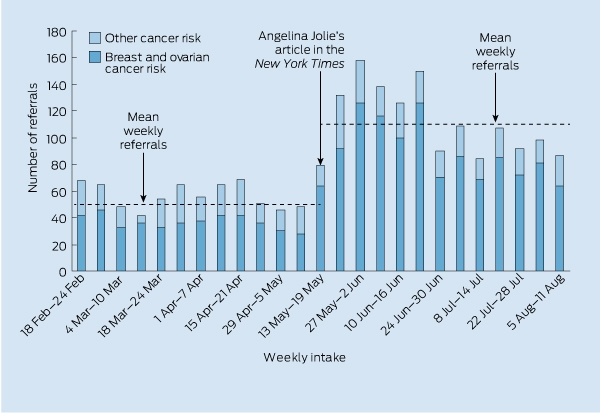
The article was followed by a period of intense media interest locally: 233 print articles on this issue were published in Australia in the following week. The effect was felt immediately in the FCCs. Within days, the number of referrals of individuals concerned about their family history more than doubled, as shown by the activity data from two large hospital-based FCCs in Victoria for this period (Box). As expected, most of the contact involved people with personal and family histories of breast and ovarian cancer, most of whom had genuine issues around increased familial risk. Based on the broad risk categories described by Cancer Australia,2 the initial risk assessment showed that 64% (483/760) of these contacts and referrals involved patients at high risk (equivalent to more than a three-times increase in lifetime relative risk for breast cancer), with this proportion unchanged from 64% (229/357) in the preceding 6 weeks.
Genetic testing through a public clinic will be an option for some of these women. However, individuals are frequently unaware that the decision to offer testing follows a detailed analysis that includes verification of the family history, review of the tumour pathology, and consideration of which family member is the most appropriate person to be tested for the mutation. Private laboratory testing remains an option for women who are ineligible for a state government-funded test. This complex reality is at odds with the expectations created through media interest. This has resulted in increased waiting times for assessment across Australian FCCs. Three months after the announcement, referrals to the FCCs remain twice as high as for the equivalent quarter the previous year.
For clinicians working in familial cancer, the extra activity is welcome, reflecting a genuine unmet need. However, the increased attention has highlighted the challenges in this rapidly developing field. The level of funding for genetic tests was insufficient to meet the rising demand even before recent events. The indications for genetic testing are expanding, and being increasingly interwoven with decisions around acute cancer management through treatment-focused testing.3 Indeed, the remarkable progress in sequencing technologies means that the capacity for genetic testing will soon be limited only by our ability to interpret the information in clinically meaningful ways. More broadly, if genetics is to achieve its potential and enter mainstream cancer care, the current model of time- and information-intensive counselling may need to be revisited. If a more effective and streamlined approach does indeed emerge, Jolie’s announcement could come to be seen as an important watershed.
Competing interests
No relevant disclosures.
Acknowledgements
We thank Maira Kentwell and Mary-Anne Young for helpful discussions, and Wendy Hertan and Penny Fannin for compiling a Factiva search of print publications. We receive funding from the National Health and Medical Research Council, National Breast Cancer Foundation and Victorian Cancer Agency.
References
- Jolie A. My medical choice. New York Times 2013; 14 May. http://www.nytimes. com/2013/05/14/opinion/my-medical-choice.html (accessed Oct 2013).
- Cancer Australia. Advice about familial aspects of breast cancer and epithelial ovarian cancer. http://canceraustralia.gov.au/publications-and-resources/cancer-australia-publications/advice-about-familial-aspects-breast-cancer-and (accessed Oct 2013).
- Trainer AH, Lewis CR, Tucker K, et al. The role of BRCA mutation testing in determining breast cancer therapy. Nat Rev Clin Oncol 2010; 7: 708-717. 0_i1115611
Provenance: Commissioned; externally peer reviewed.
Newborn Screening: Equity for Aboriginal and Torres Strait Islander Families in the Context of Emerging Genomics
Gail Garvey, Sarah Norris, Joanne Scarfe, Louise Lyons
When ‘Liver Enzymes’ Are Not Hepatic: Late-Onset Pompe Disease
Shauna Madigan, Georgina England, Wayne Rankin
Genomic Newborn Screening: Verdict From an Australian Citizens’ Jury
Emma Frost, Zornitza L. Stark, Kristen Nowak, Louise Healy, Sarah Norris, Stacy M. Carter
Genomic Testing Access for Hearing Loss Must Catch Up to the Evidence
Emma McGonigal, Andrew V. White, Valerie Sung, Karen Liddle, Lilian Downie, Emily Shepard
Population-Based Melanoma Screening Using Integrated Risk Scores in Australia: A Narrative Review to Determine Readiness
Courtney K. Wallingford, Chloe Mighton, Tamara Dawson, Anne Cust, H. Peter Soyer, Yvonne Bombard, Tatiane Yanes, Aideen McInerney-Leo
Genomic Newborn Screening: Commodity or Public Good?
Christopher Gyngell, Sebastian Lunke, Danya Vears, Zornitza L. Stark