




Volume 198 - Issue 8
Early obstetric simulators in Australia
Authors: Harry Owen and Damian J McDonald
Med J Aust 2013; 198 (8): 449-451. || doi: 10.5694/mja13.10130
Published online: 20 May 2013
Published online: 20 May 2013
The authors outline the development of obstetric training and simulation in 18th and 19th century London, and describe the historical obstetric simulators on display in Australia.
Simulation became important for obstetric training in the 18th and 19th centuries
The increased numbers of medical students in Australia, coming from a greater number of medical schools, have put pressure on the traditional obstetric education requirement for students to personally deliver babies under supervision. There is a real chance that students may “miss out” on this experience, and universities may need to resort to using simulation to give students those experiences and skills.
Aside from being a substitute for performing procedures where there is less opportunity for students to do so on real patients, simulation is increasingly being used to improve medical education and training because it offers a risk-free environment for learning new skills and practising management of occasional but serious conditions that need prompt and effective intervention. Similar observations were made around 300 years ago, when simulators began to be used in obstetric training.1,2 Surgery simulators were used more than a thousand years earlier, but obstetrics was the first discipline to widely integrate simulation in training.1 In the second half of the 18th century, London was a centre of excellence for obstetrics and attracted students from all over the United Kingdom, Europe and the United States. A certain apothecary, Matthew Flinders, attended a simulation-based obstetric training course there and was then able to successfully manage several difficult deliveries.3 In this article, we outline this training and the development of simulation in 18th and 19th centuries, and describe the historical obstetric simulators that are on display in Australia.
Obstetric training
In the 17th century it was recognised that the outcome of labour could be improved by intervention, and in the 18th century a new health care professional appeared — the man-midwife or accoucheur. William Smellie was an early specialist in this discipline and designed several simulators for use in his training courses. One of his students, Colin Mackenzie, became an assistant but left after an argument over the dubious manner in which the body of a woman pregnant with twins was obtained by Smellie for dissection.3 Mackenzie then established a school of midwifery in St Saviour’s Churchyard in Southwark, London. His lectures included the use of anatomical preparations and “machines” to demonstrate difficult deliveries, and on which students could practise.
Much as now, many health professionals in the 18th century were city-based. While apothecaries were originally compounders of medicines, many also consulted, particularly in the countryside. Some, such as Flinders, undertook additional training so that they could provide comprehensive health care, and these “apothecaries plus” were the progenitors of general practitioners. They were looked down upon by physicians and surgeons, although their training meant they were sometimes better providers of health care. After training as an apothecary, Flinders went to London where he “walked the wards” at The London Hospital on Whitechapel Road as a pupil of the surgeon Richard Grindall and studied obstetrics at Mackenzie’s School of Midwifery.
Flinders received his certificate in the “theory and practise of midwifery” on 16 July 1770. It was signed by David Orme, a man-midwife at the City of London Lying-in Hospital who supplemented his income by teaching midwifery at Mackenzie’s school. When Mackenzie died, Orme bought the school’s collection of simulators and anatomical preparations in order to continue the school. The collection must have been extensive, because Orme paid 1000 guineas for it, equivalent to around $250 000 today.4
Life-saving interventions were a point of differentiation between the man-midwife and the midwife, and justified the higher fees charged by the man-midwife. The fees alone did not reflect the time and disruption caused by attending a labour, but obstetrics became an important part of 18th century general practice because of the connection it created between families and the practitioner. However, failure in the form of a maternal death could quickly destroy a reputation, and simulation-based training on the management of difficult births was highly valued.5 We know from Flinders’ diaries that his training on simulators meant he was able to use obstetric forceps, hooks and the crotchet when necessary.6 Fortunately, there were no complications when Flinders delivered his first son in 1774, whom he also called Matthew. It was expected that the boy would become an apothecary like his father and grandfather.
Early obstetric simulators
Obstetric simulators were first developed at the beginning of the 18th century, and two distinct types were developed: one was based on a skeletal pelvis, and the other had the appearance of a female torso. The pelvis simulator was used with a fetal mannequin or preserved fetus cadaver to demonstrate the usual passage of the fetus through the birth canal and the consequences and management of other fetal presentations. Sometimes a leather (or later rubber) uterus was placed in the pelvis so that some procedures could be practised. The torso simulator was used with a fetal mannequin or preserved fetus cadaver to practise delivery and obstetric interventions.
Natural mannequins
In the 18th century, preserved fetal cadavers were often used in obstetric training. In the 19th century, deceased parturients were frequently used as “natural mannequins”. Johann Lucas Boër, the first director of obstetrics at the Vienna General Hospital who had trained in London, used a pelvis simulator for teaching. In 1823 he was replaced by the more progressive Johann Klein, who quickly introduced teaching through anatomical pathology.
The subjects for operation were the bodies of women who had died in the hospital, most likely in the lying-in division, because recent parturition would improve them as “material”. The abdomen was opened and the pelvic viscera removed by way of preparation, so as to make room for the foetus. After the foetal corpse had been placed into position, it was held by the teacher and the pupil proceeded to perform the operations of version, decapitation, etc. as required.7
Under Boër the maternal mortality from puerperal fever was around 1%, but under Klein it was frequently over 20%.8 One inquiry into what caused the high rate of puerperal fever at the hospital concluded it was the result of large numbers of foreign medical students.9 After thousands of maternal deaths, the relationship between dissection and puerperal fever was discovered by one of Klein’s assistants, Ignaz Semmelweis. Klein was not impressed and made sure Semmelweis did not get his contract extended at the hospital. After appeals to the university, Semmelweis was eventually offered a private lectureship; however, with the condition that he teach only using mannequins.
Advances in simulator technology
Some 18th century torso simulators had a uterus made from glass so that changes in fetal position during birth and the effect of obstetric manoeuvres could be observed for teaching and assessment. While the fetus could be put in different positions or changed, the maternal simulator was generally fixed. In the second half of the 19th century, simulators that could be adjusted were developed. The Budin–Pinard simulator, for example, had a mechanism to change the shape of the pelvis.10 The original Schultze simulator used preserved female external genitalia and internal organs but it was later redesigned with rubber parts. Preserved fetal cadavers continued to be used well into the 20th century.11
Matthew Flinders: the apothecary’s son turned navy captain
In the 18th century it was usual for the sons of apothecaries to train as apothecaries. We know what the training involved from the writing of another apothecary, James Parkinson, a contemporary of Flinders senior, and who also studied under Richard Grindall.
The first four or five years are almost entirely appropriated to the compounding of medicines; the art of which, with every habit of exactness, might just as well be obtained in as many months. The remaining years of his apprenticeship bring with them the acquisition of the art of bleeding, of dressing a blister, and, for the completion of the climax — of exhibiting an enema.12
Later in life, Flinders junior recalled that when he read Robinson Crusoe he realised there would be more excitement at sea than in apothecary training. He joined the Royal Navy, against his father’s wishes, for a career that would change Australia.
Early obstetric simulators in Australia
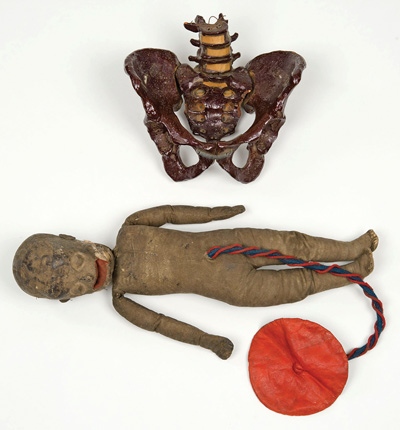
Pelvis and torso simulators typical of those used in the 18th and 19th centuries can be seen in collections in Australia. A ceramic pelvis and mannequin thought to have come from a collection started by James Simpson in Edinburgh is on display in the medical library at Flinders University in Adelaide (Box 1). Simpson established a large collection of obstetric specimens and apparatus in the middle of the 19th century and documented this as part of his application for the Chair of Obstetrics at the University of Edinburgh.13 The fetal mannequin has facial features, cranial sutures and fingers and toes. This meant it could be used by students to identify fetal presentation by “touch” and to practise version and the Mauriceau–Smellie–Veit manoeuvre in breech delivery.
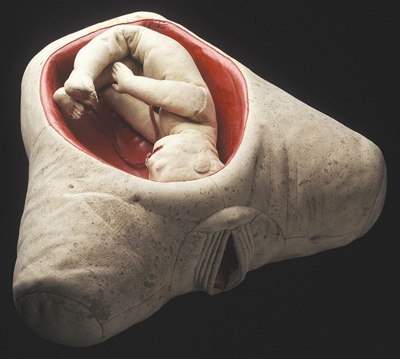
A female torso simulator and fetal mannequin are on display at the Powerhouse Museum in Sydney (Box 2). Several manufacturers made these models in the 19th century and although some were quite distinct, copies with minor modifications were common. Most simulators at this time were, like the Powerhouse model, covered with leather for durability. The fetus could be put in the abdominal cavity in any position to demonstrate causes of prolonged labour or covered with a blanket for students to practise normal delivery, version, use of the perforator, and other procedures. Reed’s book, Operative obstetrics on the manikin for students and practitioners, shows how this was done.14
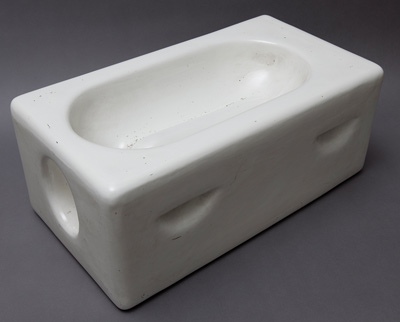
Also in the Powerhouse Museum collection is a glazed ceramic obstetric simulator designed by Douglas to be easy to clean after being used with fetal cadavers (Box 3).11 Its purpose is not instantly recognisable from its form, and Douglas noted that this meant it did not need to be put away or covered when not being used. The cost of consumables for this simulator was kept low by fashioning the pelvic floor and external genitalia from rubber balls.11

Competing interests
No relevant disclosures.
References
- Owen H. Early use of simulation in medical education. Simul Healthc 2012; 7: 102-116. 0_BABDFAAI
- Azzaroli Puccetti ML. Human anatomy in wax during Florentine enlightenment. Ital J Anat Embryol 1997; 102: 77-89. 0_i1115678
- Shelton DC. Man-midwifery history: 1730–1930. J Obstet Gynaecol 2012; 32: 718-723. 0_i1115680
- Wadd W. Mems. Maxims and memoirs. London: Callow and Wilson, 1827. 0_i1115682
- Bell B. The life, character and writings of William Hey of Leeds: a discourse delivered at the annual meeting of the Harveian society, Edinburgh, April 12, 1867. Edinb Med J 1867; 12 part 2: 1062-1065. 0_i1115684
- Beardsley M, Bennett N. “Gratefull to providence”: the diary and accounts of Matthew Flinders, surgeon, apothecary and man-midwife, 1775–1802. Vol 1: 1775–1784. Lincoln: Lincoln Record Society, 2007. 0_i1115686
- Elek SD. Semmelweis commemoration. Semmelweis and the Oath of Hippocrates. Proc R Soc Med 1996; 59: 346-352. 0_i1115688
- Noakes TD, Borresen J, Hew-Butler T, et al. Semmelweis and the aetiology of puerperal sepsis 160 years on: an historical review. Epidemiol Infect 2008; 136: 1-9. 0_i1115690
- Gillies D. Hempelian and Kuhnian approaches in the philosophy of medicine: the Semmelweis case. Stud Hist Philos Biol Biomed Sci 2005; 36: 159-181. 0_i1115692
- Owen H, Pelosi MA 2nd. A historical examination of the Budin–Pinard Phantom: what can contemporary obstetrics education learn from simulators of the past? Acad Med 2013; Mar 21. [Epub ahead of print]. 0_i1115695
- Douglas D. The teaching of practical obstetrics. J Obstet Gynaecol Br Emp 1933; 40: 99-102. 0_i1115698
- Parkinson J. The hospital pupil; or, an essay intended to facilitate the study of medicine and surgery. In four letters. . . . By James Parkinson. London: H. D. Symonds, 1800. 0_i1115700
- Chair of midwifery. Testimonials in favour of James Y Simpson, MD. Edinburgh: Thomas Allan & Co, 1839. 0_i1115702
- Reed CB. Operative obstetrics on the manikin for students and practitioners. Philadelphia: P. Blakiston’s Son & Co, 1931. 0_i1115704
Provenance: Not commissioned; externally peer reviewed.
Prisoner of war pathology in Changi, 1942–1945
Kate Ariotti, Elizabeth Roberts‐Pedersen
Should medical eponyms continue to be used in everyday practice?
Leya Nedumannil, Diana Lewis
100 years on: the first use of insulin in Australia
Sophie Templer
Reflections on the life and career of Professor Dame Valerie Beral AC DBE FRS FRCOG FMedSci (1943–2022)
Karen Canfell, Bette Liu, Emily Banks
The Honourable Dr Donald James Grimes AO
Michael Kirby, Patti Warn
From wipeout to drill out: a history of exostosis management and Australian surfing
Alon Taylor, Hannah North, Narinder P Singh, Paul A Fagan