




Volume 198 - Issue 6
The quality of international normalised ratio control in southern Tasmania
Authors: Luke R E Bereznicki, Alexandra R Madden and Gregory M Peterson
Med J Aust 2013; 198 (6): 315. || doi: 10.5694/mja12.11370
Published online: 1 April 2013
Published online: 1 April 2013
To the Editor: The Australian Government’s recently completed Review of anticoagulation therapies in atrial fibrillation (AF) identified that the quality of international normalised ratio (INR) control was one of a number of factors creating uncertainty regarding the cost-effectiveness of novel anticoagulants in the Australian setting.1
INR control, usually expressed as the percentage of time in the therapeutic range (TTR), is critical in determining the relative efficacy, ...
To the Editor: The Australian Government’s recently completed Review of anticoagulation therapies in atrial fibrillation (AF) identified that the quality of international normalised ratio (INR) control was one of a number of factors creating uncertainty regarding the cost-effectiveness of novel anticoagulants in the Australian setting.1
INR control, usually expressed as the percentage of time in the therapeutic range (TTR), is critical in determining the relative efficacy, safety and cost-effectiveness of novel anticoagulants compared with warfarin.2,3 There is a strong correlation between TTR and clinical outcomes for patients taking warfarin.4,5 A review of retrospective studies in patients with AF found that a 7% improvement in TTR is associated with one less haemorrhagic event per 100 patient-years and a 12% improvement is associated with one less thromboembolic event per 100 patient-years.5
There is a paucity of data available regarding INR control in Australia outside of trial conditions. We conducted a retrospective observational study with the aim of determining the quality of INR control in a large cohort of patients in southern Tasmania. We examined INR results for southern Tasmanian people from December 2003 to November 2010. Data were obtained from the major private pathology provider and were screened to identify patients who were receiving monitoring for warfarin therapy, and who received continuous INR monitoring from 2007 to 2010. There were 1137 patients with continuous data for 2007–2010, spanning a mean of 3.5 years.
This group had a mean TTR (assuming a therapeutic range of 2–3) of 69.1% and a mean testing interval of 22.9 days. Patients spent a mean of 18.3% of their time with an INR < 2 and 12.6% of their time with an INR > 3. The proportion of patients with a mean TTR < 60% was 22.3%, and 52.5% had a TTR > 70% (Box).
The observed mean TTR of almost 70% is superior to that reported in the warfarin arms of recent clinical trials comparing novel anticoagulants to warfarin (mean TTR, 55%–64%).1 Optimisation of TTR is critical for patients who are prescribed warfarin, and TTR could be used as an ongoing audit parameter to identify patients with poor INR control and provide the impetus for interventions to reduce the risk of warfarin-related adverse events. The use of TTR in general practice systems and pathology reports would give prescribers a sound basis on which to make decisions about a range of interventions that could improve the quality of warfarin management. The TTR could also act as an indicator to switch therapy to an alternative anticoagulant if reasonable INR control could not be achieved.
In summary, Australian “real-world” INR control was better than expected and, at the observed level of INR control, the benefits of novel anticoagulants compared with warfarin may be lost for most patients.1
Distribution of patients in southern Tasmania who received continuous warfarin monitoring during 2007–2010, according to mean percentage time in therapeutic range (TTR) (n = 1137)
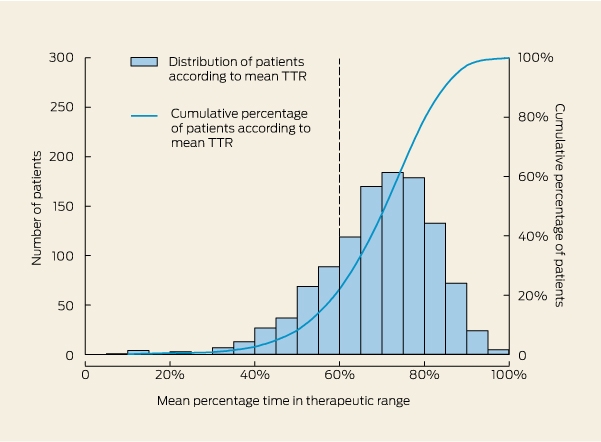
The dotted line indicates a TTR of 60%. This is considered in the literature to be a benchmark for acceptable INR control.1
Competing interests
Luke Bereznicki and Gregory Peterson have received consultancy fees from Aspen Pharmacare Australia and Boehringer Ingelheim. Luke Bereznicki has also received consultancy fees from Roche Diagnostics Australia and Sanofi Aventis, and speakers honoraria from Roche Diagnostics Australia and Boehringer Ingelheim.
Acknowledgements
We thank Peter Gee for analysing project data and Daniel Owens for facilitating access to pathology data and assisting with the project.
References
- Department of Health and Ageing. Review of anticoagulation therapies in atrial fibrillation. Final report. 2012. http://www.pbs.gov.au/info/publication/factsheets/shared/anticoagulation-review (accessed Feb 2013).
- Wallentin L, Yusuf S, Ezekowitz MD, et al. Efficacy and safety of dabigatran compared with warfarin at different levels of international normalised ratio control for stroke prevention in atrial fibrillation: an analysis of the RE-LY trial. Lancet 2010; 376: 975-983. 0_CHDCDACD
- Shah SV, Gage BF. Cost-effectiveness of dabigatran for stroke prophylaxis in atrial fibrillation. Circulation 2011; 123: 2562-2570. 0_i1142893
- White HD, Gruber M, Feyzi J, et al. Comparison of outcomes among patients randomized to warfarin therapy accprding to anticoagulant control: results from SPORTIF III and V. Arch Intern Med 2007; 167: 239-245. 0_i1142895
- Wan Y, Heneghan C, Perera R, et al. Anticoagulation control and prediction of adverse events in patients with atrial fibrillation: a systematic review. Circ Cardiovasc Qual Outcomes 2008; 1: 84-91. 0_i1142899