




Volume 198 - Issue 4
Futile treatment: the ethicist’s perspective
Author: Dominic J C Wilkinson
Med J Aust 2013; 198 (4): 223-224. || doi: 10.5694/mja12.10778
Published online: 4 March 2013
Published online: 4 March 2013
We need to pay attention to the reasons why treatment is judged to be futileWhen doctors are confronted with making treatment decisions in the context of a terminally ill patient, the way forward is often difficult and confused. Bringing an ethics perspective to bear on the problem can help to resolve what the essential issues are, in turn enabling a clearer path to appropriate decisions ...
We need to pay attention to the reasons why treatment is judged to be futile
When doctors are confronted with making treatment decisions in the context of a terminally ill patient, the way forward is often difficult and confused. Bringing an ethics perspective to bear on the problem can help to resolve what the essential issues are, in turn enabling a clearer path to appropriate decisions by the people who ought to be making those decisions. In many cases where further treatment of a patient may be thought to be futile, such as John’s case, described by Koczwara,1 the central ethical question is whether treatment is medically inappropriate or futile, and whether, as a consequence, it may be withdrawn or withheld against the wishes of his family.
Is treatment inappropriate or futile?
There are many different terms that are used to describe treatment that medical professionals feel should not be provided, even if the patient or family request it.2 Sometimes, as in John’s case, it is called “futile”;1 at other times it is referred to as “inappropriate”, “non-beneficial”3 or “not indicated”.4 These terms suggest that there is a simple yes or no answer — treatment is either futile or it is not — and that this answer can be readily determined. However, in practice there are often disagreements between different medical professionals and between clinicians and families about whether treatment is futile. These disagreements partly stem from differences in assessment of the facts, including the nature of a patient’s illness and the prognosis with treatment. But they are also crucially based on different assessments of the goals of treatment, and on what would best reflect the interests of the patient. A doctor might regard treatment as futile if it is unlikely to lead to the patient being discharged alive from hospital, while a patient may see the same treatment as not futile if it gives him a chance of living long enough to see a new grandchild. One important step, wherever there are disputes, is to identify the goals of treatment for each party.5,6
May treatment be withheld or withdrawn?
What happens in the case where the patient or their surrogate decisionmaker may well have identified a different goal from clinicians? There are ultimately only two ethical reasons for refusing to provide treatment that a patient or his or her surrogate is requesting (Box).2 The first reason for refusal is that providing treatment would harm the patient. Either the chance or duration of survival is so small, or the quality of life is so poor (or both) that the physician judges that the harms of treatment outweigh the benefits. The second reason is that providing treatment would harm other patients. Where there are limited health care resources, providing treatment would mean that other patients who stand a greater chance of benefit are prevented from accessing it.7 Sometimes, perhaps often, both of these reasons will apply.
Would treatment be harmful to the patient?
In John’s case, the clinicians involved may well have believed that treatment was harmful for him, but his son disagreed. The critical question then is what the patient’s values are or were. Would he have judged treatment to be worth continuing, or thought that the harms outweigh the benefits? If the evidence says yes, then we have a strong prima facie reason to provide it. This reflects the importance of patient autonomy in Western medical ethics. But it also reflects the genuine philosophical uncertainty about how we should assess the benefits and burdens of treatment and determine whether treatment is harmful.8,9 Given this uncertainty, it is not clear why we should privilege a medical view over the patient’s view. To do so appears unjustifiably paternalistic.
However, in John’s case, there does appear to be evidence from his recent behaviour and interactions that he would not have wanted further treatment. Other members of the family appeared to support this. (We should nevertheless be careful to distinguish between what families want and what they think the patient would have wanted, since these may not coincide). If this was the case, then it is questionable whether the son was genuinely representing John’s wishes. There are a range of reasons why surrogates might request treatment that is contrary to the patient’s own wishes and interests, including guilt, denial, personal fear of losing a loved family member, religious reasons or, even occasionally, financial advantage.10,11 In such situations, an alternative surrogate decisionmaker should be sought.
Would treatment be harmful to others?
Resource allocation is not often explicitly acknowledged as a justification for forgoing treatment.12 Yet it is frequently present below the surface, and arguably provides the strongest justification for not providing treatment. This is based on the widely held principle, articulated by philosopher John Stuart Mill, that individual freedom may only be limited to prevent harm to others.13,14
If it did transpire that a patient such as John would have wanted cardiopulmonary resuscitation (CPR) in the event of a cardiac arrest, should it be provided? The chance of “success” is low in a patient with malignancy and multiorgan failure.15 Some ethicists have argued that in some circumstances it would be appropriate to provide futile CPR.16 However, the strongest reason for declining to provide CPR in John’s particular case is not that it would not be successful — on the contrary, it is because it may be successful and lead to John being intubated and ventilated and transferred to the intensive care unit (ICU). John’s son apparently did not want him to be admitted to the ICU, so there may not be a strong resource-based reason for declining to provide CPR. But what if the son had insisted on John being admitted to the ICU? In public health systems with limited intensive care beds, there are often patients who are declined admission to intensive care who would potentially benefit.17 Refusing to admit John to intensive care would not be paternalistic (ie, assuming values that he does not share). Rather, it would reflect the common values of wider society and the imperative to use scarce public resources fairly.
The important practical question is how resource-based decisions to decline treatment should be made. Such decisions need to be transparent and accountable,18 and should ideally be based on consensus guidelines or hospital policy.19 In their absence, hospital ethics committees may provide a mechanism for fairly considering differing points of view, and arbitrating whether it is reasonable to withhold treatment.
Conclusions
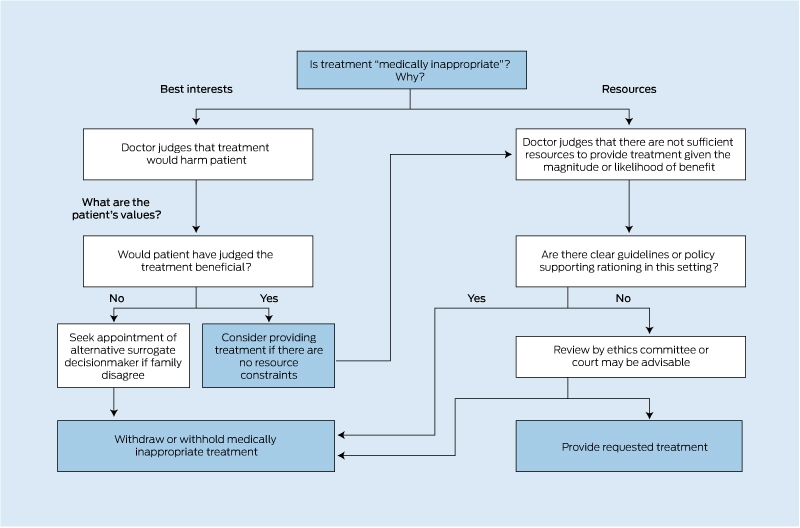
Ultimately, many cases are resolved by consultation and discussion. However, it is ethical for clinicians to refuse to provide treatment either where this would be contrary to the best interests of the patient, or where resources are insufficient. Giving attention to the reason for judging treatment to be futile may help in identifying the best way to resolve a dispute.
Resolving disputes about treatment judged to be medically inappropriate or futile*
* Adapted from Curr Opin Anaesthesiol 2011; 24: 160-165.2 Used with permission.
Key issues
Can we improve our ability to determine what the patient would have wanted?
How do we deal with differences between families and medical staff about the appropriate goals of treatment?
Can we develop fair rules or guidelines for determining which costly treatments (of low efficacy or chance of success) should not be provided?
What is the best process for fairly resolving disputes about medically inappropriate treatment?
Competing interests
No relevant disclosures.
Acknowledgements
I thank Professor Julian Savulescu for his valuable assistance in analysing this topic and developing the figure.
References
- Koczwara B. What is futile and who decides? The clinician’s dilemma. Med J Aust 2013; 198; 221-222. 0_i1139939
- Wilkinson DJC, Savulescu J. Knowing when to stop: futility in the ICU. Curr Opin Anaesthesiol 2011; 24: 160-165. 0_i1139941
- American College of Emergency Physicians. Non-beneficial (“futile”) emergency medical interventions. 2008. http://www.acep.org/practres.aspx?id=29590 (accessed Oct 2010).
- McCabe MS, Storm C. When doctors and patients disagree about medical futility. J Oncol Pract 2008; 4: 207-209. 0_i1139945
- Truog RD, Brett AS, Frader J. The problem with futility. N Engl J Med 1992; 326: 1560-1564. 0_i1139947
- Chwang E. Futility clarified. J Law Med Ethics 2009; 37: 487-495, 396. 0_i1139949
- Niederman M, Berger J. The delivery of futile care is harmful to other patients. Crit Care Med 2010; 38 (10 Suppl): S518-S522. 0_i1139951
- Veatch RM. Abandoning informed consent. Hastings Cent Rep 1995; 25: 5-12. 0_i1139953
- DeGrazia D. Value theory and the best interests standard. Bioethics 1995; 9: 50-61. 0_i1139955
- Jecker NS, Schneiderman LJ. When families request that “everything possible” be done. J Med Philos 1995; 20: 145-163. 0_i1139957
- Rothchild E. Family dynamics in decisions to withhold or withdraw treatment. In: Steinberg MD, Youngner SJ, editors. End-of-life decisions: a psychosocial perspective. Washington, DC: American Psychiatric Press, 1998. 0_i1139959
- Sprung CL, Woodcock T, Sjokvist P, et al. Reasons, considerations, difficulties and documentation of end-of-life decisions in European intensive care units: the ETHICUS Study. Intensive Care Med 2008; 34: 271-277. 0_i1139961
- Mill JS. On liberty. New York: Bobbs-Merrill, 1956. 0_i1139963
- Feinberg J. The moral limits of the criminal law: harm to others. Oxford: Oxford University Press, 1984. 0_i1139965
- Larkin GL, Copes WS, Nathanson BH, et al. Pre-resuscitation factors associated with mortality in 49,130 cases of in-hospital cardiac arrest: a report from the National Registry for Cardiopulmonary Resuscitation. Resuscitation 2010; 81: 302-311. 0_i1139967
- Truog RD. Is it always wrong to perform futile CPR? N Engl J Med 2010; 362: 477-479. 0_i1139969
- Wilkinson D, Savulescu J. A costly separation between withholding and withdrawing treatment in intensive care. Bioethics Jul 5 2012. doi: 10.1111/j.1467-8519.2012.01981.x [epub ahead of print]. 0_i1139972
- Daniels N. Justice, health, and healthcare. Am J Bioeth 2001; 1: 2-16. 0_i1139974
- Orentlicher D. Rationing health care: its a matter of the health care system’s structure. Ann Health Law 2010; 19: 449. 0_i1139977
Provenance: Commissioned; externally peer reviewed.
Mending the Road: A Way Forward From Silence and Silencing
Ayman Hamdan, Anisa J. N. Jafar
Seven Vessel Spontaneous Coronary Artery Dissection and Concurrent Transient Global Amnesia After an Emotional Trigger
Michael J. Stewart, Tom R. Sutherland
Seven Vessel Spontaneous Coronary Artery Dissection and Concurrent Transient Global Amnesia After an Emotional Trigger
Virginia Barbour
Research Priority Setting Is Not Research: A Call for Ethical Clarity in Australia
Bec Jenkinson, Gordon McGurk, Jonathan Quicke, Janelle Bowden, Nadine E. Foster
Organ Donation After Oral Ingestion of a Voluntary Assisted Dying Substance
Joanne Kantianis, Helen I. Opdam, Rohit L. D'Costa
Equity, Diversity and Inclusion From the Start: Reforming Australia's Research Infrastructure for Inclusive Participation
Danielle M. Muscat, Kirsten J. McCaffery, Heather L. Shepherd, Marguerite Tracy