





Volume 198 - Issue 10
Where is the next generation of medical educators?
Author: David A Kandiah
Med J Aust 2013; 198 (10): 534-535. || doi: 10.5694/mja13.10196
Published online: 3 June 2013
Published online: 3 June 2013
To the Editor: The arguments put forward by Hu and colleagues for recognition of medical education as a specialty are persuasive, especially considering current national requirements for accreditation to ensure delivery of high-quality programs.1
In recent decades, medical educationalists have flooded journals and other publications with articles (Box). Many have resulted from, and led to, innovative educational programs. Unlike other areas of scientific research, however, the ...
To the Editor: The arguments put forward by Hu and colleagues for recognition of medical education as a specialty are persuasive, especially considering current national requirements for accreditation to ensure delivery of high-quality programs.1
In recent decades, medical educationalists have flooded journals and other publications with articles (Box). Many have resulted from, and led to, innovative educational programs. Unlike other areas of scientific research, however, the true impact of these educational programs may only be appreciated after 10 years.2 Such research needs to be done to demonstrate the effectiveness of educational interventions.
Medical educators need to prove to the community that they have clearly improved the quality of both teaching and learning, and their graduate doctors. Very few education providers assess the quality of the clinical care their graduates provide, instead using evaluation of the course as a surrogate marker, which can be modified by successful statistical manipulation of data.3 This evaluation needs to be done by external organisations such as colleges of postgraduate training, and by clinical supervisors in prevocational and vocational training. It is relevant to note that of the four Australian-based authors of the editorial,1 two come from medical schools whose graduates rate the overall teaching quality as worse than average.4
After 25 years, I know which medical school graduates I will happily employ, because they are clinically competent, reliable, keen to learn and show compassion to patients and colleagues. Focused discussions with these graduates consistently show that it is skilled clinicians and excellent mentors, not specialist medical educators, who have honed their abilities.
Number of publications on medical education over time*
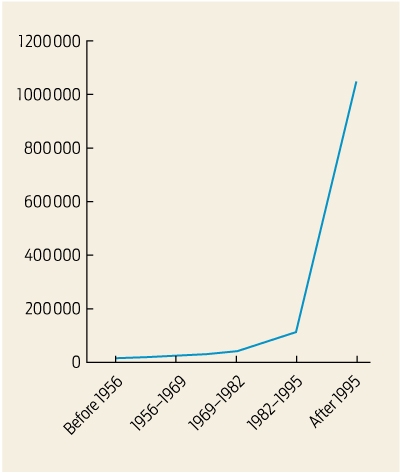
* The figures were derived in February 2013 from a search of OneSearch (http://libguides.library.uwa.edu.au/onesearch), a research repository of journal articles, book chapters, newspaper articles, conference papers and broad cross-disciplinary databases.
Competing interests
No relevant disclosures.
References
- Hu WCY, McColl GJ, Thistlethwaite JE, et al. Where is the next generation of medical educators [editorial]? Med J Aust 2013; 198: 8-9. 0_CHDIFBIC
- Peters AS, Greenberger-Rosovsky R, Crowder C, et al. Long-term outcomes of the New Pathway Program at Harvard Medical School: a randomized controlled trial. Acad Med 2000; 75: 470-479. 0_i1142874
- Colliver JA. Effectiveness of problem-based learning curricula: research and theory. Acad Med 2000; 75: 259-266. 0_i1142877
- Hobsons Course Finder. The good universities guide: what you can expect from undergraduate study in medicine. http://gooduniguide.com.au/ratings/fos/24/UG (accessed Feb 2013).