





Volume 198 - Issue 10
Burns from motorcycle exhausts among children in New South Wales: a continuing problem
Authors: Ela J Hyland, Rachel A D’Cruz and John G Harvey
Med J Aust 2013; 198 (10): 530-530. || doi: 10.5694/mja13.10247
Published online: 3 June 2013
Published online: 3 June 2013
An audit of cases treated at a major children’s hospital reveals that significant burns from motorcycle exhausts still occur much too frequently
To the Editor: Burns remain a common occurrence among children, with scalds accounting for 55% of these injuries in Australia and New Zealand.1 Although a less frequent mechanism, contact burns now account for up to 30% of all burns among children.1,2 The Burns Unit (BU) at the Children’s Hospital at Westmead serves the paediatric population of New South Wales and the Australian Capital Territory. Recently, our BU has identified a rise in the number of contact burns from motorcycle exhausts among children.
Following Sydney Children’s Hospitals Network Human Research Ethics Committee approval, we performed a retrospective case series review of children ≤ 16 years of age who were referred to our BU between 1 January 2008 and 31 December 2011 and who had sustained contact burns from the exhausts of either adult or children’s motorcycles.
Over the 4-year study period, there were 96 children with motorcycle exhaust contact burns, 75 (78%) of whom were male. The mean age was 8.6 years. Forty-five (47%) of the burns occurred in backyards; 16 (17%) occurred on farms; 14 (15%) occurred in sport and recreation areas; seven (7%) occurred in driveways; seven (7%) occurred on public roads; and in seven cases (7%), the location was unknown. Only 53 (55%) of the children had adequate first aid. Of the 41 children (43%) admitted to hospital, all required skin grafting (Box). The mean length of stay was 2.4 days. Out of the total of 96 children, wound infections occurred in seven (7%), and three (3%) had a history of prior burns.
A previous study from our institution first identified concerns relating to children sustaining contact burns from exhaust systems.3 Despite this, the incidence of children sustaining motorcycle exhaust burns appears to be increasing.2,3 Between 2008 and 2012, an average of 24 children per year presented to our BU with motorcycle exhaust burns, compared with 15 per year in our earlier study.2
These results indicate that there remains a need to educate the community and health professionals regarding the dangers of motorcycle exhausts. We suggest that there should be implementation of widespread advocacy for the use of protective clothing. Consideration should also be given to the introduction of legislation requiring the modification of all motorcycle exhausts, particularly those designed for children, to reduce the incidence of contact burns in this population.
Box
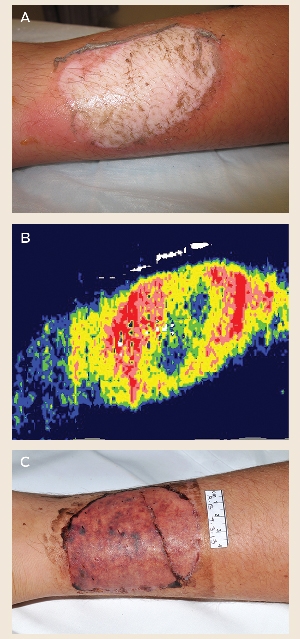
Burn injury to the right leg of a 13-year-old boy secondary to contact with a motorcycle exhaust: (A) on presentation; (B) as a laser Doppler image showing a deep-dermal/full-thickness burn centrally (blue); and (C) after skin grafting.
Competing interests
No relevant disclosures.
References
- Bi-National Burns Registry Project Team. Bi-National Burns Registry Annual Report. 1 July 2009 – 30 June 2010. Melbourne: Monash University, Australia. http://www.med.monash. edu.au/assets/docs/sphpm/bi-nbr-annual-report.pdf (accessed Sep 2012).
- Abeyasundara SL, Rajan V, Lam L, et al. The changing pattern of pediatric burns. J Burn Care Res 2011; 32: 178-184. 0_i1142889
- Rajan V, Abeyasundara SL, Harvey JG, Holland AJ. Exhaust burns in children. Burns 2011; 37: 273-276. 0_i1142892
Barriers and Facilitators to Timely Detection and Optimal Management of Chronic Wet Cough in Aboriginal Children Across Australia From the Perspectives of Carers of Aboriginal Children: A Qualitative Study
Gloria T. Y. Lau, Pam Laird, Robyn Aitken, Melanie Barwick, Liam Bedford, Emily R. Bowden, Jamie Everingham, Angela Fuery, Reece Griffin, Neha Jain, Mina Kinghorn, Renae Knapp, Gabrielle B. McCallum, Peter Morris, Richard Norman, Peter C. Richmond, Aarti Saiganesh, Slade Sibosado, Cameron Taylor, Maree Toombs, Roz Walker, Joan Wilson, Anne B. Chang, André Schultz
Barriers and Facilitators to Timely Detection and Optimal Management of Chronic Wet Cough in Aboriginal Children Across Australia From the Perspective of Health Care Providers: A Qualitative Study
Gloria T. Y. Lau, Pamela Laird, Robyn Aitken, Melanie Barwick, Liam Bedford, Emily R. Bowden, Corey Dalton, Jamie Everingham, Angela Fuery, Reece Griffin, Neha Jain, Mina Kinghorn, Renae Knapp, Gabrielle B. McCallum, Peter Morris, Richard Norman, Peter C. Richmond, Aarti Saiganesh, Slade Sibosado, Maree Toombs, Roz Walker, Joan Wilson, Anne B. Chang, André Schultz
Short-Term Safety of Concomitant Meningococcal B and National Immunisation Program Vaccines in Infants Aged < 15 Months: A Survey-Based Surveillance Study
Thuy Nguyen, Evelyn C. S. Tay, Michael Dymock, Thomas L. Snelling, Lucy Dawes, Julie Marsh, Yue Wu, Alan Leeb, Nicholas Wood, Lucy Deng
The GenV Biobank: Enabling Biological Research in a Large Longitudinal Population-Representative Cohort of Australian Newborns and Their Parents
Katherine Lange, Kim L. Powell, Yeukai Mangwiro, Tony Frugier, Donna T. Geddes, Melissa Wake, Richard Saffery
Watchful Waiting Compared With Immediate Antibiotics for Urban Aboriginal and Torres Strait Islander Children With Uncomplicated Acute Otitis Media (WATCH): A Non-Inferiority Randomised Controlled Trial
Jennifer S. Reath, Hasantha Gunasekera, Sanja Lujic, Amanda J. Leach, Letitia Campbell, Robyn Walsh, Tim Usherwood, Geoffrey K. Spurling, Claudette A. Tyson, Deborah A. Askew, Kelvin Kong, Chelsea J. Watego, Peter Morris, Wendy Hu, Penelope A. Abbott
A Rare Case of Storage Mite Anaphylaxis in Infancy
Eliza Kluckow, Katie Frith