




Volume 197 - Issue 9
Where to die?
Authors: Vineet Sarode, John Reeves, Jonathan Barrett and Jennifer McCambley
Med J Aust 2012; 197 (9): 524-525. || doi: 10.5694/mja12.10262
Published online: 5 November 2012
Published online: 5 November 2012
In the past, most deaths took place at home. There has recently been a lot of interest in providing patients and their families with a “good death”, and research has shown that if a choice was given to terminally ill patients in the intensive care unit (ICU), they would prefer to die at home. Much ...
An intensive care patient, terminally ill, chooses to die at home
In the past, most deaths took place at home. There has recently been a lot of interest in providing patients and their families with a “good death”,1 and research has shown that if a choice was given to terminally ill patients in the intensive care unit (ICU), they would prefer to die at home.2 Much of the palliative care literature is about providing care for a terminally ill patient in the patient’s home. However, little information is available on taking a critically ill patient home to die.
In some reports, only one patient was taken home to die, but in others, 10%–44% of ICU patients went home to die.3-10 Although all the patients had wished to die at home, some authors emphasised that decisions to transfer patients home to die were often based on religious or cultural beliefs, such as Muslim religious values or Maori,9 Polynesian or Chinese6 cultural beliefs. We found one report from an ICU with a well structured “going home initiative” program, but it involved transporting the patient home after extubation (for logistical reasons).11
Case report
We were involved in a challenging and logistically difficult case, in which the patient presented with a putative diagnosis of end-stage progressive motor neurone disease. All her activities of daily living had deteriorated dramatically, and she presented to our emergency department with acute-on-chronic respiratory failure. She was admitted to the ICU for temporary ventilatory support to allow confirmation of the diagnosis. Within days of her admission, it became clear that she was in a terminal phase of her illness. Her respiratory reserve was minimal. With mechanical ventilation, her sensorium cleared and she was able to communicate. When her prognosis was explained to her, she expressed a clear and unambiguous wish to die at home, surrounded by her family and friends, rather than in the ICU.
To the best of our knowledge, this scenario has not been reported before in Australia. After discussion with our hospital ethics committee and extensive discussions with the patient, her family, our palliative care team and our medical administration, we agreed to fulfil her wish. We planned for her to be taken home intubated and ventilated. Once she had spent some time with loved ones, we planned withdrawal of ICU support there.
On the day of the patient’s going home, we went through a conventional checklist that included airway equipment, medicines, an oxygen cylinder with suction assembly, and her paperwork, including a death certificate. We telephoned her general practitioner and palliative care nurse before the transport team departed. The patient was comfortable and awake throughout the journey home and did not request any sedation. She remained on spontaneous breathing mode with a few assisted breaths. After reaching her home, we moved her to the couch in the lounge room. She was welcomed by her family and friends and joined by her pets, and everyone had a chance to speak a few words about her and to her. One logistical issue encountered was the lack of a communication white board for the patient, which was overcome by the use of an iPad. After she had spent some time with her family, friends and pets, she indicated her readiness to say goodbye, and we extubated her. She died peacefully in the presence of her husband and family. This was a humbling and unique experience for everyone, and the people present expressed their gratitude to our team for her care.
In the event that the patient had needed ongoing palliation beyond an initial observation period of 1–2 hours after extubation, we had planned to hand care over to her palliative care nurse who was with us at that time.
At what cost?
Cost to the hospital
The financial cost of this exercise included transport to an adjacent suburb by high acuity ambulance ($750), and wages for 4 hours for two registered nurses (a critical care registered nurse and a palliative care nurse) at $32 per hour and an ICU consultant at $115 per hour ($716). The total expense was $1466, which is half the cost of a day in ICU. This was borne by the hospital.
Cost to the family
Using a multidimensional palliative care outcome scale12 applied retrospectively, the end-of-life care given scored well: zero in most categories and a score of 3 for “family being anxious and worried most of the time”, which was expected. We followed up the patient’s family regularly in the months after her death, and at 4 months we asked them about their feelings about her going home to die. We obtained written, informed consent to publish this report and quote their comments.
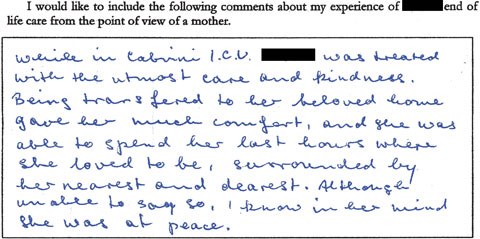
In her mother’s words:
While in Cabrini ICU, [my daughter] was treated with the utmost care and kindness. Being transferred to her beloved home gave her much comfort, and she was able to spend her last hours where she loved to be, surrounded by her nearest and dearest. Although unable to say so, I know in her mind, she was at peace.
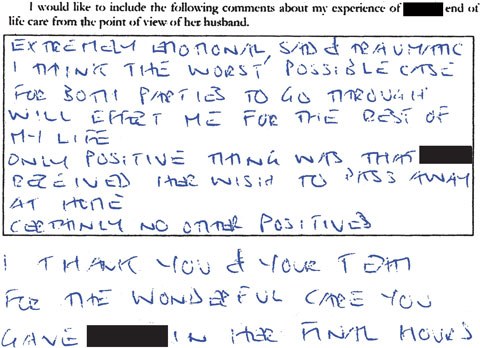
In her husband’s words:
Extremely emotional, sad and traumatic. I think the worst possible case for both parties to go through. Will affect me for the rest of my life. Only positive thing was that [my wife] received her wish to pass away at home. Certainly no other positives. I thank you and your team for the wonderful care you gave [my wife] in her final hours.
Conclusion
It is uncommon for a patient to be transferred home from ICU for palliative care in Australia. The ability to meet the patient and family’s preferences is a strong predictor of quality of death. It may be as important as the place of death.8 Our positive therapeutic relationship and the ability to achieve home palliation may both have contributed to the quality of death for this patient.
The experience of granting this woman’s last request had a positive impact on the hospital community, but the impact on her closest family was mixed. Her mother was anxious in anticipation, but relieved and grateful in retrospect. Her husband had lasting misgivings about the process. It may become a standard of care to include discussion regarding home palliation for ICU patients, but the potential effect on staff, relatives and friends should be considered carefully.
We suggest that the patient, nearest family members, the GP and other specialists, including ICU and palliative care specialists, should be involved in the decision and in the actual process of home palliation. An ICU specialist should be present during transfer and during the initial few hours at home. Afterwards, care can be handed over to the palliative care team with the GP’s involvement, especially if there is likely to be a prolonged course of care.
Competing interests
No relevant disclosures.
Acknowledgements
We are very thankful to the patient’s family for their generosity in allowing us to share this important story with our colleagues.
References
- Kehl KA. Moving toward peace: an analysis of the concept of a good death. Am J Hosp Palliat Care 2006; 23: 277-286. i1115631
- Yang L, Sakamoto N, Marui E. A study of home deaths in Japan from 1951 to 2002. BMC Palliat Care 2006; 5: 2. i1115633
- Beuks BC, Nijhof AC, Meertens JH, et al. A good death. Intensive Care Med 2006; 32: 752-753. i1115635
- Boussarsar M, Bouchoucha S. Dying at home: cultural and religious preferences. Intensive Care Med 2006; 32: 1917-1918.
- Hawdon JM, Williams S, Weindling AM. Withdrawal of neonatal intensive care in the home. Arch Dis Child 1994; 71: F142-F144.
- Huang YC, Huang SJ, Ko WJ. Going home to die from surgical intensive care units. Intensive Care Med 2009; 35: 810-815. i1115639
- Kallel H, Dammak H, Bahloul M, et al. A good death: another break in the wall. Intensive Care Med 2006; 32: 1915-1916.
- Kumar G, Obuch S, Vyakarnam P. Withdrawal of intensive care treatment at home — ‘a good death’. Anaesth Intensive Care 2009; 37: 484-486. i1115642
- Mann S, Galler D, Williams P, Frost P. Caring for patients and families at the end of life: withdrawal of intensive care in the patient’s home. N Z Med J 2004; 117: U935. i1115644
- Ryder-Lewis M. Going home from ICU to die: a celebration of life. Nurs Crit Care 2005; 10: 116-121. i1115647
- Lusardi P, Jodka P, Stambovsky M, et al. The going home initiative: getting critical care patients home with hospice. Crit Care Nurse 2011; 31: 46-57. i1115649
- Cicely Saunders Institute. Palliative care outcome scale. http://www.csi.kcl.ac.uk/pos.html (accessed Jul 2012).
Mending the Road: A Way Forward From Silence and Silencing
Ayman Hamdan, Anisa J. N. Jafar
Seven Vessel Spontaneous Coronary Artery Dissection and Concurrent Transient Global Amnesia After an Emotional Trigger
Michael J. Stewart, Tom R. Sutherland
Seven Vessel Spontaneous Coronary Artery Dissection and Concurrent Transient Global Amnesia After an Emotional Trigger
Virginia Barbour
Research Priority Setting Is Not Research: A Call for Ethical Clarity in Australia
Bec Jenkinson, Gordon McGurk, Jonathan Quicke, Janelle Bowden, Nadine E. Foster
Organ Donation After Oral Ingestion of a Voluntary Assisted Dying Substance
Joanne Kantianis, Helen I. Opdam, Rohit L. D'Costa
Equity, Diversity and Inclusion From the Start: Reforming Australia's Research Infrastructure for Inclusive Participation
Danielle M. Muscat, Kirsten J. McCaffery, Heather L. Shepherd, Marguerite Tracy