




Volume 197 - Issue 8
Botulinum toxin type A should be PBS listed for treatment of palmar hyperhidrosis
Authors: Ingrid C Chung and Bruce C L McGeorge
Med J Aust 2012; 197 (8): 445. || doi: 10.5694/mja12.11150
Published online: 15 October 2012
Published online: 15 October 2012
To the Editor: Hyperhidrosis is uncontrollable, excessive sweating. Severe primary focal palmar hyperhidrosis is a significant disability. It interferes with many activities of daily living and induces social avoidance behaviours that can lead to symptoms of social anxiety disorder. Symptoms begin in childhood or around puberty and affect both sexes equally.1
There are a number of treatments for palmar hyperhidrosis, which have varying degrees of success. ...
To the Editor: Hyperhidrosis is uncontrollable, excessive sweating. Severe primary focal palmar hyperhidrosis is a significant disability. It interferes with many activities of daily living and induces social avoidance behaviours that can lead to symptoms of social anxiety disorder. Symptoms begin in childhood or around puberty and affect both sexes equally.1
There are a number of treatments for palmar hyperhidrosis, which have varying degrees of success. Medical treatments are temporary and include topical aluminium chloride and tap water iontophoresis. Surgical sympathectomy is a longer-term option with intrinsic risks.
Botulinum toxin type A (BTX-A) is an effective treatment for palmar hyperhidrosis. BTX-A acts by blocking acetylcholine release at the neuro-muscular junction, inhibiting the transmission of nerve signals that trigger sweating.2 It lasts for about 6 months, although it has been reported to last for up to 12 months.3 It has relatively few side effects, and is long lasting in comparison with other medical treatments.
BTX-A treatment is available under the Pharmaceutical Benefits Scheme (PBS) for axillary hyperhidrosis, but not for palmar hyperhidrosis.
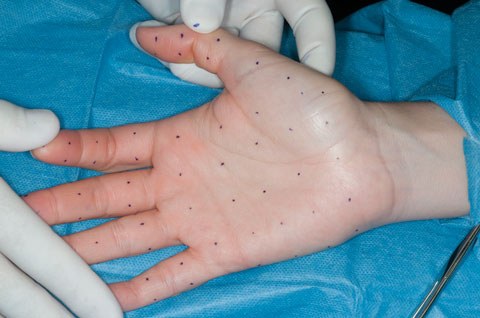
Recently two patients with palmar hyperhidrosis underwent BTX-A treatment at the Royal Darwin Hospital. BTX-A was injected into multiple injection sites over the palm, palmar surface of the fingers and thumb, and along the ulnar border of the dominant hand in the subepidermal plane (Box). The patients completed the Dermatology Life Quality Index (DLQI) before treatment and 2 weeks afterwards. Both patients had a substantial improvement in their DLQI score. One patient wrote an unsolicited letter detailing the benefits she found after treatment.
A patient’s constant awareness of such a condition affecting them impacts on all domains of their life: functional, social, personal and emotional. Our patients described a multitude of difficulties with practical tasks as well as social interaction when living with palmar hyper-hidrosis. It is a condition that can be ameliorated with subepidermal BTX-A treatment. It is disappointing that BTX-A is not available on the PBS for palmar hyperhidrosis, when such a straightforward procedure can have immense impact on the quality of life of those affected by this condition.
Competing interests
No relevant disclosures.
References
- Fealey RD, Hebert AA. Disorders of the eccrine sweat glands and sweating. In: Goldsmith LA, Katz SI, Gilchrest BA, et al, editors. Fitzpatrick’s dermatology in general medicine. 8th ed. New York: McGraw-Hill, 2012: 936-946. BABDAAHB
- Bhidayasiri R, Truong D. Expanding use of botulinum toxin. J Neurol Sci 2005; 235: 1-9. CBBJHFFI
- Shelley WB, Talanin NY, Shelley ED. Botulinum toxin therapy for palmar hyperhidrosis. J Am Acad Dermatol 1998; 38: 227-229. i1142874
Diagnosing Acute Kava Dermopathy: A Case Report of a Characteristic Cutaneous Eruption
Ali Abid, Nicholas Allen, Abeer Hagelamin, Christopher Henderson, Artiene Tatian
Localised Herpes Simplex Following Midline Laparotomy
Jessica S. Bulluss, Paul Chee, Matthew J. Verheyden
No silver lining with health misinformation: argyria caused by intentional silver consumption
Luke Collins, Logesh Palanikumar, Stephen Bacchi
Lingual Raynaud phenomenon
Michael Taggart, Mina John
Melasma in the male: a less well recognised entity
Tim Aung, Rowland Noakes
Age group‐specific changes in keratinocyte cancer treatment rates in Australia, 2012–2021: a retrospective cohort study based on MBS claims data
Catherine M Olsen, Nirmala Pandeya, Rachel E Neale, David C Whiteman