




Volume 197 - Issue 6
Chromoblastomycosis in a Solomon Islander
Authors: James Knox and Caroline Marshall
Med J Aust 2012; 197 (6): 350. || doi: 10.5694/mja12.10006
Published online: 17 September 2012
Published online: 17 September 2012
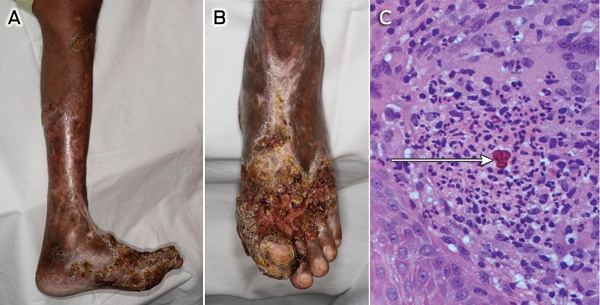
A 71-year-old farmer from the Solomon Islands presented in Melbourne with fungating skin lesions on his left lower leg. The process began 20 years earlier, leaving areas of scarring between the active sites (Figure, A and B). He was otherwise well.
A skin biopsy showed granulomatous inflammation with sclerotic bodies characteristic of chromoblastomycosis (Figure, C), and Fonsecaea pedrosoi was subsequently cultured and confirmed by ribosomal DNA internal ...
A 71-year-old farmer from the Solomon Islands presented in Melbourne with fungating skin lesions on his left lower leg. The process began 20 years earlier, leaving areas of scarring between the active sites (Figure, A and B). He was otherwise well.
A skin biopsy showed granulomatous inflammation with sclerotic bodies characteristic of chromoblastomycosis (Figure, C), and Fonsecaea pedrosoi was subsequently cultured and confirmed by ribosomal DNA internal transcribed spacer sequencing. Treatment combining surgical debridement, terbinafine and itraconazole is planned.
Although chromoblastomycosis occurs in the tropics worldwide, it is seldom reported in Pacific Island nations.1 Advanced presentations such as this are not uncommon in endemic areas.2
Acknowledgements
We are grateful to Karin Leder and Robert Commons for their assistance with the manuscript, and to the microbiology staff of the Royal Melbourne Hospital, the Austin Hospital and Westmead Hospital for their support.
References
- Woodgyer AJ, Bennetts GP, Rush-Munro FM. Four non-endemic New Zealand cases of chromoblastomycosis. Australas J Dermatol 1992; 33: 169-176. 0_CHDHCEEE
- Queiroz-Telles F, Esterre P, Perez-Blanco M, et al. Chromoblastomycosis: an overview of clinical manifestations, diagnosis and treatment. Med Mycol 2009; 47: 3-15. 0_i1115589
Costs of Delivering the Hep B PAST Model of Care in Remote Australia: A Retrospective Pre–Post Study
Hoa Nguyen, Anh Le Tuan Nguyen, Paula Binks, Melita McKinnon, Emily Vintour-Cesar, Karen Wills, Nicola Stephens, Benjamin Cowie, Joshua S. Davis, Yuejen Zhao, Peter Nihill, Julie A. Campbell, Andrew J. Palmer, Jane Davies, Barbara de Graaff
Buruli Ulcer Acquired From Ringtail Possum Rescue
Daniel P. O'Brien, Naomi Clarke, Sara Bonnici, Mohammad A. Hussain
Q Fever Visceral Abscesses After Contact With Native Australian Marsupials
Samantha J. Laws, Enzo Binotto, James Stewart, Jennifer Ho, Trent Yarwood, Josh Hanson, Simon Smith
Hospital-Admitted Injection-Related Infections Among Incarcerated People Who Inject Drugs in Australia: A Retrospective Cohort Study
Andrew Palmer, Matthew Carter, Jeremy Yeo, Cecilia Shim, Jason Connor, Jeremy Hayllar, Gerald Holtmann, Naomi Moy, Elliott G. Playford, Naomi Runnegar, Paul J. Clark
The Live Attenuated Influenza Vaccine in Australia: An Additional Tool for Influenza Prevention
Cyra Patel, Alexis Pillsbury, Tran Nguyen, Xia Wang, Helen E. Quinn, Clayton K. Chiu, Allen C. Cheng, Katie L. Flanagan, Zhicheng Wang
Reflex Testing for Hepatitis D Infection: A Unique Opportunity to Reduce Hepatitis D-Related Chronic Liver Disease Deaths in Australia
Jessica Howell, Lauren Andersson, Miriam T. Levy, James O'Beirne, Leon Adams, Katharine Irvine, Avik Majumdar, Golo Ahlenstiel, Kathy Jackson, Krispin Hajkowicz, Joseph Doyle, Jane Davies, Sarah Cherian, Wayne Dimech, Alexander J. Thompson