




Volume 197 - Issue 5
Listening to what Indigenous people in remote communities say about alcohol restrictions and cannabis use: “Good thing that the alcohol’s gone, but the gunja has kept going”
Authors: Alan R Clough, Cape York Cannabis Project Team
Med J Aust 2012; 197 (5): 275. || doi: 10.5694/mja12.10343
Published online: 3 September 2012
Published online: 3 September 2012
In Cape York Indigenous communities, alcohol restrictions started in 2002-2003, with local prohibition in some communities since 2008. These restrictions may have halved alcohol-related injuries, a historically important change. However, residents of Cape York Indigenous communities suggest that there has been an accompanying rise in cannabis use over this period. During consultations in 2011 for Minister Macklin’s controversial Stronger Futures in ...
To the Editor: In Cape York Indigenous communities, alcohol restrictions started in 2002–2003, with local prohibition in some communities since 2008.1 These restrictions may have halved alcohol-related injuries,1 a historically important change. However, residents of Cape York Indigenous communities suggest that there has been an accompanying rise in cannabis use over this period (Box 1). During consultations in 2011 for Minister Macklin’s controversial Stronger Futures in the Northern Territory Act 2012, concerns about cannabis use were also raised by Northern Territory Aboriginal people.2 While the Northern Territory Emergency Response2 (NTER) promised stronger alcohol restrictions, the concerns of Aboriginal people about cannabis use in their communities have been ignored.
Some observers are concerned that the positive effects of NTER alcohol restrictions may be undermined if these controls are blamed for causing an epidemic of cannabis use.3 Unfortunately, in the NT, links between recent alcohol restrictions and cannabis use cannot be established retrospectively, because alcohol has generally been controlled in remote communities since 1978 under the restricted area provisions of the NT Liquor Act 1978.3 This predates a documented rise in cannabis use from the mid to late 1990s in remote NT communities.4 But in Cape York, alcohol restrictions commenced after cannabis was introduced, so possible links can be investigated.
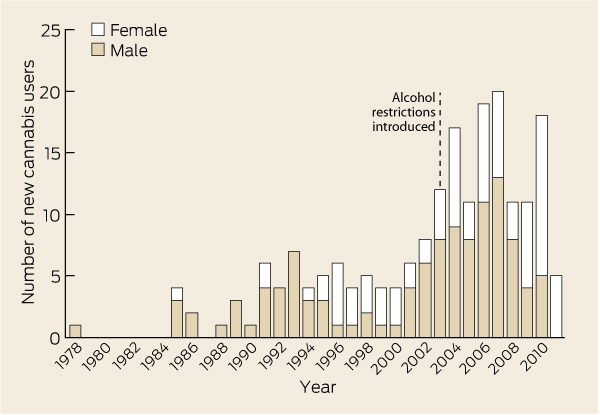
In three Cape York communities where alcohol was abruptly restricted in mid 2003 and prohibited in 2008, we recently interviewed 431 people aged 15–49 years about cannabis. This provided the first opportunity to understand the effect of alcohol restrictions on cannabis use with quantitative data. The number of people taking up cannabis increased markedly after 2003 across the communities (Box 2) (incidence rate ratio [IRR], 2.93; 95% CI, 2.20–3.91; P < 0.001). A concerning number of women began using cannabis after alcohol restrictions were introduced (IRR, 4.51; 95% CI, 2.60–7.83; P < 0.001), and there has been a significant increase in the number of men taking up cannabis (IRR, 2.81; 95% CI, 2.11–3.74; P < 0.001) (Box 2).
Most of our interview group were aged less than 25 years. Recent data links cannabis use with psychosis in more than 50% of patients in Cape York.5 Much attention is rightly focused on controlling alcohol consumption in remote Indigenous communities. Indigenous people in both NT and Cape York communities have expressed concern about interlinked substance misuse issues and, particularly in Cape York, the impact on crucial segments of the population (young women and their children). Immediate, inclusive policy review is required to address these concerns.
1 Statements made by 15–49-year-old survey participants from three remote Cape York Indigenous communities
“Good thing that the alcohol’s gone, but the gunja has kept going.”
“Since the alcohol management plans gunja is becoming more in the community. Even people who never used to smoke, young and old, the ones who used to hunt now smoke.”
“Hanging for a drink so have a smoke to relax — even people who never smoked.”
“I can’t have a beer so I have a cone each afternoon.”
“It’s easier to smoke [cannabis] than get a drink in a dry community.”
“Two sisters and one sister-cousin smoke and get stressed out when they don’t have it. They get angry with mum. They smoke more with alcohol restrictions.”
Competing interests
No relevant disclosures.
Acknowledgements
The Cape York Cannabis Project Team includes Susan Jacups, Jan Robertson, Bernadette Rogerson and Veronica Graham. These individuals are co-authors of the letter. We wish to thank shire councils and community organisations that support the research, and the entire Cape York Cannabis Project Team for data collection, comments on the letter and statistical analysis. This research is supported by National Health and Medical Research Council Project Grant #601002. Ethics approval was provided by the Cairns and Hinterland Health Service District Ethics Committee and the James Cook University Human Research Ethics Committee.
References
- Margolis SA, Ypinazar VA, Muller R, Clough AR. Increasing alcohol restrictions and rates of serious injury in four remote Australian Indigenous communities. Med J Aust 2011; 194: 503-506. 0_BABEBCAE
- Australian Government. Stronger futures in the Northern Territory report on consultations October 2011. http://www.indigenous.gov.au/wp-content/uploads/2011/10/consult_1710111.pdf (accessed Feb 2012).
- Gray DA. The Northern Territory Emergency Response and cannabis use in remote Indigenous communities [letter]. Med J Aust 2010; 192: 555. 0_i1142894
- Clough AR, Cairney S, Maruff P, Parker R. Rising cannabis use in Indigenous communities [letter]. Med J Aust 2002; 177: 395-396. 0_i1142897
- Hunter EM, Gynther BD, Anderson CJ, et al. Psychosis in Indigenous populations of Cape York and the Torres Strait. Med J Aust 2012; 196: 133-135. 0_i1142899
Costs of Delivering the Hep B PAST Model of Care in Remote Australia: A Retrospective Pre–Post Study
Hoa Nguyen, Anh Le Tuan Nguyen, Paula Binks, Melita McKinnon, Emily Vintour-Cesar, Karen Wills, Nicola Stephens, Benjamin Cowie, Joshua S. Davis, Yuejen Zhao, Peter Nihill, Julie A. Campbell, Andrew J. Palmer, Jane Davies, Barbara de Graaff
Epidemiology and Quality of Care for Aboriginal and Torres Strait Islander Peoples Treated by Emergency Medical Services for Stroke in Victoria, Australia: Retrospective Analysis of Linked Data
Candice Menezes, Ziad Nehme, Luke J. Burchill, Tegwyn McManamny, Angela Dos Santos, Michelle Crilly, Luke P. Dawson, Benjamin Clissold, David Anderson, Emily Nehme
Hepatitis C Among First Nations Australians: A Rethink Is Required to Meet the 2030 Elimination Target
James Ward, Emily Pegler, Kellie Stacy, Stephen Harfield
Sovereignty and Survival: Understanding Lung Cancer Outcomes for Aboriginal and Torres Strait Islander People in Australia, a Case–Control Study
Alice R. T. Bergin, Luc te Marvelde, Roger L. Milne, Benjamin J. Solomon, Kris Ivanova, Peter Savas, Stephen J. Luen, Jay Hamann, Andrea Casey, Nicole Watt, Sue M. Evans, Gail Garvey, Sherene Loi
Rethinking Rheumatic Fever Diagnosis: Progress, Pitfalls and the Path Towards a Definitive Test
Anna P. Ralph, Rachel Webb, Tom Parks, Nicole J. Moreland, Asha C. Bowen, Benjamin Jones, Emma Ndagire, Andrea Z. Beaton
Not Gone but Often Forgotten: Action Needed to Address Tuberculosis in Aboriginal and Torres Strait Islander Communities
Nikkita Joshua, Emma L. Smith, Eunice (Cheeky) Love, Christopher P. Lowbridge, Nicole Tukana, Amy Bowden, Megan A. Campbell, Dawn Casey, James Ward