




Volume 197 - Issue 2
Desvenlafaxine-induced myositis with positive medication rechallenge
Authors: Maximilian Stephens, Jeffrey T J Rowland and Anis Zand Irani
Med J Aust 2012; 197 (2): 91-92. || doi: 10.5694/mja12.10503
Published online: 16 July 2012
Published online: 16 July 2012
To the Editor: A 23-year-old woman presented to the emergency department with bilateral pain, swelling and loss of power in her upper arms, which had started that morning. She had no history of significant trauma. Her medical history was significant for Wolff-Parkinson-White syndrome, diagnosed 3 weeks earlier at the same institution, and mild depression, diagnosed 8 months earlier, for which she had been taking desvenlafaxine (50 mg daily ...
To the Editor: A 23-year-old woman presented to the emergency department with bilateral pain, swelling and loss of power in her upper arms, which had started that morning. She had no history of significant trauma. Her medical history was significant for Wolff–Parkinson–White syndrome, diagnosed 3 weeks earlier at the same institution, and mild depression, diagnosed 8 months earlier, for which she had been taking desvenlafaxine (50 mg daily for the first 4 months, and then 100 mg daily until her presentation). She had no known adverse drug reactions.
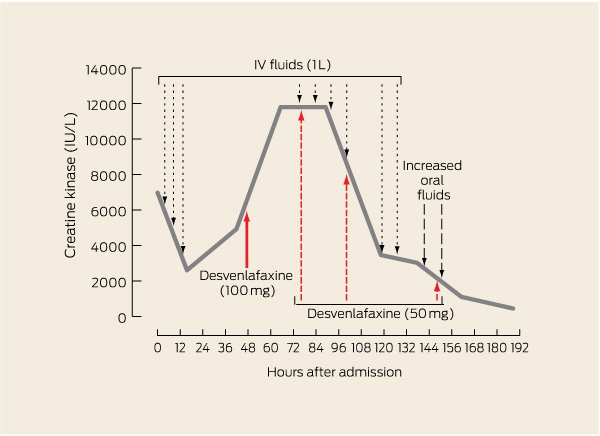
After the patient was admitted for investigations, her initial creatine kinase (CK) level was reported as 6970 IU/L (reference interval 43–145 IU/L). Venous thrombosis was ruled out with ultrasonography; however, bilateral muscle oedema was noted. She stopped taking the desvenlafaxine, and intravenous fluid therapy was initiated. Results of further investigations were normal for C-reactive protein, white cells, urine myoglobin, rheumatoid factor, and the following antibody tests: anti-SSA/Ro, anti-SSB/La, anti-ribonucleic protein, anti-Sm (Smith), anti-Sc170, anti-Jo-1, cytoplasmic and perinuclear antineutrophil cytoplasmic antibodies, and smooth muscle and mitochondrial antibodies. The patient’s CK levels and fluids were closely monitored during her admission (Box).
On Day 3 of admission, the patient experienced prominent physical withdrawal symptoms, necessitating that she take her usual 100 mg dose of desvenlafaxine. This resulted in an exacerbation of swelling to the forearms and upper arms, loss of muscle power, increased pain and a rising CK level. The patient was reviewed with the suspicion of an adverse drug reaction. Her dose of desvenlafaxine was tapered, and she successfully commenced therapy with escitalopram (10 mg daily), with no further adverse drug reactions to date. Outpatient electromyography on Day 9 showed findings consistent with upper-limb myositis.
Myositis is not listed as a potential adverse reaction in the product information for desvenlafaxine, and has since been reported to the Therapeutic Goods Administration. This case scored 9 (definite adverse drug reaction) on the scale proposed by Naranjo and colleagues for the likelihood of causality in suspected adverse drug reactions.1 After a comprehensive search on MEDLINE, it was noted that a single case of myositis has been reported for therapeutic levels of venlafaxine,2 desvenlafaxine being the active metabolite of this parent drug. Rhabdomyolysis has been reported several times for above-therapeutic venlafaxine levels.3,4 This case describes a rare adverse drug reaction for the drug desvenlafaxine. We urge practitioners to be aware of this when prescribing this drug.
Competing interests
No relevant disclosures.
References
- Naranjo CA, Busto U, Sellers EM, et al. A method for estimating the probability of adverse drug reactions. Clin Pharmacol Ther 1981; 30: 239-245. 0_CHDEFIEA
- Jewell DP, Thompson IW, Sullivan BA, Bondeson J. Reversible focal myositis in a patient taking venlafaxine. Rheumatology (Oxford) 2004; 43: 1590-1593. 0_i1142870
- Oliver JJ, Kelly C, Jarvie D, et al. Venlafaxine poisoning complicated by a late rise in creatinine kinase: two case reports. Hum Exp Toxicol 2002; 21: 463-466. 0_CBBCEBHE
- Pascale P, Oddo M, Pacher P, et al. Severe rhabdomyolysis following venlafaxine overdose. Ther Drug Monit 2005; 27: 562-564. 0_i1142875