




Volume 197 - Issue 10
Influenza vaccination uptake in an Australian hospital: time to make it mandatory for health care workers?
Authors: Vivian K Y Leung, Susan E Harper and Monica A Slavin
Med J Aust 2012; 197 (10): 552. || doi: 10.5694/mja12.11199
Published online: 19 November 2012
Published online: 19 November 2012
Some facilities in the United States have enforced a mandatory influenza vaccination policy with punitive action for noncompliance, resulting in sustained vaccination rates of above 97%.
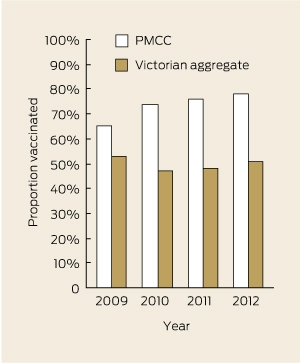
To the Editor: Poor influenza vaccination uptake among Australian health care workers has recently come under scrutiny in the media.1 The Australian immunisation handbook recommends influenza vaccination for all health care workers to prevent influenza transmission to patients and other staff.2 Despite this recommendation, the proportion of health care workers vaccinated has remained low across Victoria.3 Nevertheless, the Peter MacCallum Cancer Centre (PMCC) — a tertiary facility in Melbourne, Vic, responsible for the care of immunocompromised cancer patients — has recorded increasing vaccination uptake across four consecutive influenza seasons (Box). During our 2012 staff influenza vaccination program, overall vaccination uptake was 78% (1666/2138 employed staff); 76% and 88% among medical and nursing staff, respectively.
The vaccination program at the PMCC was delivered using a multistrategy approach. Executive endorsement, liaison with union representatives and targeted education ensured the support of managers, heads of department and other hospital staff. Intensive campaigning involved displaying posters, distributing the program timetable with employee payslips and emailing news articles. A vaccination clinic was held for 3 weeks, after which vaccination was provided by the infection control unit for 3 months. Weekend clinics and mobile vaccination services were available throughout the program.
A staff vaccination database was used to track vaccination and refusal rates. Since 2009, it has been mandatory for staff who do not wish to be vaccinated to complete a declination form. Although supervisors are provided with a weekly list of unvaccinated personnel, no punitive action is taken against staff who decline. Of all refusals at our centre, 14% were for medical reasons.
Despite having recorded our highest vaccination uptake to date, with rates in excess of Victorian trends, we consider there is room for improvement. This is particularly important, given the immuno-suppressed patient population managed at our centre. Some facilities in the United States have enforced a mandatory influenza vaccination policy with punitive action for non-compliance, resulting in sustained vaccination rates of above 97%.4 While barriers to implementation of mandatory vaccination have been previously identified,5 such policies have increased vaccination uptake among staff who decline because of personal preference.6 To our knowledge, no Victorian centre has employed such a strategy. We believe that mandating vaccination would improve and sustain its uptake among health care workers. National policy consensus is needed to assist this process.
Competing interests
No relevant disclosures.
Acknowledgements
Acknowledgement: We thank the VICNISS Healthcare Associated Infection Surveillance System Coordinating Centre (fully funded by the Department of Health Victoria) for providing pooled influenza vaccination data.
References
- Miller N. Hospital flu risk to patients. The Age (Melbourne) 2012; 15 Jul. 0_CHDFGEBH
- Australian Government Department of Health and Ageing. Australian immunisation handbook. 9th ed. 2008. http://www.health.gov.au/internet/immunise/publishing.nsf/content/handbook-home (accessed Jul 2012).
- Bull AL, Bennett N, Pitcher HC, et al. Influenza vaccine coverage among health care workers in Victorian public hospitals. Med J Aust 2007; 186: 185-186. 0_CBBHFGDH
- Rakita RM, Hagar BA, Crome P, et al. Mandatory influenza vaccination of healthcare workers: a 5-year study. Infect Control Hosp Epidemiol 2010; 31: 881-888. 0_i1142881
- Talbot TR, Babcock H, Caplan AL, et al. Revised SHEA position paper: influenza vaccination of healthcare personnel. Infect Control Hosp Epidemiol 2010; 31: 987-995. 0_pgfId-2682946
- Quan K, Tehrani DM, Dickey L, et al. Voluntary to mandatory: evolution of strategies toward influenza vaccination of healthcare personnel. Infect Control Hosp Epidemiol 2012; 33: 63-70. 0_i1142887
Costs of Delivering the Hep B PAST Model of Care in Remote Australia: A Retrospective Pre–Post Study
Hoa Nguyen, Anh Le Tuan Nguyen, Paula Binks, Melita McKinnon, Emily Vintour-Cesar, Karen Wills, Nicola Stephens, Benjamin Cowie, Joshua S. Davis, Yuejen Zhao, Peter Nihill, Julie A. Campbell, Andrew J. Palmer, Jane Davies, Barbara de Graaff
Buruli Ulcer Acquired From Ringtail Possum Rescue
Daniel P. O'Brien, Naomi Clarke, Sara Bonnici, Mohammad A. Hussain
Q Fever Visceral Abscesses After Contact With Native Australian Marsupials
Samantha J. Laws, Enzo Binotto, James Stewart, Jennifer Ho, Trent Yarwood, Josh Hanson, Simon Smith
Hospital-Admitted Injection-Related Infections Among Incarcerated People Who Inject Drugs in Australia: A Retrospective Cohort Study
Andrew Palmer, Matthew Carter, Jeremy Yeo, Cecilia Shim, Jason Connor, Jeremy Hayllar, Gerald Holtmann, Naomi Moy, Elliott G. Playford, Naomi Runnegar, Paul J. Clark
The Live Attenuated Influenza Vaccine in Australia: An Additional Tool for Influenza Prevention
Cyra Patel, Alexis Pillsbury, Tran Nguyen, Xia Wang, Helen E. Quinn, Clayton K. Chiu, Allen C. Cheng, Katie L. Flanagan, Zhicheng Wang
Reflex Testing for Hepatitis D Infection: A Unique Opportunity to Reduce Hepatitis D-Related Chronic Liver Disease Deaths in Australia
Jessica Howell, Lauren Andersson, Miriam T. Levy, James O'Beirne, Leon Adams, Katharine Irvine, Avik Majumdar, Golo Ahlenstiel, Kathy Jackson, Krispin Hajkowicz, Joseph Doyle, Jane Davies, Sarah Cherian, Wayne Dimech, Alexander J. Thompson