




Volume 196 - Issue 8
Extensive cystic hydatid disease
Authors: Melanie C Figtree, Matthew R Watts, Robyn Timmins, Ross Smith and Bernard J Hudson
Med J Aust 2012; 196 (8): 520. || doi: 10.5694/mja11.11570
Published online: 7 May 2012
Published online: 7 May 2012
A 46-year-old woman, who had lived in rural Australia as a child, presented with abdominal distension, jaundice and cachexia. Abdominal computed tomography showed extensive cystic disease of the liver, peritoneum, ovaries and uterus; well circumscribed coarsely calcified cysts were visible in the abdomen and pelvis (Figure A). Results of hydatid serological testing were consistent with ...
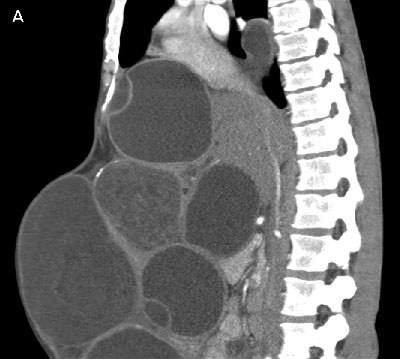
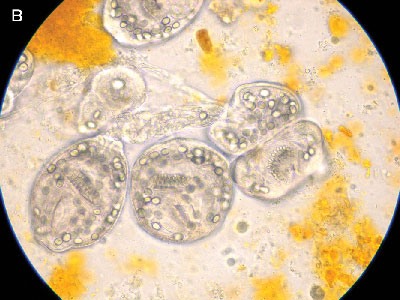
A 46-year-old woman, who had lived in rural Australia as a child, presented with abdominal distension, jaundice and cachexia. Abdominal computed tomography showed extensive cystic disease of the liver, peritoneum, ovaries and uterus; well circumscribed coarsely calcified cysts were visible in the abdomen and pelvis (Figure A). Results of hydatid serological testing were consistent with Echinococcus granulosus infection (indirect haemagglutination titre, 256). The patient was managed with preoperative albendazole therapy, extensive surgical excision, hypertonic saline irrigation, and decompression of the ruptured left hepatic duct with a T-tube. Microscopy of cystic fluid aspirated during surgery showed viable evaginating protoscolices (Figure B; original magnification, × 400). Long-term suppressive therapy — albendazole 400 mg twice daily plus praziquantel 40 mg/kg twice weekly — was initiated with good effect.
Costs of Delivering the Hep B PAST Model of Care in Remote Australia: A Retrospective Pre–Post Study
Hoa Nguyen, Anh Le Tuan Nguyen, Paula Binks, Melita McKinnon, Emily Vintour-Cesar, Karen Wills, Nicola Stephens, Benjamin Cowie, Joshua S. Davis, Yuejen Zhao, Peter Nihill, Julie A. Campbell, Andrew J. Palmer, Jane Davies, Barbara de Graaff
Buruli Ulcer Acquired From Ringtail Possum Rescue
Daniel P. O'Brien, Naomi Clarke, Sara Bonnici, Mohammad A. Hussain
Q Fever Visceral Abscesses After Contact With Native Australian Marsupials
Samantha J. Laws, Enzo Binotto, James Stewart, Jennifer Ho, Trent Yarwood, Josh Hanson, Simon Smith
Hospital-Admitted Injection-Related Infections Among Incarcerated People Who Inject Drugs in Australia: A Retrospective Cohort Study
Andrew Palmer, Matthew Carter, Jeremy Yeo, Cecilia Shim, Jason Connor, Jeremy Hayllar, Gerald Holtmann, Naomi Moy, Elliott G. Playford, Naomi Runnegar, Paul J. Clark
The Live Attenuated Influenza Vaccine in Australia: An Additional Tool for Influenza Prevention
Cyra Patel, Alexis Pillsbury, Tran Nguyen, Xia Wang, Helen E. Quinn, Clayton K. Chiu, Allen C. Cheng, Katie L. Flanagan, Zhicheng Wang
Reflex Testing for Hepatitis D Infection: A Unique Opportunity to Reduce Hepatitis D-Related Chronic Liver Disease Deaths in Australia
Jessica Howell, Lauren Andersson, Miriam T. Levy, James O'Beirne, Leon Adams, Katharine Irvine, Avik Majumdar, Golo Ahlenstiel, Kathy Jackson, Krispin Hajkowicz, Joseph Doyle, Jane Davies, Sarah Cherian, Wayne Dimech, Alexander J. Thompson