




Volume 196 - Issue 7
Human papillomavirus vaccination and cervical cancer screening by socioeconomic status, Victoria
Authors: Bianca Barbaro, Julia M L Brotherton and Dorota M Gertig
Med J Aust 2012; 196 (7): 445. || doi: 10.5694/mja11.11360
Published online: 16 April 2012
Published online: 16 April 2012
To the Editor: From 2007 to 2009 in Australia, a three-dose course of quadrivalent human papillomavirus (HPV) vaccine was offered to all females aged 12-26 years through school and primary health care settings, with coverage recorded on the ...
To the Editor: From 2007 to 2009 in Australia, a three-dose course of quadrivalent human papillomavirus (HPV) vaccine was offered to all females aged 12–26 years through school and primary health care settings, with coverage recorded on the National HPV Vaccination Program Register (NHVPR).
Women of lower socioeconomic status are at higher risk of cervical cancer in Australia.1 Inequities in cervical cancer screening have also been recognised by numerous studies nationally and internationally.1-3 If females in lower socioeconomic groups have lower participation in HPV vaccination, existing inequities in cervical cancer risk could widen.
We analysed Victorian data on participation in HPV vaccination and cervical cancer screening (obtained from the NHVPR and the Victorian Cervical Cytology Registry) by socioeconomic status (based on Australian Bureau of Statistics 2006 Index of Relative Socio-economic Disadvantage for statistical local areas).
From 1 July 2006 to 30 June 2008, participation in cervical screening was 58.7% in the most disadvantaged areas compared with 68.9% in the least disadvantaged areas (Box 1). A strong association was found between living in an area with higher average socioeconomic status and higher cervical screening rates in Victoria (P < 0.001).
In contrast, HPV vaccination coverage from 2007 to 2009 showed a less pronounced socioeconomic gradient (Box 2). For the cohort of schoolgirls aged 12–17 years in 2007, three-dose coverage ranged from 73.1% in the most disadvantaged areas to 75.9% in the least disadvantaged areas (P < 0.001); for the cohort of women aged 18–26 years in 2007, coverage was 33.4% in the most disadvantaged areas and 38.0% in the least disadvantaged areas (P < 0.001).
The National Cervical Screening Program is delivered mainly through primary health care services by general practitioners and nurses. The government-funded HPV vaccination program, delivered through schools, has contributed to a fairly equitable uptake across Victoria. Similar results have been found in the United Kingdom, which also has a school-based program,4 but not in the United States, where vaccination is not school based and universal government funding is not provided.5
Prevention of cervical cancer using school-based vaccination programs may result in more equitable cervical cancer prevention for females across the community than screening as currently accessed in Victoria. This ecological analysis should be supplemented by local monitoring of HPV vaccination coverage within and between schools at the area level, to ensure a reduction in inequities in cervical cancer incidence and mortality.
1 Participation in the National Cervical Screening Program by quintile of socioeconomic disadvantage, Victoria, July 2006 – June 2008*
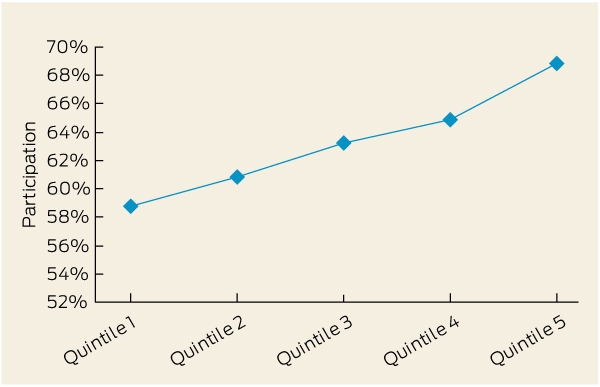
* Crude rates of women aged 20–69 years living in Victoria screened as a proportion of the eligible female population, calculated as 2-yearly participation rates as routine screening is recommended every 2 years. Numerators do not include those who had had a hysterectomy (according to Victorian Cervical Cytology Registry data). Denominators are Australian Bureau of Statistics estimated resident populations adjusted for estimated proportions of women who had had a hysterectomy using national hysterectomy fractions derived from the 2004–05 Australian Bureau of Statistics National Health Survey (sum of denominators = 1 470 589). Quintile 1 represents most disadvantaged areas; Quintile 5 represents least disadvantaged areas (based on residential address).
2 National HPV Vaccination Program coverage at March 2011 by quintile of socioeconomic disadvantage, Victoria, 2007–2009*
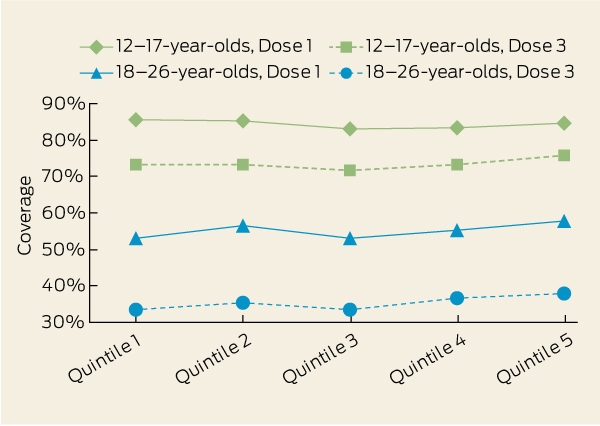
* Crude rates of females aged 12–26 years in 2007 (ie, those eligible for vaccination in the catch-up program) who received a dose during the catch-up program from 2007 to 2009 as a proportion of the eligible female population (sum of denominators = 205 612 for 12–17-year-olds; sum of denominators = 343 609 for 18–26-year-olds). Data extracted from the National HPV Vaccination Program Register in March 2011. Denominators are Australian Bureau of Statistics estimated resident populations. Girls aged 12–17 years were grouped to represent those vaccinated in school settings, and women aged 18–26 years represent those vaccinated in out-of-school settings. Quintile 1 represents most disadvantaged areas; Quintile 5 represents least disadvantaged areas (based on residential address).
Competing interests
Julia Brotherton and Dorota Gertig are investigators on an Australian Research Council Linkage Grant, for which CSL Biotherapies is a partner organisation. Julia Brotherton was an investigator on a national HPV prevalence study (2005–2008) that received funding from CSL Biotherapies and GlaxoSmithKline.
Acknowledgements
We thank Genevieve Chappell for provision of, and advice on, NHVPR data. The NHVPR is funded by the Australian Government. The Victorian Cervical Cytology Registry is funded by the Victorian Government. The NHVPR and Victorian Cervical Cytology Registry are operated by the Victorian Cytology Service.
References
- Australian Institute of Health and Welfare. Cervical screening in Australia 2007–2008. Canberra: AIHW, 2010. (AIHW Cat. No. CAN 50.) http://www.aihw.gov.au/publication-detail/?id=6442468364 (accessed Oct 2011).
- Taylor RJ, Mamoon HA, Morrell SL, Wain GV. Cervical screening by socio-economic status in Australia. Aust N Z J Public Health 2001; 25: 256-260. 0_pgfId-2511013
- Akers AY, Newmann SJ, Smith JS. Factors underlying disparities in cervical cancer incidence, screening, and treatment in the United States. Curr Probl Cancer 2007; 31: 157-181. 0_i1142886
- Desai S, Soldan K, White J, Gill ON. Human papillomavirus vaccine coverage. Lancet 2010; 376: 328-329. 0_i1142888
- Bach PB. Gardasil: from bench, to bedside, to blunder. Lancet 2010; 375: 963-964. 0_i1142891
Pharmaceutical Industry Payments to Patient Groups in Australia: A Longitudinal Analysis of a Decade of Disclosures
Ashleigh Hooimeyer, Annim Mohammad, Alice Fabbri, Lisa Parker, Kellia Chiu, Barbara Mintzes
Not Gone but Often Forgotten: Action Needed to Address Tuberculosis in Aboriginal and Torres Strait Islander Communities
Nikkita Joshua, Emma L. Smith, Eunice (Cheeky) Love, Christopher P. Lowbridge, Nicole Tukana, Amy Bowden, Megan A. Campbell, Dawn Casey, James Ward
Unshrouding Social Determinants: A Case for Standardised Data in Australia's Health Information Ecosystem
Christopher Ryan, Christine T. Shiner, Rebecca J. Harris, Carrie Lethborg, Vijaya Sundararajan
Inequity Is Our Biggest Killer: Looking Upstream to Tackle the Burden of Disease in Australia
Meggan J. Devery, Katie Brooker, Kitty-Rose Foley
Inequity Is Our Biggest Killer: Looking Upstream to Tackle the Burden of Disease in Australia
Lucio Naccarella, Katrina Plamondon, Alison Brown, Alexandra Kent, Sana Shahram, Donya Eghrari, Nicole M. Rankin, Stephanie Best, Marlena Klaic, Zoe Fehlberg, Michelle Lambert, Sue Crengle
Inequity Is Our Biggest Killer: Looking Upstream to Tackle the Burden of Disease in Australia
Saman Khalatbari-Soltani, Edward Jegasothy, Seye Abimbola, Anita van Zwieten