




Volume 196 - Issue 4
Stevens–Johnson syndrome after varicella vaccination
Authors: Elizabeth M Christou and Orli Wargon
Med J Aust 2012; 196 (4): 240-241. || doi: 10.5694/mja11.11484
Published online: 5 March 2012
Published online: 5 March 2012
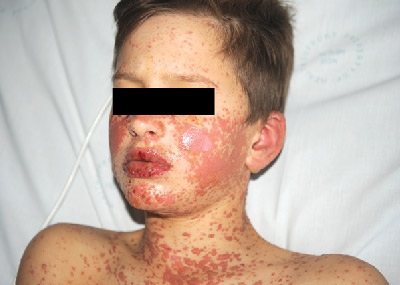
To the Editor: A 12-year-old boy presented to a regional emergency department with a 3-day history of progressing bilateral conjunctival injection, fevers (39°C), a widespread erythematous bullous rash, and superficial erosions to his lips, oral mucosa and urethral meatus.
The patient was admitted to hospital for management of Stevens–Johnson syndrome (SJS). Initial treatment included intravenous f luids, intravenous ceftriaxone and oral azithromycin before transfer to a tertiary referral hospital.
The patient had not taken any oral medications or over-the-counter therapies. He had no preceding viral symptoms. However, 2 weeks before onset of symptoms, he had received vaccination against varicella-zoster virus.
On Day 1 of admission, intravenous immunoglobulin (Intragam P, CSL, Melbourne, VIC; batch numbers 3740600696, 3740500668, 3740600690, 3740600679) was administered at a dose of 1 mg/kg and repeated 20 hours later. On Day 2, oral prednisolone therapy (1 mg/kg/day) was initiated and continued for 5 days, and antibiotics were administered for 8 days (cefotaxime [50 mg/kg] and azithromycin [10 mg/kg]). Mycoplasma pneumoniae serological testing of blood samples taken on admission was negative.
Bilateral conjunctival ulcers were managed with topical chloramphenicol eye ointment, topical 0.5% prednisone, lubricant drops and normal saline washes.
The patient developed further areas of bullae and erosions to his cheeks and ears (Box). He also developed palmar papules, and dusky finger tips and toes. Skin bullous lesions were managed with daily sterile aspiration, and erosions were managed with silver-impregnated silicone dressings (Mepilex Ag, Mölnlycke Health Care, Gothenburg, Sweden).
The patient’s rash and fevers abated, and he was discharged on Day 12 with advice from the dietitian and physiotherapy-assisted mobilisation. Sequelae at 2 months included cutaneous post-inflammatory hyperpigmentation.
SJS after varicella infection has been reported,1,2 and a single case after varicella vaccination was included in a case series of six possible cases of SJS after vaccinations.3 SJS after medication use or infection with M. pneumoniae is well documented; however, cases where no clear cause can be documented result in increased parental anxiety. This case of SJS was preceded by varicella-zoster vaccination performed as part of school protocol. In the absence of any other obvious cause, it has been reported to alert practitioners of the possibility of a link (Therapeutic Goods Administration adverse drug reaction no. 291111).
Competing interests
No relevant disclosures.
References
- Bay A, Akdeniz N, Calka O, et al. Primary varicella infection associated with stevens-johnson syndrome in a Turkish child. J Dermatol 2005; 32: 745-750. 0_i1142869
- Choy AC, Yarnold PR, Brown JE, et al. Virus induced erythema multiforme and Stevens Johnson syndrome. Allergy Proc 1995; 16: 157-161. 0_i1142871
- Ball R, Ball LK, Wise RP, et al. Stevens–Johnson syndrome and toxic epidermal necrolysis after vaccination: reports to the vaccine adverse event reporting system. Pediatr Infect Dis J 2001; 20: 219-223. 0_i1142875
Diagnosing Acute Kava Dermopathy: A Case Report of a Characteristic Cutaneous Eruption
Ali Abid, Nicholas Allen, Abeer Hagelamin, Christopher Henderson, Artiene Tatian
Localised Herpes Simplex Following Midline Laparotomy
Jessica S. Bulluss, Paul Chee, Matthew J. Verheyden
No silver lining with health misinformation: argyria caused by intentional silver consumption
Luke Collins, Logesh Palanikumar, Stephen Bacchi
Lingual Raynaud phenomenon
Michael Taggart, Mina John
Melasma in the male: a less well recognised entity
Tim Aung, Rowland Noakes
Age group‐specific changes in keratinocyte cancer treatment rates in Australia, 2012–2021: a retrospective cohort study based on MBS claims data
Catherine M Olsen, Nirmala Pandeya, Rachel E Neale, David C Whiteman