




Volume 196 - Issue 11
Your time starts now — translation time lines for major ophthalmic discoveries
Author: David A Mackey
Med J Aust 2012; 196 (11): 672-674. || doi: 10.5694/mja11.11322
Published online: 18 June 2012
Published online: 18 June 2012
Key performance indicators for medical research do not always indicate the long-term success of a treatmentTranslation into reduced morbidity and mortality is the ultimate measure of success for medical research. However, this may take decades and often researchers are dead before the full impact of their research is realised. Gregor Mendel’s research is an excellent example, with the most important publication in genetics remaining uncited ...
Key performance indicators for medical research do not always indicate the long-term success of a treatment
Translation into reduced morbidity and mortality is the ultimate measure of success for medical research. However, this may take decades and often researchers are dead before the full impact of their research is realised. Gregor Mendel’s research is an excellent example, with the most important publication in genetics remaining uncited for 30 years.1 The key performance indicators for medical research are publications and their citations — the number of papers published in peer-reviewed journals, the number of times these publications are cited, and the impact factor of the journal in which they are published.2
How long does it take for a key publication to translate into new treatments that reduce morbidity and mortality? Some treatments evolve via gradual improvements. For example, bone marrow transplantation was first proposed in 1957,3 but it was not until the 1980s that it became accepted treatment and successfully saved lives.4 Patient survival improved over the following 25 years, with further incremental advances expanding the medical indications and increasing the numbers of patients who benefit.
Funding bodies need to be aware of realistic bench-to-bedside time lines if they are to effectively engage with medical researchers to achieve real advances in treatments. However, little research regarding this aspect of medical research translation has been conducted. Focusing on ophthalmology, I investigated the time line for translation for: anti-vascular endothelial growth factor (anti-VEGF) agents for age-related macular degeneration (AMD), the leading cause of blindness in developed countries;5 the development of laser photocoagulation to treat diabetic retinopathy; intraocular lens (IOL) implantation for aphakia after extraction of cataract;5 maternal rubella as the cause of congenital cataract, the most highly cited article in 160 years of ophthalmic literature;6and the lead-up to the use of penicillin, which was first used to treat ophthalmia neonatorum.7
Major research translations in ophthalmology
Anti-VEGF therapy for AMD
Treatment of AMD with anti-VEGF agents is one of the greatest advances in ophthalmology. In 1971, Judah Folkman proposed a blocking drug8 against a vascular factor that had first been identified in 1945.9 In 2002, a rare eye cancer was treated with an anti-VEGF antibody with dramatic success10 and, in 2006, the ANCHOR (Anti-VEGF Antibody for the Treatment of Predominantly Classic Choroidal Neovascularization in Age-related Macular Degeneration) and MARINA (Minimally Classic/Occult Trial of the Anti-VEGF Antibody Ranibizumab in the Treatment of Neovascular AMD) studies showed the efficacy of anti-VEGF antibodies in the treatment of AMD.11,12 This treatment was so successful that an editorial published in The New England Journal of Medicine described it as miraculous!13 A search of the Web of Knowledge indexing service showed that more than half the top 20 most frequently cited articles in ophthalmology journals from 2005 to 2010 relate to anti-VEGF treatments. Folkman died just after the fruition of 35 years of work.
Lasers in ophthalmology, starting with diabetic retinopathy
Gerhard Meyer-Schwickerath first used sunlight coagulation to treat a retinal detachment in 1949.14 He went on to develop the Xenon arc light coagulator in the 1950s.15 The first functioning laser was developed in 196016 and laser’s utility as a surgical tool was recognised in 1965.17 The first major translation of laser in ophthalmology came in 1976, when laser treatment was shown to be effective for diabetic retinopathy in the Diabetic Retinopathy Study.18 Other lasers, such as the Nd:YAG and excimer lasers, expanded the scope of treatment. The translation time line from 1949 to 1976 is 27 years, and from 1960 to 1976 it is 16 years.
IOL implantation after cataract extraction
IOL development began with the serendipitous observation of an injured World War II fighter pilot who had part of the perspex (polymethyl methacrylate) from his aircraft cockpit canopy lodged in his eyeball. The eye tolerated the perspex quite well. This led Harold Ridley to develop a perspex IOL, first implanted in 1949, but the initial work was unpromising.19 Phakoemulsification, developed in the 1960s, provided a suitable method of cataract extraction to maximise the benefit of IOLs. Ridley met enormous opposition from the ophthalmic establishment. Because of high complication rates for inexperienced surgeons, Ralph Nader’s consumer organisation, Public Citizen, campaigned against IOLs, wanting them banned by the United States Food and Drug Administration.20 It was not until the early 1980s that IOLs became the standard of care — over 30 years after the first one was implanted.21 Before IOLs, the standard was to operate on people when the better eye deteriorated to a visual acuity of worse than 6/60. With many refinements to IOLs, ophthalmologists now operate on people with mild visual loss, such as a visual acuity better than 6/12 (the cut-off for driving in many countries). Ridley was belatedly recognised for his work and perseverance with a knighthood at the age of 93 years.
Vaccination for rubella embryopathy
Norman Gregg’s 1941 paper reporting the association of maternal rubella infection and congenital cataract6 is the most cited paper in an ophthalmic journal in over 160 years.22 The impact of rubella embryopathy is enormous; major epidemics in countries such as the US in the 1960s affected tens of thousands of pregnancies.23 Gregg was knighted in 1953 but died in 1966, before the final step in translating his discovery. The virus was isolated in 1962 and the rubella vaccine released in 1969, virtually eliminating this major health problem.23 The translation time line from 1941 to 1969 is 28 years.
Penicillin for infections
In the case of penicillin, bread with a blue mould to treat suppurating wounds was a staple of folk medicine since the Middle Ages in Europe.24 Alexander Fleming’s famous observation in 192825 was rapidly followed when Cecil Paine used penicillin to (unsuccessfully) treat sycosis barbae in 1930. Paine then went on to treat ophthalmia neonatorum, a gonococcal infection in infants. He achieved the first recorded cure with penicillin on 25 November 1930. He then cured four additional patients (one adult and three infants) of eye infections, but failed to cure a fifth.7 In the United Kingdom, 28.5% of children in schools for the blind in 1922 had been blinded by ophthalmia neonatorum; estimates from 1884 were 30%–41%.26 The decline in cases of blindness due to ophthalmia neonatorum occurred before the widespread use of penicillin because of improved notification, Crede’s prophylaxis (early treatment with asepsis and silver, such as Argyrol) and, in the 1930s, the use of sulphonamides.26 Howard Florey read Fleming’s work in 193828 and by 1941, with Ernst Chain and Norman Heatley, they had treated their first patient, Albert Alexander, who had been scratched with a rose thorn. His face and scalp were swollen, and his eye had been removed to relieve some of the pain from the periorbital cellulitis. Within 24 hours of being given penicillin, he began to recover. Unfortunately, when they ran out of penicillin he relapsed and died. By 1945, penicillin production was an industrial process for the allies of World War II. So 1928–1945 represents a relatively rapid 17-year translation time line. The even more rapid recognition of this translation came with the Nobel Prize in Physiology or Medicine being awarded to Florey, Chain and Fleming in 1945. The development of new antimicrobials and the race against microbial resistance continues today.
Citation rates for leading discovery papers
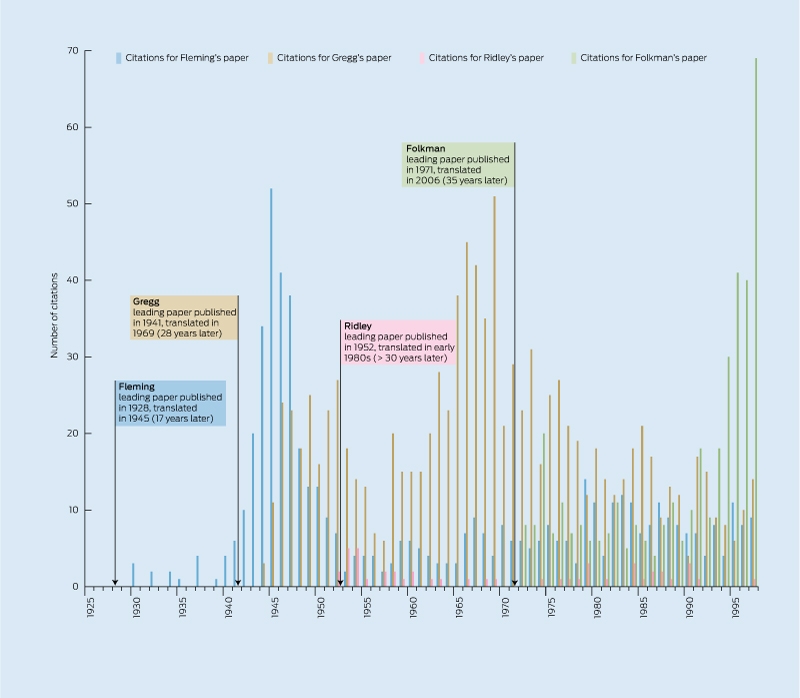
For each of these advances, I identified the leading paper that first described the discovery. Using the Web of Knowledge, I searched for citations of these papers (Box), which showed high citation rates for papers by Fleming,25 Gregg6 and Folkman8 and peaks in citations before translation. Citations for Fleming’s paper peaked early, Gregg’s paper was cited consistently and citations of Folkman’s paper increased exponentially. The paper by Ridley,19 who had the longest and most persistent opposition to his work, had low citation rates. Unlike Mendel, however, Ridley lived to see the recognition and translation of his work. As Meyer-Schwickerath’s leading paper was published in German,14 it was difficult to identify citations. The sentinel laser paper16 has been cited over 1000 times, mainly in literature on physics — not a true representation of a medical research translation metric.
Conclusion
Many other ophthalmic advances have led to major improvements in health care. The advance of spectacles for correction of refractive error, which has had the greatest overall impact on vision, took from classical times until the glass blowers of the Renaissance to be translated — over 1500 years! Many steps led to the diagnosis and prevention of glaucoma, but none is easily singled out. Treatments for trachoma, river blindness and vitamin A deficiency have had major impacts on prevention of blindness but are not universal.
Not all important research is driven by the need for translation to help humanity. Florey said
People sometimes think that I and the others worked on penicillin because we were interested in suffering humanity. I don’t think it ever crossed our minds about suffering humanity. This was an interesting scientific exercise, and because it was of some use in medicine is very gratifying, but this was not the reason that we started working on it.28
In reality, all translational research begins with “blue sky research”, some of which may take decades to translate.
Research funders must consider the long-term view for translation of major advances in medicine. Numbers of publication citations indicate that a researcher is being productive, but they are not perfect key performance indicators for medical research. The Human Genome Project is only a decade old. Those who claim that it has failed to translate into clinical outcomes should look at real time lines for research translation. Then we can all look forward to the advances in health care that it will bring.
Competing interests
No relevant disclosures.
References
- Sorsby A. Gregor Mendel. Br Med J 1965; 1: 333-338. 0_i1115718
- Cartwright VA, McGhee CN. Ophthalmology and vision science research. Part 1: Understanding and using journal impact factors and citation indices. J Cataract Refract Surg 2005; 31: 1999-2007. 0_i1115720
- Thomas ED, Lochte HL Jr, Lu WC, Ferrebee JW. Intravenous infusion of bone marrow in patients receiving radiation and chemotherapy. N Engl J Med 1957; 257: 491-496. 0_i1115722
- Appelbaum FR. Hematopoietic-cell transplantation at 50. N Engl J Med 2007; 357: 1472-1475. 0_i1115724
- Resnikoff S, Pascolini D, Etya’ale D, et al. Global data on visual impairment in the year 2002. Bull World Health Organ 2004; 82: 844-851. 0_i1115726
- Gregg NM. Congenital cataract following German measles in the mother. Trans Ophthalmol Soc Aust 1941; 3: 35-46. 0_i1115728
- Wainwright M, Swan HT. C. G. Paine and the earliest surviving clinical records of penicillin therapy. Med Hist 1986; 30: 42-56. 0_i1115730
- Folkman J. Tumor angiogenesis: therapeutic implications. N Engl J Med 1971; 285: 1182-1186. 0_i1115732
- Algire GH, Chalkley HW, Legallais FY, Park HD. Vascular reactions of normal and malignant tissues in vivo. I. Vascular reactions of mice to wounds and to normal and neoplastic transplants. J Natl Cancer Inst 1945; 6: 73-85. 0_i1115734
- Aiello LP, George DJ, Cahill MT, et al. Rapid and durable recovery of visual function in a patient with von hippel-lindau syndrome after systemic therapy with vascular endothelial growth factor receptor inhibitor su5416. Ophthalmology 2002; 109: 1745-1751. 0_i1115736
- Brown DM, Kaiser PK, Michels M, et al. Ranibizumab versus verteporfin for neovascular age-related macular degeneration. N Engl J Med 2006; 355: 1432-1444. 0_i1115738
- Rosenfeld PJ, Brown DM, Heier JS, et al. Ranibizumab for neovascular age-related macular degeneration. N Engl J Med 2006; 355: 1419-1431. 0_i1115740
- Stone EM. A very effective treatment for neovascular macular degeneration [editorial]. N Engl J Med 2006; 355: 1493-1495. 0_i1115742
- Meyer-Schwickerath G. [Light coagulation; a method for treatment and prevention of the retinal detachment] [German]. Albrecht Von Graefes Arch Ophthalmol 1954; 156: 2-34. 0_i1115744
- O’Malley P. Portable xenon arc light coagulator. Br J Ophthalmol 1973; 57: 935-944. 0_i1115746
- Maiman TH. Stimulated optical radiation in ruby [letter]. Nature 1960; 187: 493-494. 0_i1115748
- Hoye RC, Minton JP. The noble gas ion laser as a light-knife. Surg Forum 1965; 16: 93-95. 0_i1115750
- The Diabetic Retinopathy Study Research Group. Preliminary report on effects of photocoagulation therapy. Am J Ophthalmol 1976; 81: 383-396. 0_i1115752
- Ridley H. Intra-ocular acrylic lenses; a recent development in the surgery of cataract. Br J Ophthalmol 1952; 36: 113-122. 0_i1115754
- Jaffe NS. The introduction of IOL: how the struggle for lens implants’ acceptance was won. Cataract Refract Surg Today 2005 ;Oct: 32-35. 0_i1115756
- Jaffe NS. Cataract surgery — a modern attitude toward a technologic explosion. N Engl J Med 1978; 299: 235-237. 0_i1115758
- Ohba N, Nakao K. The 101 most frequently cited articles in ophthalmology journals from 1850 to 1949. Arch Ophthalmol 2010; 128: 1610-1617. 0_i1115760
- Mackey DA. 2005 Gregg Lecture: Congenital cataract — from rubella to genetics. Clin Experiment Ophthalmol 2006; 34: 199-207. 0_i1115762
- Tyndall J. The optical deportment of the atmosphere in relation to the phenomena of putrefaction and infection. Philos Trans R Soc Lond B Biol Sci 1876; 166: 27-74. 0_i1115764
- Fleming A. On the antibacterial action of cultures of a penicillium, with special reference to their use in the isolation of B. influenzae. Br J Exp Pathol 1929; 10: 226-236. 0_i1115766
- Sorsby A. Ophthalmia neonatorum. Br J Vener Dis 1950; 26: 57-62. 0_i1115768
- Chain E, Florey HW, Gardner AD, et al. Penicillin as a chemotherapeutic agent. Lancet 1940; 236: 226-228. 0_i1115771
- Florey HL. Howard Walter Florey interviewed by Hazel de Berg in the Hazel de Berg collection [sound recording]. Canberra: National Library of Australia, 1967. 0_i1115773
Provenance: Not commissioned; externally peer reviewed.
Prisoner of war pathology in Changi, 1942–1945
Kate Ariotti, Elizabeth Roberts‐Pedersen
Should medical eponyms continue to be used in everyday practice?
Leya Nedumannil, Diana Lewis
100 years on: the first use of insulin in Australia
Sophie Templer
Reflections on the life and career of Professor Dame Valerie Beral AC DBE FRS FRCOG FMedSci (1943–2022)
Karen Canfell, Bette Liu, Emily Banks
The Honourable Dr Donald James Grimes AO
Michael Kirby, Patti Warn
From wipeout to drill out: a history of exostosis management and Australian surfing
Alon Taylor, Hannah North, Narinder P Singh, Paul A Fagan