




Volume 196 - Issue 11
Do the benefits of screening mammography outweigh the harms of overdiagnosis and unnecessary treatment?
Authors: Alexandra L Barratt and Paul P Glasziou
Med J Aust 2012; 196 (11): 681. || doi: 10.5694/mja12.10236
Published online: 18 June 2012
Published online: 18 June 2012
To the Editor: Although both sides of the debate about screening mammography1,2 acknowledge the mortality benefit due to screening and the risk of overdiagnosis, the magnitude and relative value of these need further clarification and reflection. In calculating the number of breast cancer deaths averted using a relative risk reduction of 35%, Roder and Olver overstate the benefit.
Other estimates of effect are lower (eg, ...
To the Editor: Although both sides of the debate about screening mammography1,2 acknowledge the mortality benefit due to screening and the risk of overdiagnosis, the magnitude and relative value of these need further clarification and reflection. In calculating the number of breast cancer deaths averted using a relative risk reduction of 35%, Roder and Olver overstate the benefit. Other estimates of effect are lower (eg, 15%,3 16% [all ages] and 22% [> 50 years],4 and 19%5) and lead to a calculation of fewer averted deaths.
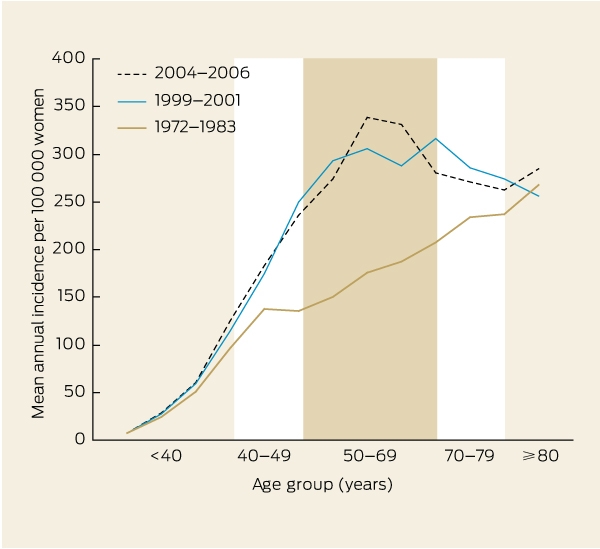
Roder and Olver also call for more research on overdiagnosis. That research has been done6-8 — the increase in incidence is impressive and most marked in women of screening age (Box).6 While contributing factors include a background increase in breast cancer incidence, changes in risk factors (reproductive behaviour, weight and hormone therapy) and screening lead time, an analysis of the New South Wales data that accounted for these factors found overdiagnosis in 30%–40% of apparent cancers detected among women screened, accounting for about one in four of all invasive breast cancers diagnosed in the state.6 International estimates using recent observational data are similar.7,8
Although there is residual uncertainty, more research will not resolve the central dispute about whether the benefit outweighs the harm. It is simply a value judgement. We already have enough evidence to decide — but the central issue now is who should make the decision. Policymakers, experts, or the women potentially engaged in screening? Until we have some form of proper informed “consent” from the target population, we must stop promoting breast cancer screening with information that overstates the benefit and understates the harm.
Mean annual age-specific breast cancer incidence in women before universal health insurance (Medicare) (1972–1983) and under established organised mammography screening (1999–2001 and 2004–2006) in New South Wales6
Competing interests
No relevant disclosures.
References
- Roder DM, Olver IN. Do the benefits of screening mammography outweigh the harms of overdiagnosis and unnecessary treatment? — Yes [opposing views]. Med J Aust 2012; 196: 16. 0_CBBICCEF
- Bell RJ, Burton RC. Do the benefits of screening mammography outweigh the harms of overdiagnosis and unnecessary treatment? — No [opposing views]. Med J Aust 2012; 196: 17. 0_i1142891
- Gotzsche PC, Nielsen M. Screening for breast cancer with mammography. Cochrane Database Syst Rev 2011; (1): CD001877. 0_i1142893
- Humphrey LL, Helfand M, Chan BK, Woolf SH. Breast cancer screening: a summary of the evidence for the US Preventive Services Task Force. Ann Intern Med 2002; 137: 347-360. 0_i1142895
- Glasziou P, Houssami N. The evidence base for breast cancer screening. Prev Med 2011; 2 Jun [Epub ahead of print]. 0_i1142897
- Morrell S, Barratt A. Irwig L, et al. Estimates of overdiagnosis of invasive breast cancer associated with screening mammography. Cancer Causes Control 2010; 21: 275-282. 0_i1142899
- Kalager M, Adami HO, Bretthauer M, Tamimi RM. Overdiagnosis of invasive breast cancer due to mammography screening: results from the Norwegian Screening Program. Ann Intern Med 2012; 156: 491-499. 0_i1142901
- Jørgensen KJ, Gøtzsche PC. Overdiagnosis in publicly organised mammography screening programmes: systematic review of incidence trends. BMJ 2009; 339: b2587. doi: 10.1136/bmj.b2587. 0_i1142905
From Ambition to Action: Closing Policy, Equity and Implementation Gaps in the Australian Cancer Plan's ‘Enhanced Consumer Experience’
Carla Thamm, Elise Button, Oluwaseyifunmi A. Agbejule, Reegan Knowles, Karen van Gorp, Mark B. Pinkham, Meinir Krishnasamy, Alexandra L. McCarthy, Raymond J. Chan
Sovereignty and Survival: Understanding Lung Cancer Outcomes for Aboriginal and Torres Strait Islander People in Australia, a Case–Control Study
Alice R. T. Bergin, Luc te Marvelde, Roger L. Milne, Benjamin J. Solomon, Kris Ivanova, Peter Savas, Stephen J. Luen, Jay Hamann, Andrea Casey, Nicole Watt, Sue M. Evans, Gail Garvey, Sherene Loi
The Changing Indications for Adult Liver Transplantation in Australia: A Narrative Review
Fadak Mohammadi, Alan J. Wigg, Ken Liu, Simone I. Strasser
Uneven Ground: Survival Differences Among Victorian Lung Cancer Patients by Location of Residence (2011–2023): A Retrospective Cohort Study
Evangeline Samuel, Eldho Paul, Mike Lloyd, Sanuki Tissera, Craig Underhill, Sagun Parakh, Phillip Parente, Inger Olesen, Javier Torres, Katharine See, Gavin M. Wright, David Langton, Thomas John, Matthew Conron, James Bartlett, Nicola Atkin, Nikolajs Zeps, Susan V. Harden, Wasek Faisal, John R. Zalcberg, Rob G. Stirling
Early-Onset Colorectal Cancer With Liver-Only Metastases: A Retrospective Cohort Study Integrating Prospectively Collected Real-World Clinical and Molecular Data From an Australian National Database (2009–2024) to Guide Treatment Planning
Savio G. Barreto, Christos S. Karapetis, Shahid Ullah, Matthew Burge, Susan Caird, Angus Campbell, Azim Jalali, Ross Jennens, Muhammad A. Khattak, Belinda Lee, Stephanie H. Lim, Shehara Mendis, Louise Nott, Timothy J. Price, Jeremy D. Shapiro, Jeanne Tie, Javier Torres, Colin Williams, Rachel Wong, Vanessa Wong, Peter Gibbs
Australian Pathways for Specialist Pain Management and Early Palliative Care for People With Pancreatic Cancer: Developed Using a Community Consensus Approach
Jennifer Philip, Melanie R. Lovell, Kylee Bellingham, Gail Garvey, Gregory B. Crawford, Nicole M. Rankin, Kara Burns, Isabel Young, Vivienne Milch, Dorothy Keefe, Katrina Anderson, James Lawson, Meinir Krishnasamy