





Volume 196 - Issue 10
Inappropriate defibrillator shocks caused by oversensing of T-wave in hyperkalaemia
Authors: Bo Xu, Howard Connor and Robert Ziffer
Med J Aust 2012; 196 (10): 626. || doi: 10.5694/mja12.10165
Published online: 4 June 2012
Published online: 4 June 2012
To the Editor: A 62-year-old woman was admitted on 10 January 2012 for cardiac monitoring after her implantable cardioverter-defibrillator (ICD) discharged four times over a few hours. She had a history of ventricular tachycardia due to ischaemic cardiomyopathy, and had had an ICD (D284DRG Maximo II DR, Medtronic, Minneapolis, Minn, USA) inserted
6 years earlier. Her ICD had ...
To the Editor: A 62-year-old woman was admitted on 10 January 2012 for cardiac monitoring after her implantable cardioverter–defibrillator (ICD) discharged four times over a few hours. She had a history of ventricular tachycardia due to ischaemic cardiomyopathy, and had had an ICD (D284DRG Maximo II DR, Medtronic, Minneapolis, Minn, USA) inserted 6 years earlier. Her ICD had not previously discharged since insertion. Her medical history included hypertension and emphysema. Interrogation of the device revealed that during the defibrillator shocks, the patient was in sinus rhythm, and the ICD was double counting tall T-waves as R-waves (Box). She did not have ventricular tachycardia or fibrillation. The T-waves suggested underlying hyperkalaemia, and her serum potassium level was 6.2 mmol/L (reference interval, 3.5–5.0 mmol/L). It was discovered that, 1 month before presenting at our hospital, she had been started on potassium replacement therapy to treat a serum potassium level of 3.7 mmol/L, and had not undergone follow-up blood tests. We discontinued the patient’s potassium replacement therapy and treated her hyperkalaemia with oral potassium-binding resin. After correction of the hyperkalaemia, the patient’s T-wave morphology normalised, and there were no further inappropriate shocks.
We believe this is the first Australian report of inappropriate defibrillator shock caused by oversensing of T-wave in hyperkalaemia. There are only three other similar published cases in the literature.-3 As in this case, the oversensing of T-wave in the other cases was corrected by addressing the underlying cause of hyperkalaemia. Fortunately, the inappropriate shocks in our patient led to the discovery of hyperkalaemia. This case highlights the importance of regular monitoring of blood tests when starting a new medication. Use of an apparently innocent medicine such as oral potassium can lead to defibrillator shocks and serious complications. Patients’ medications should be reviewed and monitored regularly in this context.
Implantable cardioverter–defibrillator electrogram recordings demonstrating appropriate sensing of QRS-complexes and inappropriate double counting of tall T-waves in a patient with hyperkalaemia
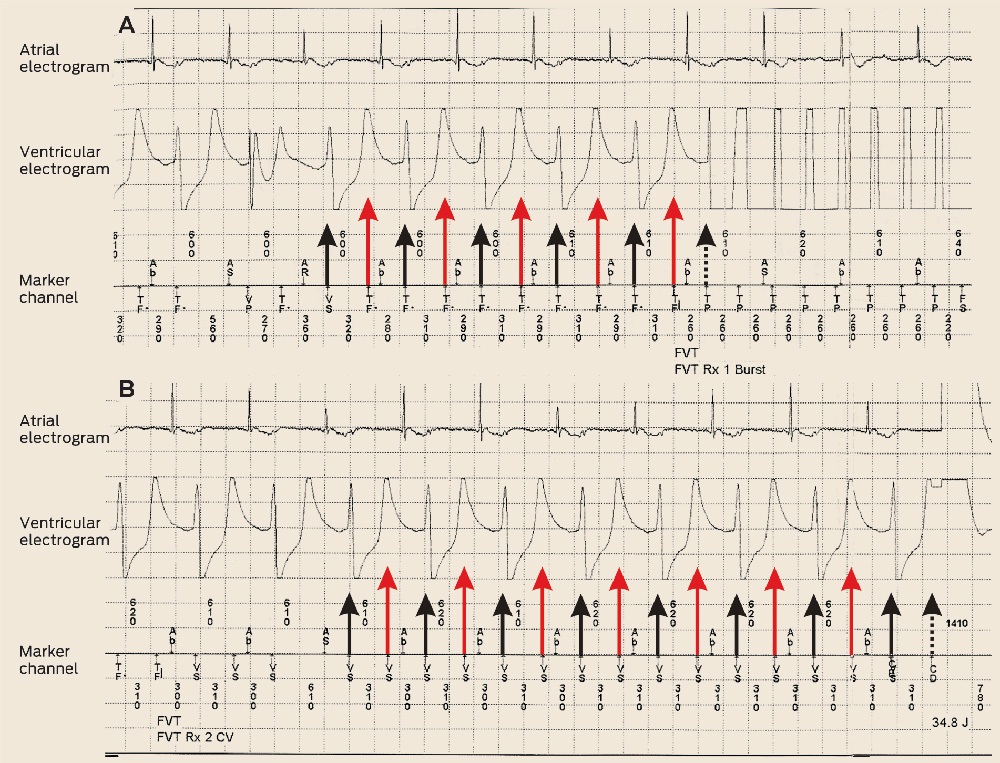
FVT = fast ventricular tachycardia. CD = cardioversion delivered. Black arrows = QRS-complexes. Red arrows = tall T-waves. First dotted black arrow (recording A) = first treatment, when antitachycardia pacing was done. Second dotted black arrow (recording B) = second treatment, when CD occurred. Time scale: each square represents 0.2 seconds. Inappropriate double counting of tall T-waves in hyperkalaemia led to the ventricular rate being perceived as double the actual rate, leading to initial treatment of the perceived FVT with antitachycardia pacing. Inappropriate double counting of tall T-waves continued despite antitachycardia pacing, resulting in the treatment of the perceived FVT with CD.
Competing interests
No relevant disclosures.
References
- Koul AK, Keller S, Clancy JF, et al. Hyperkalemia induced T wave oversensing leading to loss of biventricular pacing and inappropriate ICD shocks. Pacing Clin Electrophysiol 2004; 27: 681-683. link_1
- Arthur W, Kaye GC. Hyperkalemia diagnosed by implantable cardioverter defibrillator T wave sensing. Pacing Clin Electrophysiol 2001; 24: 908-909. 0_pgfId-1144123
- Hosaka Y, Chinushi M, Iijima K, et al. Correlation between surface and intracardiac electrocardiogram in a patient with inappropriate defibrillation shocks due to hyperkalaemia. Intern Med 2009; 48: 1153-1156. 0_i1142862
Fatty Liver Disease in Australia: A Narrative Review on the Epidemiology, Natural History, Prognostication and Management in People With Metabolic Dysfunction
Karl Vaz, Daniel Clayton-Chubb, William W. Kemp, Stuart K. Roberts, Ammar Majeed
Sex Differences in Management and Outcomes of People With ST-Elevation Myocardial Infarction, New South Wales, 2011–2020: A Retrospective Cohort Study
Adam C. Livori, Jedidiah I. Morton, Dianna J. Magliano, Jonathan E. Shaw
Rethinking Rheumatic Fever Diagnosis: Progress, Pitfalls and the Path Towards a Definitive Test
Anna P. Ralph, Rachel Webb, Tom Parks, Nicole J. Moreland, Asha C. Bowen, Benjamin Jones, Emma Ndagire, Andrea Z. Beaton
Sex Differences in Management and Outcomes of People With ST-Elevation Myocardial Infarction, New South Wales, 2011–2020: A Retrospective Cohort Study
Samia Kazi, Simone Marschner, Clara K. Chow
Distribution of Cardiovascular Disease Risk Based on the Updated 2023 Guideline-Recommended Australian Cardiovascular Disease Risk Algorithm and Comparison With the 2012 Algorithm: An Observational Study
Nina Lazarevic, Meghana Bhat, Grace Joshy, Danielle C. Butler, Mark Woodward, Anushka Patel, Rod T. Jackson, Garry Jennings, Rosemary Wyber, Ellie Paige, Emily Banks
They Brought the Hospital to Me
Hugh N. Burrill