




Volume 196 - Issue 1
We’ll drink to that: the 200th anniversary of Australia’s oldest hospital
Author: Astika K Kappagoda
Med J Aust 2012; 196 (1): 77-78. || doi: 10.5694/mja11.11539
Published online: 16 January 2012
Published online: 16 January 2012
An elderly lady with an interesting clinical history
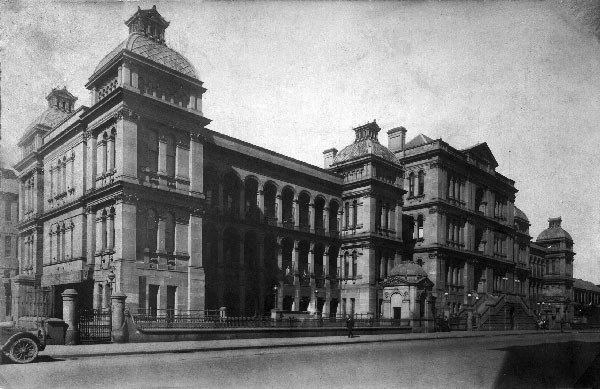
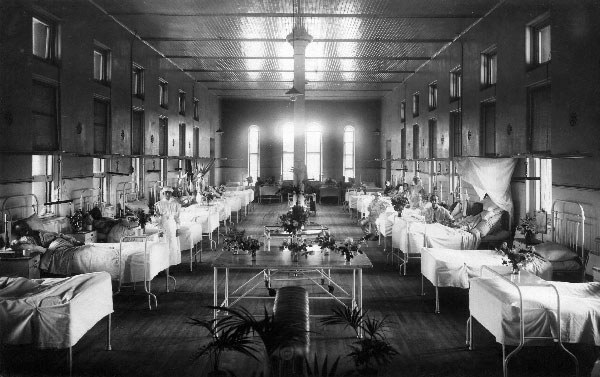
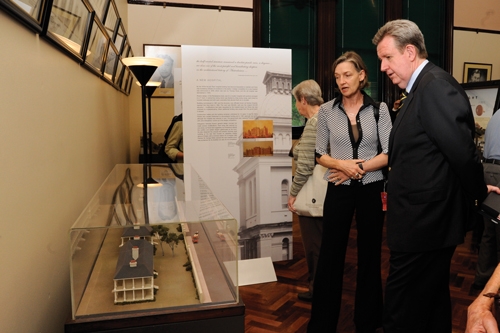
Sydney Hospital, Australia’s oldest hospital, celebrated its anniversary at its present site on Sunday 30 October 2011, 200 years after New South Wales Governor Lachlan Macquarie laid its foundation stone. On Saturday 29 October, many current and former staff, patients, and other people interested in an integral part of Australia’s and Sydney’s history attended an open day and historical exhibition. The story of Sydney Hospital parallels that of Sydney itself — founded in makeshift circumstances to treat convicts, initially dependent on questionable dealings between commerce and government, but eventually establishing itself as a general hospital, serving and supporting a busy and vigorously growing colony and city. Over time, it has moved into providing a somewhat eclectic mix of specialist medical services to both the local Sydney community and New South Wales.
Sydney Hospital was founded in 1788 alongside the initial settlement at Sydney Cove. In this case, “founded” meant a series of tents were pitched at the settlement for the medical treatment of convicts and settlers; they were only later complemented by prefabricated buildings brought from Britain by the Second Fleet. In stark contrast to later 19th century, more orderly, attempts at planning for civic improvement and social order, Sydney Hospital simply grew outside of its tents and temporary structures at the harbour foreshore to occupy whatever surrounding buildings were available to meet burgeoning demand.1
A “public–private partnership”, or a rum deal?
In 1810, Lachlan Macquarie decided that something had to be done to found a permanent site for the colony’s hospital. The modestly named Macquarie Street was constructed to transport the necessary construction material from the harbour to the hospital site.1 This road was to become a major element of the city plan, eventually featuring almost all of New South Wales’ administrative and governing institutions — which it still does today to a large degree. The building of the hospital turned out to be the genesis of a substantial part of Sydney’s city centre and civic life.
The construction of the hospital (which the British government refused to fund) only occurred as a result of Macquarie agreeing to a tender put forward by businessmen Garnham Blaxcell and Alexander Riley in conjunction with the colony’s acting principal surgeon D’Arcy Wentworth. These three individuals — all with an admirable diversification of commercial interests — intended that Macquarie’s need for a permanent colony hospital would be financially lucrative for them. They agreed to build the hospital in exchange for being granted convict labour and a monopoly importation licence for 45 000 gallons (about 200 000 L) of rum.1 As a result of this “public–private partnership”, the “Rum Hospital” — the nickname given by the population, in the Australian tradition of calling a spade a spade — was born. Officially named the Sydney Infirmary, it was eventually called Sydney Hospital from 1881. It was given the Bank of New South Wales’ first account number (00001) — Wentworth owned shares in the bank — and still has this account number, with what is now named Westpac Bank.
The building was overly large for the time, prompting questions as to how to use it. It housed not only the wards for convict patients and the surgeons’ quarters, but also, at various times, the Royal Mint, the Legislative Council, the Supreme Court and the Sydney Dispensary, which looked after those who were free but poor, for whom the government had no responsibility.2 It had structural defects from the start, and the centre of the building eventually had to be demolished and rebuilt in the late 1800s. The last of the defects were only uncovered and remedied in a thoroughgoing restoration in the 1980s.
Nevertheless, the hospital as an institution survived and expanded. Florence Nightingale, in response to written appeals from the politician and later New South Wales premier Henry Parkes, sent out from Britain her protégé Lucy Osburn and five other nurses (the “Nightingale Nurses”) to establish Australia’s first nursing school on site.3 This was housed in the Nightingale Wing, which opened in 1869 and is the oldest of the existing buildings on the site.
Firsts in research and health care
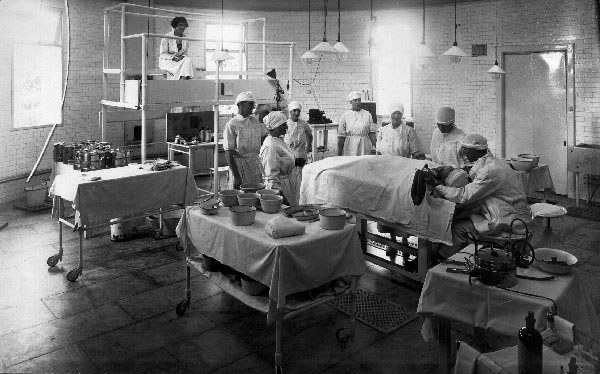
Sydney hospital has been the site of a number of firsts in medical care in Australia. It hosted the first operation under general anaesthetic (a leg amputation under chloroform) and the first postmortem examination (which appears not to be the same patient). Its staff performed the first x-ray, the first blood transfusion, the first frozen section histopathology, and the first radiotherapy treatment (with radium) in Australia. It was also the place in Australia where a number of specialised surgical procedures were done for the first time — abdominal aortic aneurysm repair, liver transplantation and corrective surgery for cryptophthalmos (this also a world first) being among them.
Medical research started with the arrival of the First Fleet. Principal surgeon Dennis Considen investigated the therapeutic properties of native flora, especially eucalyptus.4 However, Australia’s first medical research institute — the Kanematsu Memorial Institute of Pathology — came into being at Sydney Hospital much later, in 1933. The institute was set up with funds from a company that had been founded in 1889 by Fusajiro Kanematsu, the first Japanese merchant to trade with Australia (its Japanese name was not dropped during World War II, underlining Kanematsu’s respected status).5 John Eccles and Bernard Katz worked there in its early days, performing research into the electrophysiological properties of neuromuscular junctions,5 and later separately won Nobel Prizes for Medicine for research into synapse physiology.
The hospital and its specialties
Sydney Hospital was also the first in Australia to establish a number of specialised medical units within a hospital — including coronary care, renal, leukaemia, colorectal and melanoma units. The first-ever specialty unit at the hospital, established in 1878, accommodated the “eye beds”. This unit was relocated to Millers Point and then to Woolloomooloo, developing into the Sydney Eye Hospital, which then returned to the original Sydney Hospital site in 1996. It is now the largest eye hospital in the southern hemisphere, providing specialised tertiary and quaternary referral ophthalmological services. The hand surgery unit, still in existence, was the first of its kind in Australia.
The Nightingale Wing moved on from being a centre for nurse education to accommodate the Sydney Sexual Health Centre, New South Wales’ largest sexual health service (initially the “Blue Light Clinic”, which treated local sailors). In 1987, the hospital established off-site primary care services in sexual health and HIV medicine at the Kirketon Road Centre in Kings Cross.
Sydney Hospital has undergone a long, varied and often haphazard evolution, from tending to scurvied convicts in a tent, to being the first medical institution to bring new kinds of medical care to Sydney and Australia, and to its current role as a provider of a number of specialist services. At the same time, it is the Sydney central business district’s “local hospital”. The founding of the, at the time, grandiose building by Macquarie 200 years ago, predicated on the rum trade, was the catalyst for the establishment of many aspects of health care in New South Wales and Australia. It is an institution deserving of a toast — nowadays, not necessarily with rum — by doctors in Australia.
Competing interests
No relevant disclosures.
Acknowledgements
I thank the Media and Communications Office, South Eastern Sydney and Illawarra Shoalhaven Local Health Districts for their assistance in the preparation of this article.
References
- Parliament of New South Wales. The “Rum Hospital” and Parliament House: History Bulletin 9, Parliament of New South Wales, 2001.
- Historic Houses Trust. History of the mint. Rum Hospital 1811–1854. http://www.hht.net.au/discover/highlights/guidebooks/history_of_the_mint (accessed Dec 2011).
- South Eastern Sydney and Illawarra Health Service. Lucy Osburn — a true nursing pioneer. http://www.sesiahs.health.nsw.gov.au/sydhosp/osburn.asp (accessed Dec 2011).
- MacPherson J. Dennis Considen, Assistant Surgeon of the First Fleet. Med J Aust 1927; 2: 770-773. 0_i1115635
- Institute of Haematology, Royal Prince Alfred Hospital. History of the Kanematsu Laboratories. http://www.sswahs.nsw.gov.au/SSWPS/ToDelete/RPAH/KMI/history.html (accessed Dec 2011).