




Volume 196 - Issue 1
Falling through the cracks: the hidden economic burden of chronic illness and disability on Australian households
Authors: Stephen Jan, Beverley M Essue and Stephen R Leeder
Med J Aust 2012; 196 (1): 29-31. || doi: 10.5694/mja11.11105
Published online: 16 January 2012
Published online: 16 January 2012
Major reform plus targeted strategies have the potential to provide relief
Underpinning recent global health initiatives, including the Millennium Development Goals and the United Nations’ High-level Meeting of the General Assembly on the Prevention and Control of Non-communicable Diseases, has been recognition of the links between illness, disability, poverty and economic development. In Australia, the economic effects of illness, particularly long-term illness and disability, are often overlooked or examined exclusively in terms of the consequences for government budgets and the economy. While such analyses may be effective in alerting policymakers to the scale of particular epidemics, they provide little indication of the direct impact of illness on the wellbeing of those in the community. To do this, the unit of analysis needs to be shifted from the macro economy to individuals and households.
The existence of universal publicly funded health care and social security arrangements has possibly encouraged complacency among researchers and policymakers about tackling this issue. However, there is emerging evidence in Australia that chronic illness and disability are associated with serious levels of economic hardship and that such hardship affects health behaviour1-3 — thereby completing a cycle in which poor health leads to poverty, which then leads to poor health. The economic consequences in question include not only the out-of-pocket costs of medical treatment, but also the costs of self-management (eg, home modifications, transport and paid care) and loss of income for patients and carers.1,3,4 As a result, those of low socioeconomic status are at greater risk of experiencing illness and disability and are more vulnerable to the consequences.
Out-of-pocket costs
The most direct manner in which the economic impact of illness is felt is through the out-of-pocket costs of care. In Australia, despite a free public hospital system and universal social health insurance coverage through Medicare, levels of out-of-pocket payments are high by international, high-income country standards. In a recent Commonwealth Fund survey of 11 high-income countries, the incidence of out-of-pocket spending exceeding US$1000 in the previous year among individual respondents was 21% in Australia — behind only the United States (35%) and Switzerland (25%), and well above countries such as the United Kingdom (1%), France (4%) and New Zealand (7%).5 In 2009, out-of-pocket spending as a proportion of total health expenditure was 18.2% in Australia — above the Organisation for Economic Cooperation and Development (OECD) median of 15.8% (Box 1).6
This proportion has remained steady in Australia, not varying much from the 1999 value of 19.9%, and seems unlikely to change given one of the recommendations of the National Health and Hospitals Reform Commission: “We want to see the overall balance of spending through taxation, private health insurance, and out-of-pocket contribution maintained over the next decade.”7 It is hard to see any compelling fiscal justification for such a policy when a comparison across OECD countries indicates that public spending on health in Australia in 2009 (5.8% of gross domestic product) was well below the OECD median (6.9%).6
What are the implications of these costs?
The picture emerging from recent studies in Australia is that major burdens are being imposed on particular patient populations by high out-of-pocket costs.1-4 For example, in a study of patients with chronic obstructive pulmonary disease (COPD), 46% of patients experienced an incidence of catastrophic health care spending — defined as out-of-pocket costs exceeding 10% of income for the period studied.1 The main out-of-pocket costs incurred by these patients are shown in Box 2. In general, evidence suggests that the high burden of out-of-pocket costs tends to be skewed toward those with comorbidity1 and those with more severe illness.8,9 However, the hardship related to such burden tends to be most pronounced in people who have retired1 and those of low socioeconomic status,1 and there is little evidence of concession or insurance status providing significant protection.1,10 In addition, substantial costs incurred by patients are often not for health care but for home modifications, social support and transport.1,3,4,10
Significantly, increasing levels of out-of-pocket costs associated with copayments for PBS-listed medications have been found to be associated with reduced rates of prescriptions being filled.2 Such findings are supported by evidence from a qualitative study of patients with chronic illness in western Sydney and the Australian Capital Territory; lack of affordability of medical treatment, and thus impaired ability to self-manage, was a major aspect of economic hardship for these patients.3 Putting these findings into context, over the past 10 years the out-of-pocket burden associated with both MBS-listed medical services and PBS-listed medications has increased substantially (by 4.2% and 6.7% per year respectively).6 The concern is that these rising levels of copayment will adversely affect compliance, particularly in patients who require long-term treatment.
Indirect costs
Illness and disability also affect household economic circumstances through their effect on employment. In 2006, 33% of 18–64-year-olds who reported specific limitations or restrictions lived in households in the lowest income quintile, compared with 10% of those without such impairment.11 This pattern is further pronounced in individuals with intellectual disability and severe or profound disability, with 40% and 36% of people in these groups, respectively, living in the lowest income quintile households.11 This impact extends to informal carers, who often leave paid employment to care for a sick family member. While there are income support programs in place to assist those with long-term illness and their carers, often these barely cover living and medical expenses.3 Nevertheless, the prospect of losing income support payments and concessional status as a result of resuming employment can create a welfare trap for patients and carers, particularly those in low-income occupational groups.
Financial stress and illness-related poverty
In Australia in 2009, 28 665 individuals became bankrupt, of whom 11% cited ill health or absence of health insurance as the primary reason.12 While illness-induced bankruptcy is not as large a problem in Australia as it is elsewhere (such as the US, where it caused 62% of bankruptcies in 200713), significant numbers of Australians are catastrophically affected by illness. In addition, disability has been found to be associated with more acute measures of economic hardship, such as financial stress based on an individual’s ability to raise a sum of money for something important. The Australian Institute of Health and Welfare (AIHW) has found that individuals with specific limitations or restrictions, when compared with those without impairment, report over double the rate of being unable to raise $2000 (26% v 11%).11 Another criterion for assessing financial stress is the inability to make necessary household payments. According to the AIHW, 34% of 18–64-year-olds with specific limitations or restrictions reported at least one such incident in the previous 12 months, compared with 18% of those without impairment.11
One study which adopted this broader perspective of examining the economic impact of illness and disability on households found that, in patients with COPD in western Sydney, 78% reported at least one instance of being unable to make necessary payments in the previous 12 months or, to do so, needed help, sold assets, moved house or borrowed money.1 Similarly, in individuals participating in the Household, Income and Labour Dynamics in Australia (HILDA) Survey, a population-based longitudinal survey, such incidences of financial stress were found to be strongly associated with disability, poor physical function and poor mental health.14
What can be done?
The studies conducted in Australia indicate that health-related economic hardship tends to disproportionately affect specific patient populations, largely due to costs that are conventionally treated as being unrelated to the health sector. In the absence of comprehensive evidence, it is only possible to gather findings from a patchwork of unrelated studies. Priority should therefore be given to developing a consistent approach that records the specific costs to individuals and their households associated with illness and identifies the impact of these costs on health behaviour and wellbeing. The available evidence indicates that the out-of-pocket costs of treatment and self-management and loss of income from chronic illness and disability are associated with economic hardship, catastrophic health care spending and non-compliance with medical treatment.
Major reform, such as the recently proposed National Disability Insurance Scheme (NDIS), has the potential to address hardship associated with illness and injury. However, meaningful improvement is also possible through small-scale targeted strategies. As household economic burden is skewed toward specific patient groups, effective remedies could include focused interventions such as income support and subsidies. These measures would identify and catch those individuals and households that currently fall through the cracks. They would also be unlikely to involve changes that distort current health care priorities or restructure the responsibilities of different government sectors. Furthermore, they could be implemented quickly. Ultimately, both broad-brush policies such as the NDIS and targeted support measures are needed to provide direct relief to individuals and households most at risk of illness- and disability-related economic hardship.
1 Out-of-pocket costs as a share of total health expenditure in OECD countries, 2009*
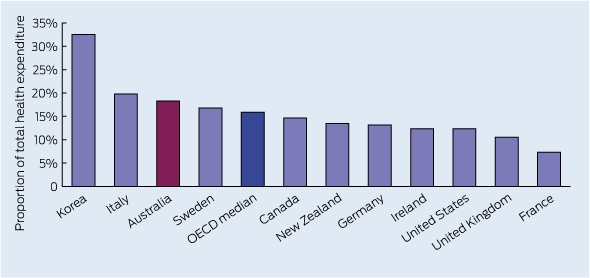 OECD = Organisation for Economic Cooperation and Development. * Reproduced with permission from the Australian Institute of Health and Welfare.6 |
Competing interests
No relevant disclosures.
Acknowledgements
This article has been written as part of the Serious and Continuing Illness Policy and Practice Study, a National Health and Medical Research Council (NHMRC)-funded program (402793) conducted at the Australian National University and University of Sydney and administered by the Menzies Centre for Health Policy. Stephen Jan is supported by an NHMRC Career Development Award (457117).
References
- Essue B, Jan S, Kelly P, et al. We can’t afford my chronic illness! The out-of-pocket burden associated with managing chronic obstructive pulmonary disease in Western Sydney, Australia. J Health Serv Res Policy 2011; 16: 226-231. 0_CHDIFCCH
- Hynd A, Roughead EE, Preen DB, et al. The impact of co-payment increases on dispensings of government-subsidised medicines in Australia. Pharmacoepidemiol Drug Saf 2008; 17: 1091-1099. 0_CHDJJHBE
- Jeon YH, Essue B, Jan S, et al. Economic hardship associated with managing chronic illness: a qualitative inquiry. BMC Health Serv Res 2009; 9: 182. 0_i1115724
- Kenny P, Hall J, King M, Lancsar E. Sources of variation in the costs of health care for asthma patients in Australia. J Health Serv Res Policy 2009; 14: 133-140. 0_i1115726
- Schoen C, Osborn R, Squires D, et al. How health insurance design affects access to care and costs, by income, in eleven countries. Health Aff (Millwood) 2010; 29: 2323-2334. 0_i1115728
- Australian Institute of Health and Welfare. Health expenditure Australia 2009–10. Canberra: AIHW, 2011. 0_i1115730
- National Health and Hospitals Reform Commission. A healthier future for all Australians: final report June 2009. Canberra: Department of Health and Ageing, 2009. 0_i1115732
- Cohn RJ, Goodenough B, Foreman T, Suneson J. Hidden financial costs in treatment for childhood cancer: an Australian study of lifestyle implications for families absorbing out-of-pocket expenses. J Pediatr Hematol Oncol 2003; 25: 854-863. 0_i1115734
- Gordon L, Scuffham P, Hayes S, Newman B. Exploring the economic impact of breast cancers during the 18 months following diagnosis. Psychooncology 2007; 16: 1130-1139. 0_i1115736
- Dewey HM, Thrift AG, Mihalopoulos C, et al. ‘Out of pocket’ costs to stroke patients during the first year after stroke — results from the North East Melbourne Stroke Incidence Study. J Clin Neurosci 2004; 11: 134-137. 0_i1115738
- Australian Institute of Health and Welfare. Australia’s welfare 2009. Canberra: AIHW, 2009. 0_i1115740
- Insolvency and Trustee Service Australia. Profile of debtors 2009. Canberra: ITSA, 2010. 0_i1115742
- Himmelstein DU, Thorne D, Warren E, Woolhandler S. Medical bankruptcy in the United States, 2007: results of a national study. Am J Med 2009; 122: 741-746. 0_i1115746
- Headey B. A framework for assessing poverty, disadvantage and low capabilities in Australia. Canberra: Melbourne Institute, 2005. 0_i1115747
Provenance: Not commissioned; externally peer reviewed.
Capturing the Benefits of Clinical Quality Registries
Taryn Bessen, Stephen McDonald
Medical Colleges Have an Obligation to Ensure Full Participation in Clinical Quality Registries
Thomas J. Hugh
Getting on the Same Page: Why Australia Needs a National Maternity Early Warning System (MEWS) Chart
Briony A. Cutts, Lucy Bowyer, Nisha Khot, Sandra Lowe, Stefan C. Kane
Data for Equity: Can Linked Administrative Data Inform Pathways to More Equitable Child Health?
Sarah Gray, Shuaijun Guo, Meredith O'Connor, Elodie O'Connor, Katrina Williams, Hannah Badland, Susan Woolfenden, Josie Dickerson, Gerry Redmond, Marnie Downes, Sharon R. Goldfeld
Specialty College Selection: Why Change is Critical to Support a Future Rural Workforce
Matthew R. McGrail, Jenny May AM, Katherine Logan
Differentiated and simplified oral HIV pre‐exposure prophylaxis (PrEP) models hold the key to virtually eliminating HIV transmission in Australia by 2030
Tyson Arapali, Sarah Warzywoda, Anthony K J Smith, Curtis Chan, Timothy R Broady, Erin Sullivan, Catherine MacPhail, Mohamed A Hammoud, Alexander Dowell‐Day, Benjamin R Bavinton