




Volume 195 - Issue 6
Changes in the sodium content of bread in Australia and New Zealand between 2007 and 2010: implications for policy
Authors: Elizabeth K Dunford, Helen Eyles, Cliona Ni Mhurchu, Jacqui L Webster and Bruce C Neal
Med J Aust 2011; 195 (6): 346-349. || doi: 10.5694/mja11.10673
Published online: 19 September 2011
Published online: 19 September 2011
Abstract
Objective: To define the effectiveness of recent efforts by the Australian Division of World Action on Salt and Health, and the Heart Foundation in New Zealand to reduce sodium levels in breads in Australia and New Zealand.
Design and setting: Data on the sodium contents of packaged sliced bread products sold in Australian and New Zealand supermarkets were collected from the product labels of 157 breads in 2007 and 167 breads in 2010, and were compared overall, by bread type, by manufacturer, and between nations.
Main outcome measures: Mean sodium values in bread and proportions of breads meeting the targets of 400 mg/100 g in Australia and 450 mg/100 g in New Zealand.
Results: Overall mean sodium content in bread in Australia was 434 mg/100 g in 2007 and 435 mg/100 g in 2010; corresponding values for New Zealand were 469 mg/100 g and 439 mg/100 g. The proportion of Australian breads meeting the national target increased from 29% in 2007 to 50% in 2010; the proportion of New Zealand breads meeting the national target increased from 49% in 2007 to 90% in 2010. There were clear differences between the results achieved by different companies.
Conclusions: Voluntary efforts by non-governmental organisations have had some impact on sodium levels in bread, particularly in New Zealand. However, substantial room for further improvement remains. If additional reductions are not achieved under the current voluntary arrangements, legislated approaches may be required.
It is well established that excess dietary sodium consumed throughout life causes blood pressure to rise with age1,2 and greatly increases the risks of cardiovascular diseases.3,4 With average population sodium consumption accepted to be well above recommended dietary intakes in both Australia5 and New Zealand,6 efforts are increasingly focused on reducing population sodium intake.7,8 There is particular interest in strategies involving the food industry because some three-quarters of the sodium in Australian and New Zealand diets derives from processed foods.9 In both countries, bread is one of the biggest contributors, providing about a fifth of daily sodium intake.6,9
In 2007, the New Zealand Heart Foundation and the Australian Division of World Action on Salt and Health each launched new efforts to engage industry in new programs to reduce the sodium content of bread.10 More recently, in 2010, the Australian Government’s Food and Health Dialogue announced a voluntary sodium target for Australian breads.11 Several bread manufacturers have made commitments to reducing the salt content of their breads in both countries,10,11 and reformulation to reduce the sodium content of food is now firmly on the agenda in Australia and New Zealand.12
The primary objective of this study was to establish the effectiveness of recent efforts to achieve reductions in the sodium content of bread products in Australia and New Zealand.11,13
Methods
Data on sodium content were collected for sliced packaged breads available for sale in Australia and New Zealand in 2007 and 2010. Data were obtained directly from the mandatory Nutrition Information Panel (NIP) of all packaged breads identified during visits to two major supermarket chains in each country (Coles and Woolworths in Australia and Pak’n Save and Foodtown/Countdown in New Zealand).
For each bread product, the brand name, product name, manufacturer and sodium content per 100 g were recorded on paper data collection forms in the supermarket and subsequently entered into an electronic spreadsheet. Each bread product was categorised as “white”, “wholemeal” or “mixed grain”.
Data analysis
The mean, median, standard deviation, and range of sodium content were calculated overall, by country, by bread type, by year and by manufacturer. The proportion of Australian products meeting the Australian Food and Health Dialogue sodium target of 400 mg/100 g,11 and the proportion of New Zealand products meeting the Heart Foundation Project Target 450 target value10 of 450 mg/100 g were also calculated for 2007 and 2010.
Results
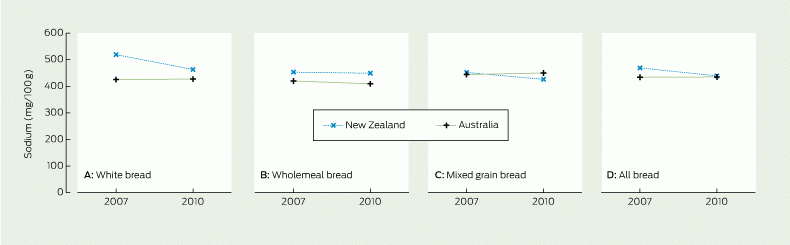
In Australia, sodium content data were available for 94 sliced bread products in 2007 and 99 in 2010. For New Zealand, the corresponding numbers were 63 and 68. For every bread type, sodium content per 100 g varied substantially across years and countries, indicating marked initial and subsequent variation in bread composition (Box 1).
Sodium content of breads in 2010
In 2010, the overall average levels of sodium in Australian breads and New Zealand breads were the same (435 mg/100 g). Similarly, overall mean sodium levels did not vary much by bread type (white, 436 mg/100 g; wholemeal, 421 mg/100 g; and mixed grain, 438 mg/100 g), although there were differences between the mean sodium contents of breads produced by different manufacturers. In Australia, for example, the mean sodium content of breads produced by George Weston Foods (394 mg/100 g) was lower than that of breads produced by Goodman Fielder (455 mg/100 g). Analyses by country showed additional variation in the mean sodium content of breads that is not apparent from the overall analyses (Box 1 and Box 2). For example, the bread types with the highest mean sodium content in Australia in 2010 were mixed grain (450 mg/100 g) followed by white (427 mg/100 g) and wholemeal (409 mg/100 g). In New Zealand, the pattern was different, with white bread (463 mg/100 g) having the highest sodium content, followed by wholemeal (449 mg/100 g) and mixed grain (426 mg/100 g).
Changes in mean sodium content between 2007 and 2010
The mean sodium content of bread products in Australia did not fall over the 4-year study period, with a mean sodium content of 434 mg/100 g in 2007 and 435 mg/100 g in 2010. However, in New Zealand, there was a 7% reduction over the same time period, from 469 mg/100 g to 435 mg/100 g, bringing mean sodium levels in New Zealand breads in line with those of Australian breads. The mean sodium content of the different bread types varied between countries and between manufacturers (Box 2 and Box 3).
Changes in the proportion of breads meeting established sodium targets between 2007 and 2010
The proportion of Australian bread products meeting the 400 mg/100 g Australian target increased from 29% in 2007 to 50% in 2010. In New Zealand, there was also an increase in the proportion of products meeting the Heart Foundation 450 mg/100 g target, from 49% in 2007 to 90% in 2010 (Box 1). The proportion of each type of bread (white, wholemeal, mixed grain) that met sodium content targets was mostly greater in 2010 than in 2007 (Box 1).
Discussion
Our findings demonstrate the potential for voluntary salt reduction programs, implemented as collaborations between non-governmental agencies and industry, to effect changes in the sodium content of bread. Our data also highlight the need for sustained action, because there is still substantial room for improvement. While the concerted efforts over 4 years of these agencies and their collaborating manufacturers has reduced the mean sodium content of New Zealand breads, there has been no corresponding reduction in mean levels in Australia. The proportion of breads meeting targets did rise in both countries, but an isolated change in this parameter is unlikely to translate into large health gains. There remains substantial scope for improvement,11,14 with the mean sodium content of breads in Australia and New Zealand still far higher than that in the United Kingdom (397 mg/100 g).15,16
The wide range of sodium levels we identified (115 mg/100 g to 770 mg/100 g) indicates that it is possible to manufacture and market breads with low sodium content, and suggests that the barriers are mostly not technical.17 Coordinating salt reduction efforts may have significant potential for delivering improvements. This is highlighted by the disparities observed for the two manufacturers in this study that operate in both Australia and New Zealand (George Weston Foods and Goodman Fielder). In 2010 in Australia, the breads of George Weston Foods had a lower mean sodium content than the breads of Goodman Fielder, but the reverse was true in New Zealand. George Weston Foods also decreased the sodium content of its breads to a greater extent in Australia than in New Zealand, while the sodium content of breads made by Goodman Fielder rose in Australia and fell in New Zealand. The absence of government leadership is an important reason for this disparity, and while non-governmental organisations can have some impact, they lack the authority and resources of government. Strong government leadership has been a central feature of the successful ongoing salt reduction programs in the UK,15 Finland,18 the United States19 and Canada.20
Ongoing monitoring of sodium levels in bread is required to assure effectiveness of any new program that is implemented. Our analysis highlights the need for careful review and interpretation of the data, with findings for Australia requiring detailed consideration in terms of their public health impact. Specifically, between 2007 and 2010 there was no change in the mean sodium concentration of breads in Australia, despite a significant improvement in the proportion of breads meeting the 400 mg/100 g target. The explanation is a shift in the range and distribution of sodium levels in Australian breads, so that in 2010 there were no longer any breads with very low sodium contents available (the lower end of the range has increased from 115 mg/100 g to 235 mg/100 g), and there were new breads with high sodium content on the market (the upper end of the range increased from 620 mg/100 g to 770 mg/100 g). It is unlikely that an improvement in the proportion meeting the 400 mg/100 g target (with no corresponding improvement in mean salt levels) will have reduced the total quantity of salt delivered to the Australian population in bread. In New Zealand, where there were improvements in both the proportion of products meeting the target and the overall mean sodium level, there is likely to have been a real fall in the amount of salt delivered to consumers in bread, with associated gains in public health.
A limitation of our study is that we did not weight sodium data by sales. Market-share data for each product would have enabled an analysis that directly quantified the impact of the changes observed on the quantity of sodium in bread products sold.21 Reassuringly, the mean sodium levels in Australia were consistent with previous data reported from sales-weighted analyses done by the national Heart Foundation in 2009.22 It is also of note that the data we present here do not include unpackaged breads and breads sold from non-supermarket outlets. In Australia, for example, it is known that Bakers Delight products have sodium levels significantly above the average.23
In conclusion, our data provide the first objective, quantitative evaluation of progress in reducing the sodium content of bread products in Australia and New Zealand. While there has been some improvement in sodium levels in New Zealand, and while the companies actively engaged in salt reduction efforts are to be congratulated, our data also highlight the need for continued action. Better results are likely to be achieved if the governments of Australia and New Zealand take committed leadership of these programs.
1 Changes in mean sodium content of Australian and New Zealand breads and proportions meeting targets between 2007 and 2010
* Australian Food and Health Dialogue target. † NZ Project Target 450 target. |
|||||||||||||||
Competing interests
Jacqui Webster is the Senior Project Manager, Elizabeth Dunford is the Research Officer and Bruce Neal is the Chairman of the Australian Division of World Action on Salt and Health. Jacqui Webster was previously responsible for implementing the United Kingdom Food Standards Agency salt reduction strategy, including the initial consultation on salt targets.
Acknowledgements
Elizabeth Dunford is supported by a Sydney Medical School Foundation scholarship; Cliona Ni Mhurchu holds the Heart Foundation of New Zealand Senior Fellowship (Grant 1380). Bruce Neal is supported by an Australian Research Council Future Fellowship. Main project funding was provided by a National Health and Medical Research Council of Australia Partnership Grant with partner support from the Australian Division of World Action on Salt and Health, the Australian Food and Grocery Council, New South Wales Health and the New South Wales Food Authority.
References
- Havas S, Dickinson B, Wilson M. The urgent need to reduce sodium consumption. JAMA 2007; 298: 1439-1441. 0_i1140763
- Intersalt Cooperative Research Group. Intersalt: an international study of electrolyte excretion and blood pressure. Results for 24 hour urinary sodium and potassium excretion. BMJ 1988; 319-328. 0_CHDJICED
- Asia Pacific Cohort Studies Collaboration. Blood pressure and cardiovascular diseases in the Asia-Pacific region. J Hypertens 2003; 21: 707-716. 0_i1140767
- Beaglehole R, Bonita R, Horton R, et al. Priority actions for the non-communicable disease crisis. Lancet 2011; 377: 1438-1447. 0_i1140769
- Australian Government National Health and Medical Research Council. Nutrient reference values for Australia and New Zealand including recommended dietary intakes. Canberra: NHMRC, 2006. http://www.nhmrc.gov.au/guidelines/publications/n35-n36-n37 (accessed Aug 2011).
- NZ Ministry of Health; University of Auckland. Nutrition and the burden of disease. New Zealand 1997–2011. Wellington: NZ Ministry of Health and the University of Auckland, 2003. 0_i1140773
- Campbell NR, Neal BC, Macgregor GA. Interested in developing a national programme to reduce dietary salt? J Hum Hypertens 2011; 31 Mar [epub ahead of print]. 0_i1140775
- Webster J, Dunford E, Huxley R, et al. The development of a national salt reduction strategy for Australia. Asia Pac J Clin Nutr 2009; 18: 303-309. 0_i1140777
- Food Standards Australia New Zealand. Proposal P230. Consideration of mandatory fortification with iodine. Canberra: FSANZ, 2007. 0_i1140779
- Heart Foundation (NZ). Reducing our sodium footprint. Feb 2010. http://www.heart foundation.org.nz/uploads/Project%20Heart SAFE_Situation%20Analysis_Sodium_Final%20 (removing%20the%20word%20project%20from%20title).pdf (accessed Aug 2011).
- The Hon Mark Butler MP, Parliamentary Secretary for Health. Salt reduction targets agreed. 22 March 2010. Canberra: Australian Government Department of Health and Ageing, 2010. http://www.health.gov.au/internet/ministers/publishing.nsf/Content/mr-yr10-mb-mb022.htm?OpenDocument (accessed Dec 2010).
- Food Industry Group (NZ). Annual report, March 2009. Auckland: FIG, 2009. http://www.fig. org.nz/Resources/Library/Documents/reports/Annual_report_2009.pdf (accessed Oct 2010).
- Heart Foundation (Aust). Heart Foundation Tick. http://www.heartfoundation.org.au/information-for-professionals/heart-foundation-tick/pages/default.aspx (accessed Aug 2010).
- New Zealand Food Safety Authority. Salt reduction at heart of new agreement [media release]. 10 Jun 2010. http://www.foodsafety. govt.nz/elibrary/industry/Salt_Reduction-Aligning_Efforts.htm (accessed Aug 2011).
- Food Standards Agency (UK). Salt reduction targets Mar 2009. http://www.food.gov.uk/multimedia/spreadsheets/salttargets2010 2012.xls (accessed Dec 2010).
- Food Standards Agency (UK). Proposals to revise the voluntary salt reduction targets. 22 Jul 2008. http://www.food.gov.uk/consultations/ukwideconsults/2008/saltreductiontargets (accessed Dec 2010).
- Girgis S, Neal B, Prescott J, et al. A one-quarter reduction in the salt content of bread can be made without detection. Eur J Clin Nutr 2003; 57: 616-620. 0_i1140795
- Pietinen P, Valsta LM, Hirvonen T, Sinkko H. Labelling the salt content in foods: a useful tool in reducing dietary sodium intake in Finland. Public Health Nutr 2008; 11: 335-340. 0_i1140797
- New York City Department of Health and Mental Hygiene. Cutting salt, improving health. http://www.nyc.gov/html/doh/html/cardio/cardio-salt-initiative.shtml (accessed Oct 2010).
- Health Canada. Sodium reduction strategy for Canada: recommendations from the Sodium Working Group. Jul 2010. http://www.hc-sc.gc.ca/fn-an/nutrition/sodium/strateg/index-eng.php (accessed Oct 2010).
- Webster JL, Dunford EK, Neal BC. A systematic survey of the sodium contents of processed foods. Am J Clin Nutr 2009; 91: 413-420. 0_i1140803
- Cleanthous X, Mackintosh AM, Anderson S. Breads in the current Australian market: sodium and fibre content report. Food Aust 2010; 62: 134-136. 0_i1140806
- Australian Division of World Action on Salt and Health. Sodium content of Australian bread products 2007–2010. Nov 2010. http://www.awash.org.au/documents/Bread%20 report%202010%20FINAL.pdf (accessed Apr 2011).
Beyond Fibrosis Stratification: Integrating Behavioural, Metabolic and Policy-Level Interventions in Metabolic Dysfunction-Associated Steatotic Liver Disease
Yousef Hakimi, Prarthana Thiagarajan, Michael Braude
Fatty Liver Disease in Australia: A Narrative Review on the Epidemiology, Natural History, Prognostication and Management in People With Metabolic Dysfunction
Karl Vaz, Daniel Clayton-Chubb, William W. Kemp, Stuart K. Roberts, Ammar Majeed
When ‘Liver Enzymes’ Are Not Hepatic: Late-Onset Pompe Disease
Shauna Madigan, Georgina England, Wayne Rankin
Fatty Liver Disease in Australia: A Narrative Review on the Epidemiology, Natural History, Prognostication and Management in People With Metabolic Dysfunction
Karl Vaz, Daniel Clayton-Chubb, William W. Kemp, Stuart K. Roberts, Ammar Majeed
The early implementation phase of the Omega‐3 Test‐and‐Treat Program for reducing the risk of preterm birth, South Australia, 2021–22: an implementation evaluation study
Karen P Best, Celine Northcott, Lucy A Simmonds, Philippa Middleton, Lisa N Yelland, Vanessa Moffa, Khoa Lam, Penelope Coates, Cornelia Späth, Carol WK Siu, Karen Glover, Rhiannon Smith, Robert Gibson, Maria Makrides
Cause‐specific mortality among Queensland people with cirrhosis, by cirrhosis aetiology and decompensation status, 2007–22: a retrospective cohort study
Vikas Bhasker, Jessica R Fong, Paul J Clark, Gunter F Hartel, Richard Skoien, James O’Beirne, Elizabeth E Powell, Patricia C Valery