




Volume 195 - Issue 11
Wife carrying for health
Authors: I-Min Lee, Sylvia Titze and Pekka Oja
Med J Aust 2011; 195 (11): 723-725. || doi: 10.5694/mja11.10808
Published online: 12 December 2011
Published online: 12 December 2011
Abstract
Objectives: To highlight a fun activity — the sport of wife carrying — and to investigate factors associated with better performance.
Design, setting and participants: Cross-sectional study based in Sonkajärvi, Finland (venue of the annual Wife Carrying World Championship race), of 172 couples participating in wife-carrying races, 1992–2010.
Main outcome measure: Race finishing time.
Results: The mean age for male participants was 32.6 (SD, 8.7) years and for female participants, 30.5 (SD, 9.2) years. The mean finishing time was 98 s. Finish times tended to be somewhat slower as the age of the male partner increased (P = 0.06), but not as the female partner’s age increased (P = 0.89). Race experience was not associated with faster times (P = 0.88). Estonians were almost 12 s faster than other nationalities, although this was not statistically significant (P = 0.25), probably due to the small number of Estonians. Men who engaged in endurance-type physical activities as hobbies (P = 0.003), or in both endurance- and strength-building activities (P = 0.001), were significantly faster than those who did neither. Among women, strength-building (P = 0.03) but not endurance-type (P = 0.36) physical activities were significantly associated with faster race times.
Conclusions: Wife carrying can be a novel option for increasing physical activity levels, which improve health. Although some key data were unavailable, such as wife’s body weight, and injury rates, this study identified several factors associated with better performance in this sport.
Physical activity enhances longevity, but the world’s population is insufficiently active.1 Although the reasons for this are complex, one barrier is that exercise is perceived as boring: a multicountry survey found that 61% of respondents would exercise more if it were fun.2
Another risk factor for premature mortality is the lack of social relationships: a meta-analysis found a 50% increased survival rate among those with stronger social relationships.3
In searching for novel approaches potentially able to address both these risk factors, we studied a little-known activity: the sport of wife carrying.
The origin of wife-carrying races lies in the legend of Rosvo-Ronkainen, a Finn living in the 1800s who led men in raiding villages for food and women, carrying the women on their backs as they ran off.4 The Finnish word eukonkanto is colloquially translated as “wife-carrying race” in English; a more accurate translation is “old hag-carrying race”.
The Wife Carrying World Championship began in 1992 at Sonkajärvi, Finland, and has been held annually since then. Contestants are winning couples from wife-carrying competitions in Australia, Estonia, Finland, Germany, Great Britain, Ireland and the United States. The competition4 involves the man running along a 253.5 m track with three obstacles, carrying his “wife”. This “wife” must weigh at least 49 kg, or be weighted to 49 kg. The “wife” need not be your own, but can be “the neighbour’s”.4 As a health bonus, the winner receives the “wife’s” weight in beer, known to improve cardiovascular health when consumed in moderation.5
Here we explore what factors predict better performance in this race.
Methods
Two investigators (S T, P O) travelled to Sonkajärvi to extract available participant and race data for all years 1992–2010. Participant data and finishing times were available from race organisers. Couples provided the following on race entry forms: year of birth, previous participation in such races, country/countries of origin, and up to two hobbies for each participant.
To investigate factors associated with faster race times, we used least squares linear regression with finishing time as the dependent variable, and the following independent variables: age (continuous); race experience (first time, experienced); man’s country (Finland, Estonia, other; woman’s country was excluded since 93.4% belonged to the same country as that of their race partner); and physical activities of man and woman (coded based on hobbies into endurance-type physical activities only, strength-building only, both types of activities, or neither). We analysed data using SPSS version 16.0 (SPSS Inc, Chicago, Ill, USA).
Approval of the study by the local ethics committee was not sought as the race organisers provided permission to use the de-identified data collected on race forms.
Results
Between 1992 and 2010, 528 couples competed in the Wife Carrying World Championships. We analysed data from 172 couples with complete information on the variables of interest. The mean age of men was 32.6 (SD, 8.7) years, and of women, 30.5 (SD, 9.2) years. The mean finishing times of included and excluded couples did not differ significantly (P = 0.26).
The mean finishing time for the included couples was 98 s (SD, 34 s). Older men had a slight speed disadvantage of 0.86 s slower for each year older (borderline significance) (Box 1). Female age was unrelated to finishing time, as was race experience (Box 1). Estonians were faster than Finns by 12 s; however, this was not significant, most likely because there were only 11 Estonian couples (Box 1).
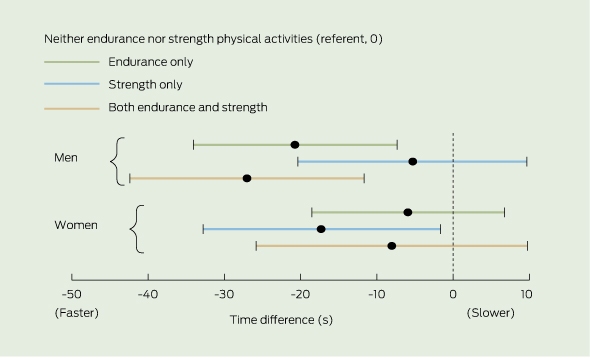
Among men, those who engaged in endurance-type physical activities only were significantly faster (by 21 s; P = 0.003) than those who did no endurance- or strength-building activities. Men who carried out both types of activities were significantly faster (by 27 s; P = 0.001) (Box 2); participation in strength-building exercises only was unrelated to race time (P = 0.49) (Box 2). In contrast, among women, strength-building activities (P = 0.03) were significantly associated with faster race times, but endurance activities (P = 0.36) and endurance and strength activities together (P = 0.37) were not (Box 2).
Discussion
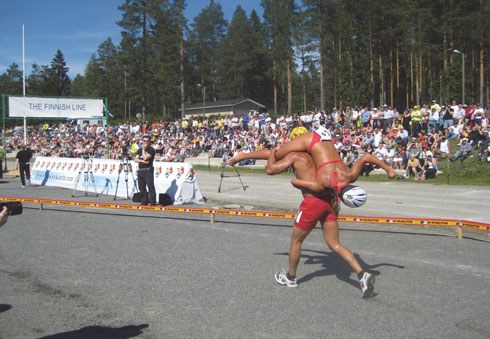
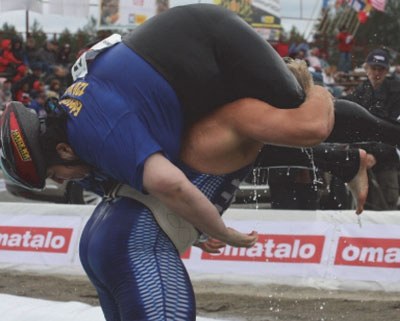
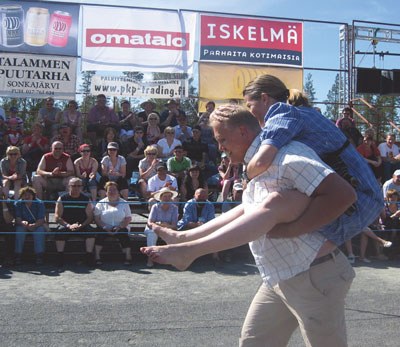
Over the first 19 years of the annual Wife Carrying World Championship, we identified several factors associated with faster wife-carrying times. Estonians had faster times, although not significantly faster (most likely due to the small sample). Estonians have developed a technique, referred to as the “Estonian carry”, where the “wife” hangs upside-down with her legs around the husband’s shoulders, holding onto his waist (photograph next page).
As expected, participation in endurance-type activities helped men race faster; however, among women, strength activities were associated with better race times, but endurance activities were not. This may be because a stronger woman can cling more tightly to the man, providing a more streamlined form while racing.
To our knowledge, this is the first study investigating faster performance in a wife-carrying competition. More research needs to be done, since our study was limited by the data available on race entry forms, leading to missing data on many couples and potential bias. While included couples probably represented the field, participants were a self-selected sample. We lacked information on potentially important factors (eg, wife’s body weight). We also lacked data on how best to train for such races (and therefore cannot ascertain whether current physical activity guidelines suffice6) and injury rate. We acknowledge the potential for injury associated with this sport; clearly, this activity is not recommended for everyone. In contrast to the sport of wife carrying, much detailed research is conducted for soccer.7,8 Soccer, immensely popular worldwide, shares similar health-bestowing characteristics — exercise, social relationships (teammate camaraderie), and beer (flung by opposing team fans) — with wife carrying.
Elevating wife-carrying races to the prominence of soccer matches will thus provide another readily available avenue for increasing physical activity levels, which enhances health.
Competing interests
No relevant disclosures.
Acknowledgements
We thank Eero Pitkänen from the municipality of Sonkajärvi, Finland, for generously providing data and photographs; and Christoph Wenger from the Institute of Sport Science, University of Graz, Austria, and Willibald Stronegger from the Institute of Social Medicine and Epidemiology, Medical University of Graz, Austria, for their assistance with data analysis.
References
- World Health Organization. The World Health Report 2002: reducing risks, promoting healthy life. Geneva, Switzerland: World Health Organization, 2002.
- Anon. Reebok and Cirque du Soleil launch innovative gym workout for women – JUKARI Fit to Fly [press release]. Canton, Mass: Business Wire 2009. http://www.businesswire. com/news/home/20090225005163/en/Reebok-Cirque-du-Soleil-Launch-Innovative-Gym (accessed Jun 2011).
- Holt-Lunstad J, Smith TB, Layton JB. Social relationships and mortality risk: a meta-analytic review. PLoS Med 2010; 7: e1000316. 0_i1149740
- Wife Carrying World Championships. http://www.eukonkanto.fi/en (accessed Jun 2011).
- Kloner RA, Rezkalla SH. To drink or not to drink? That is the question. Circulation 2007; 116: 1306-1317. 0_i1149744
- US Department of Health and Human Services. Physical Activity Guidelines Advisory Committee report, 2008. http://www.health. gov/paguidelines/ (accessed Oct 2011).
- Brink MS, Nederhof E, Visscher C, et al. Monitoring load, recovery, and performance in young elite soccer players. J Strength Cond Res 2010; 24: 597-603. 0_i1149748
- Mujika I, Santisteban J, Castagna C. In-season effect of short-term sprint and power training programs on elite junior soccer players. J Strength Cond Res 2009; 23: 2581-2587. 0_i1149750
Mild traumatic brain injury and concussion and persisting post‐concussion symptoms: new guidelines to support evidence‐based assessment and management in Australia and Aotearoa New Zealand
Karen M Barlow, Jennie L Ponsford, Alice Theodom, Gill Cowen, Gavin A Davis, Vicki Anderson, Franz E Babl, David Cole, Jennifer Cullen, Stuart R Dalziel, Melinda Fitzgerald, Howard Flavell, Caroline Yates, Rebecca Kimble, John H Olver, Rhonda Orr, Mark Ralfe, Michael Rose, Nick Rushworth, Julia Treleaven, Gary Browne, Nathan Delang, Sarah Harris, Gary Mitchell, Sean Tweedy
Physical activity interventions to prevent and manage type 2 diabetes in Aboriginal and Torres Strait Islander people: a systematic review
Raymond J Kelly, Rona Macniven, Leonid Churilov, Margaret J Morris, David O'Neal, Elif I Ekinci
The economics of a national anterior cruciate ligament injury prevention program for amateur football players: a Markov model analysis
Andrew Ross, Joosup Kim, Marnee McKay, Evangelos Pappas, Natalie Hardaker, Matt Whalan, Kerry Peek
Concussion in Aboriginal and Torres Strait Islander peoples: what is the true epidemiology?
Jonathan Bullen, Trish Hill‐Wall, Elizabeth Thomas, Richard Norman, Gill Cowen
Chronic traumatic encephalopathy in Australia: the first three years of the Australian Sports Brain Bank
Catherine M Suter, Andrew J Affleck, Maggie Lee, Alan J Pearce, Linda E Iles, Michael E Buckland