




Volume 195 - Issue 11
The glass stethoscope
Author: Milton G Roxanas
Med J Aust 2011; 195 (11): 728-729. || doi: 10.5694/mja11.11007
Published online: 12 December 2011
Published online: 12 December 2011
It has been the ambition of physicians since the origin of time to diagnose illness and internal pathology by some external means. The ancients used observation, palpation, succussion, the pulse, mensuration, uroscopy and later percussion but the first instrument to examine the inside the body in a non-invasive way was the stethoscope, which was devised by René Théophile Hyacinthe Laennec (1781–1826).
The history of listening to breath sounds dates back to antiquity, being mentioned in the Ebers Papyrus (c.1500 BC), the Hindu Vedas (c.1400–1200 BC) and the Hippocratic writings (c.400 BC),1 but a proper examination of the chest started with Josef Leopold Auenbrugger’s (1722–1809) introduction of percussion, which he learnt from his father, who used to tap kegs to determine the fluid level.2 Jean-Nicolas Corvisart (1755–1821), physician to Napoleon I, translated Auenbrugger’s book3 into French in 1808, thus popularising percussion, and taught direct auscultation by pressing the ear to the chest. Corvisart4 taught Laennec these techniques, but London physician Augustus Bozzi Granville5 stated that Laennec was dissatisfied with the results. Granville relates that Laennec became frustrated with the use of percussion and direct auscultation to examine a patient. Laennec asked “Why should we not avail ourselves of the help which acoustics yield to us?”, took a notebook from a student, rolled it lengthwise and listened to the patient’s chest.2 However, Laennec’s account of the discovery differs.6 In 1816, when he was consulting an obese female patient with heart disease, he found that “percussion and the application of the ear were of little avail on account of the great degree of fatness”.2 He states that he rolled three quires of paper into a cylinder and applied one end onto the region of the heart and the other to his ear, and was pleasantly surprised to hear the heartbeat more clearly than on direct auscultation. Laennec named his instrument “stethoscope”, derived from the Greek words stethos (chest) and skope (examination).
Thus the original stethoscope was made of paper, and Granville took one home to England when he returned in November 1817. Laennec was a good wood-turner and made his own stethoscopes out of wood (of various kinds) and sold one with each copy of his book. He also provided a do-it-yourself description of how to make one. These stethoscopes were about 30 cm long and 40 mm in diameter, with a 6 mm central bore. Laennec was fortunate to be working at a time when hospitals were becoming cleaner and more accepted, and he was consequently able to examine a large variety of patients and correlate physical findings with morbid pathology. He described bronchitis, bronchiectasis, pleurisy, lobar pneumonia, emphysema, pneumothorax, pulmonary oedema and gangrene, and his terms, such as rales, bronchophony, bruit, fremitus, cracked-pot sound, cavernous breathing and pectoriloquy, are still in use today.2 He is also known for his work on alcoholic cirrhosis: the term “Laennec’s cirrhosis” was popularised in the United States and Canada by William Osler, but ignored in France.7
The monaural stethoscope was carried, by a clip, in the crown of a top hat, and was given by teachers as a prize to top students and as a gift by wives to husbands. In 1848, Oliver Wendell Holmes wrote his “Stethoscope song” as a satirical tribute.8
The binaural stethoscope became popular in the United States earlier than in Europe, thanks to a good practical version designed by G P Cammann of New York in 1852 and William Osler’s preference for the design.1
Farquhar McCrae is believed to have brought the stethoscope to Australia in 1839.9
What of the glass stethoscope? Laennec made stethoscopes out of wood, glass, metals and “goldbeaters skin” (calf intestine), but he thought that paper, lighter wood or Indian cane were superior to glass or metal10 (he also stressed that metal and glass stethoscopes felt cold when applied to the chest11). In 1856, Austin Flint, “the American Laennec”, disagreed, believing that wood did not conduct sound as well as metal or glass.11 However, this is a strange statement, as glass itself is a poor conductor of sound and glass stethoscopes conduct sound by air alone. Fortunately, Flint changed his opinion in 1866.2
In 1864, Routh wrote that the glass stethoscope “has been used for a long time; and glass has a signal advantage. It is a beautiful conductor of sound, and rather, I think, raises the pitch”.12 He goes on to enumerate its other advantages — it is easy to clean, makes no noise when it is rubbed against clothes, and preserves women’s modesty. Routh preferred a curved type. It may also be that obstetric glass stethoscopes were more widely used because their shorter stem conducted sound better than those made from other materials. There is a short-stemmed glass stethoscope in the museum of the Royal College of Physicians in London that may have seen use in obstetrics.
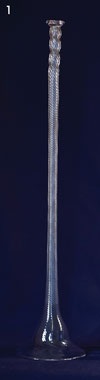
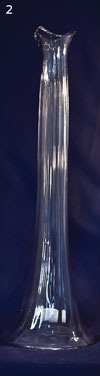
Few glass stethoscopes have stood the test of time, although it is difficult to say whether this is due to their limited production or their fragility. I have been able to trace only three: the short-stemmed obstetric example mentioned above, and two others in my collection. One, probably made in the early part of the nineteenth century, is ornate and finely sculpted, probably of French origin and about 40 cm long, with a central bore of 17 mm (Box 1). The other is of sturdier quality, heavier and of plain appearance, also about 40 cm long, with a central bore of 40 mm (Box 2). They were sometimes described as epidemic stethoscopes due to the distance they interposed between the doctor and an infected patient, or as pauper’s stethoscopes, because they were used in public clinics where the patients were poor and often filthy.
Sound conduction in these glass stethoscopes does not compare with modern stethoscopes, but it was better to use such a stethoscope than to put an ear directly, in an indiscreet way, to the chest of a naked and dirty patient.
Acknowledgements
I thank Richard Golden (New York) for encouraging me to write this article and for his suggestions to improve it, and M Donald Blaufox (New York) for his book and helpful comments. The assistance of librarians Kaye Lee (Concord Hospital) and Liz Rouse (Royal Australasian College of Physicians) in locating obscure references is gratefully acknowledged. I also thank my daughter-in-law Chantale Roxanas for her photography.
References
- Bishop PJ. Evolution of the stethoscope. J R Soc Med 1980; 73: 448-456. 0_CBBFJCHJ
- Blaufox MD. An ear to the chest: an illustrated history of the evolution of the stethoscope. New York: Parthenon Publishing Group, 2002. 0_i1115643
- Auenbrugger JL. Inventum novum ex percussione thoracis humani ut signo abstrutsos interni pectoris morbos detegendi. 1761. 0_i1115645
- Corvisart JN. Nouvelle methode pour reconnaitre les maladies internes de la poitrine. Paris: Migneret, 1808. 0_i1115647
- Granville AB. Sudden death. London: John Churchill, 1854. 0_i1115649
- Laennec RTH. De l’auscultation mediate ou traite du diagnotic des maladies des poumons et du coeur. Paris: Brosson et Chaude, 1819. 0_i1115651
- Duffin JM. Why does cirrhosis belong to Laennec? CMAJ 1987; 137: 393-396. 0_i1115653
- Holmes OW. The poetical works of Oliver Wendell Homes. Edinburgh: David Douglas, 1892. 0_i1115655
- Gandevia B. The evolution of the stethoscope and the techniques of auscultation and percussion. Med J Aust 1960; 1: 782-787. 0_i1115657
- Forbes J, Tweedie A, Conolly J. The cyclopedia of practical medicine. London: Sherwood, Gilbert, Piper, Baldwin, Craddock, 1833. 0_i1115659
- Wilbur CK. Antique medical instruments. 6th ed. Atgen, Pa: Schiffer Publishing Ltd, 2008. 0_i1115661
- Routh C. On some of the symptoms of early pregnancy. BMJ 1864; 2: 594. 0_i1115664
Prisoner of war pathology in Changi, 1942–1945
Kate Ariotti, Elizabeth Roberts‐Pedersen
Should medical eponyms continue to be used in everyday practice?
Leya Nedumannil, Diana Lewis
100 years on: the first use of insulin in Australia
Sophie Templer
Reflections on the life and career of Professor Dame Valerie Beral AC DBE FRS FRCOG FMedSci (1943–2022)
Karen Canfell, Bette Liu, Emily Banks
The Honourable Dr Donald James Grimes AO
Michael Kirby, Patti Warn
From wipeout to drill out: a history of exostosis management and Australian surfing
Alon Taylor, Hannah North, Narinder P Singh, Paul A Fagan