




Volume 195 - Issue 10
Accidental ingestion of plastic from takeaway containers — food for thought
Authors: Athanasios Sioulas, Dimitrios Polymeros, Ioannis S Papanikolaou and Konstantinos Triantafyllou
Med J Aust 2011; 195 (10): 580. || doi: 10.5694/mja11.10918
Published online: 21 November 2011
Published online: 21 November 2011
To the Editor: We read with interest the case report by Guirgis and colleagues. Recently, we examined a 62-year-old man with a 20-day history of dysphagia with solids and odynophagia. He did not recall ingesting any foreign body, and his medical history and physical examination were unremarkable.
To the Editor: We read with interest the case report by Guirgis and colleagues.1
Recently, we examined a 62-year-old man with a 20-day history of dysphagia with solids and odynophagia. He did not recall ingesting any foreign body, and his medical history and physical examination were unremarkable.
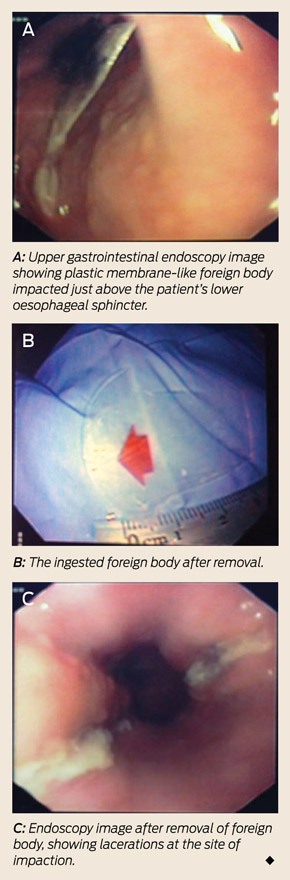
Upper gastrointestinal endoscopy showed a plastic membrane-like foreign body with sharp edges impacted just above the lower oesophageal sphincter and causing injury to the surrounding mucosa (Box, A). The endoscope could easily pass distally, and the subsequent gastroduodenoscopy did not show any mucosal lesions. A flexible overtube was placed just above the foreign body, which was then captured using rat-tooth forceps. As it was larger than the overtube diameter, the foreign body was initially folded, then wedged into the overtube and safely extracted.2 The ingested body was an arrow-shaped, stiff plastic membrane with sharp edges, measuring 3.5 cm × 2 cm (Box, B). The patient denied consuming food directly from takeaway containers. Therefore, the foreign body may have been part of a snack food package, as the patient reported that he frequently ate packaged snacks. After the foreign body had been removed, two lacerations were visible at the site of impaction (Box, C). The patient reported complete relief of his symptoms and was discharged immediately after endoscopy on oral proton-pump inhibitor treatment.
Oesophageal complications due to swallowed sharp foreign bodies include perforation, fistula formation, mediastinitis, and even aortic rupture. Such complications warrant urgent endoscopic intervention, which represents a challenge if the foreign body is larger than the diameter of the overtube.
Competing interests
No relevant disclosures.
References
- Guirgis M, Nguyen R, Pokorny C. Accidental ingestion of plastic from takeaway containers — food for thought. Med J Aust 2011; 194: 245-246. 0_CHDHGAGH
- Swaminath A, Lucas AL, Capiak K, et al. A foreign body larger than the overtube diameter: a case of a large cow foot bone causing esophageal impaction. Gastroenterol Hepatol (N Y) 2010; 6: 793-795. 0_CBBIJHFA
Early-Onset Colorectal Cancer With Liver-Only Metastases: A Retrospective Cohort Study Integrating Prospectively Collected Real-World Clinical and Molecular Data From an Australian National Database (2009–2024) to Guide Treatment Planning
Savio G. Barreto, Christos S. Karapetis, Shahid Ullah, Matthew Burge, Susan Caird, Angus Campbell, Azim Jalali, Ross Jennens, Muhammad A. Khattak, Belinda Lee, Stephanie H. Lim, Shehara Mendis, Louise Nott, Timothy J. Price, Jeremy D. Shapiro, Jeanne Tie, Javier Torres, Colin Williams, Rachel Wong, Vanessa Wong, Peter Gibbs
Australian Pathways for Specialist Pain Management and Early Palliative Care for People With Pancreatic Cancer: Developed Using a Community Consensus Approach
Jennifer Philip, Melanie R. Lovell, Kylee Bellingham, Gail Garvey, Gregory B. Crawford, Nicole M. Rankin, Kara Burns, Isabel Young, Vivienne Milch, Dorothy Keefe, Katrina Anderson, James Lawson, Meinir Krishnasamy
Cause‐specific mortality among Queensland people with cirrhosis, by cirrhosis aetiology and decompensation status, 2007–22: a retrospective cohort study
Vikas Bhasker, Jessica R Fong, Paul J Clark, Gunter F Hartel, Richard Skoien, James O’Beirne, Elizabeth E Powell, Patricia C Valery
Clinical practice guidelines for hepatocellular carcinoma surveillance for people at high risk in Australia: summary of recommendations
Jacob George, Nicole L Allard, Stuart K Roberts, Leon A Adams, Jane Davies, Behzad Hajarizadeh, Jennifer H MacLachlan, Suzanne E Mahady, Rosalie Altus, Catherine Brown, David C Fry, Belinda Greenwood‐Smith, Natali Smud, Patricia C Valery, Nafisa Yussf, Kate Broun, Denise Campbell, Karen Canfell, Chelsea Carle Harrison, Victoria Freeman, Paul Grogan, Catherine Holliday, Suzanne Hughes, Anna Kelly, Cathelijne Kemenade, Claire Latumahina, Amanda McAtamney, Megan Varlow, Joachim Worthington, Susan Yuill, Eleonora Feletto
Assessment of metabolic dysfunction‐associated fatty liver disease in primary care: a consensus statement summary
Leon A Adams, William W Kemp, Kate R Muller, Elizabeth E Powell, Stuart K Roberts, Luis Calzadilla Bertot, Stephanie Best, Gary Deed, Jon D Emery, Samantha L Hocking, Graham R Jones, John S Lubel, Sinead Sheils, Stephen M Twigg, Gerald F Watts, Jacob George
Treatment outcomes for people with hepatitis C referred to tertiary care in Victoria, 2021–22: a retrospective observational study
Elly Layton, Nicole Matthews, Brendan Quinn, Nasra Higgins, Gabrielle Lindeman, Mielle Abbott, Jennifer MacLachlan, Elizabeth Birbilis, Margaret E Hellard, Joseph Doyle, Benjamin C Cowie, Mark Stoové