




Volume 194 - Issue 8
Evidence-based asthma management in children — what’s new?
Authors: Peter P Van Asperen, Craig M Mellis, Peter D Sly and Colin F Robertson
Med J Aust 2011; 194 (8): 383-384. || doi: 10.5694/j.1326-5377.2011.tb03025.x
Published online: 18 April 2011
Published online: 18 April 2011
The Thoracic Society of Australia and New Zealand has updated its guidelines on corticosteroid use in childhood asthma
The understanding of childhood asthma has increased substantially since the publication of the Thoracic Society of Australia and New Zealand (TSANZ) position statement The role of corticosteroids in the management of childhood asthma in 2002.1 In particular, recognition of the need for separate asthma management guidelines for children aged 5 years or younger has increased,2 and considerably more clinical research evidence on the role of asthma medications in children has become available. The 2010 revision of the TSANZ position statement provides updated recommendations on the roles of inhaled corticosteroids, oral corticosteroids, leukotriene receptor antagonists and combination medications (inhaled corticosteroids plus long-acting β-agonists) in childhood asthma management based on recently published evidence.3 The role of leukotriene receptor antagonists in the management of childhood asthma has also been addressed in detail in a recent National Asthma Council Australia information paper.4
The National Asthma Council Australia provides a comprehensive overview of the role of preventive treatment in childhood asthma in its Asthma management handbook 2006.5 It advocates a stepwise approach to drug therapy that is based on asthma severity. If control is not achieved using initial preventer therapy, it is important to review the diagnosis of asthma — particularly in children aged 5 years or younger — as many children with recurrent cough are mislabelled as having asthma6 and different wheezing phenotypes require different treatment approaches.2 Before escalating the level of preventer therapy, it is also essential to check the child’s inhaler technique and adherence to treatment. Step-down treatment (“back titration”) is advocated once control has been achieved and sustained for at least 3 months.
Two placebo-controlled studies of montelukast have established the efficacy and safety of this medication and form the basis of its current Pharmaceutical Benefits Scheme listing for children with frequent intermittent or mild persistent asthma.3,4 Compared with placebo, regular montelukast therapy produces a modest reduction in exacerbation risk in children with viral-induced wheezing.3,4 An additional benefit of montelukast therapy is its proven efficacy for protecting against exercise-induced bronchoconstriction,3,4 being more effective than long-acting β-agonists without development of the tolerance seen with long-acting β-agonists.3 This information led to the current Pharmaceutical Benefits Scheme listing of montelukast for children aged 6–14 years who have ongoing activity-related asthma despite inhaled corticosteroid treatment.
The effectiveness of prophylactic inhaled corticosteroids in persistent childhood asthma is well established.3 In contrast, regular inhaled corticosteroid treatment for intermittent, viral-induced wheezing does not reduce rates of hospitalisation, use of oral corticosteroids, or frequency and duration of acute episodes.3 Systemic effects of inhaled corticosteroids in children are well documented; they include impaired linear growth, adrenal suppression, and effects on bone mineralisation.3 Although the clinical significance of these adverse effects is uncertain, factors such as individual susceptibility, severity of asthma, age, pubertal status, total dose, and dose delivery may affect risk of systemic toxicity.
Although it is common to add a long-acting β-agonist to inhaled corticosteroids (as a single combination inhaler) there are few paediatric studies examining this practice, and these suggest that, while the combination improves lung function, it does not reduce exacerbation risk — in fact, it may increase it.3 These recent studies support the current National Asthma Council recommendations of reserving the addition of long-acting β-agonists for children with asthma that is not adequately controlled by 200–250 μg/day fluticasone propionate or equivalent doses of other inhaled corticosteroids,3 and highlight the potential role of montelukast as an alternative add-on therapy. The use of long-acting β-agonists is not, however, recommended for children aged 5 years or younger.2,3
Our recommendations for preventer treatment in childhood asthma are summarised in the Box. Children with infrequent intermittent asthma require no preventer therapy. Current evidence suggests that non-steroidal preventers should be trialled first in children with frequent intermittent or mild persistent asthma, while inhaled corticosteroids are indicated as first-line preventer treatment in children with moderate–severe persistent asthma. Long-acting β-agonists or montelukast are add-on options in children with persistent symptoms despite adequate inhaled corticosteroid treatment.
In terms of acute asthma management, oral corticosteroids improve outcomes in children presenting to hospital with acute asthma, but the efficacy of oral corticosteroids for children aged 5 years or younger with acute, mild–moderate, viral-induced wheezing has been questioned.3 Based on current evidence, we recommend oral corticosteroids be reserved for children with moderate–severe acute asthma exacerbation and children with an incomplete response to β-agonists. However, in children aged 5 years or younger (particularly those with intermittent, viral-induced wheezing) the use of oral corticosteroids should be limited to those with severe wheeze who require hospital admission; an initial dose of 2 mg/kg prednisolone (maximum 60 mg) is recommended, followed by daily doses of 1 mg/kg if required. Although a 3-day course is generally sufficient, a more prolonged course may be indicated in severe cases. There is some evidence for the benefit of intermittent inhaled corticosteroids and leukotriene receptor antagonists in acute asthma, but oral corticosteroids remain the treatment of choice — particularly for more severe episodes, because of ease of administration, low cost and greater proven efficacy in severe acute asthma. The need for recurrent systemic corticosteroid therapy requires reassessment of the child’s interval therapy, particularly in cases of persistent asthma, and specialist referral.
Preventer therapy for children who have frequent intermittent or persistent asthma symptoms*
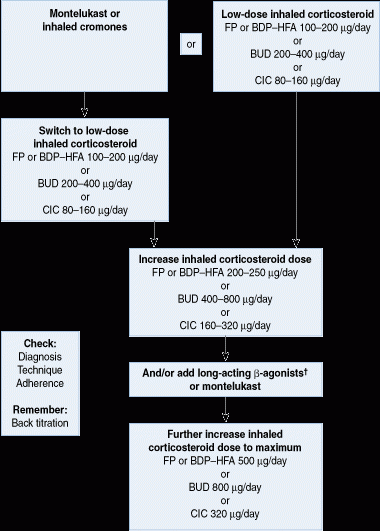
FP = fluticasone propionate.
BDP–HFA = beclomethasone dipropionate – hydrofluoroalkane.
BUD = budesonide.
CIC = ciclesonide.
* Modified from the Asthma management handbook 2006 with permission from the National Asthma Council Australia.5
† Long-acting β-agonists not recommended for children aged 5 years or younger.
Competing interests
Peter Van Asperen, Craig Mellis and Colin Robertson are members of the MSD (Australia) Paediatric Respiratory Physician Advisory Board and have received speaker fees from MSD (Australia) for presentations on management of asthma and wheeze in children. They are also members the GlaxoSmithKline Paediatric Respiratory Taskforce, which was convened to ensure appropriate prescribing of Seretide in children. Craig Mellis has also received payment for reviewing topics and chapters of UpToDate (an electronic textbook).
References
- Van Asperen PP, Mellis CM, Sly PD, for the Thoracic Society of Australia and New Zealand . The role of corticosteroids in the management of childhood asthma. Med J Aust 2002; 176: 168-173. 0_i1095915
- Global Initiative for Asthma. Global Strategy for the diagnosis and management of asthma in children 5 years and younger. 2009. http://www.ginasthma.com/Guidelineitem.asp??l1=2&l2=1&intId=1689 (accessed Mar 2011).
- Van Asperen PP, Mellis CM, Sly PD, Robertson C, for the Thoracic Society of Australia and New Zealand. The role of corticosteroids in the management of childhood asthma. 2010. http://www.thoracic.org.au/imagesDB/wysiwyg/Steroidsinasthma_2010.pdf (accessed Mar 2011).
- National Asthma Council Australia. Leukotriene receptor antagonists in the management of childhood asthma. Melbourne: NAC, 2010. http://www.nationalasthma.org.au/content/view/219/146 (accessed Mar 2011).
- National Asthma Council Australia. Asthma management handbook 2006. Melbourne: NAC, 2006. http://www.nationalasthma.org.au/cms/index.php (accessed Mar 2011).
- Chang AB, Landau LI, Van Asperen PP, et al. Cough in children: definitions and clinical evaluation. Position statement of the Thoracic Society of Australian and New Zealand. Med J Aust 2006; 184: 398-403. 0_i1095927
Provenance: Commissioned; not externally peer reviewed.
Barriers and Facilitators to Timely Detection and Optimal Management of Chronic Wet Cough in Aboriginal Children Across Australia From the Perspectives of Carers of Aboriginal Children: A Qualitative Study
Gloria T. Y. Lau, Pam Laird, Robyn Aitken, Melanie Barwick, Liam Bedford, Emily R. Bowden, Jamie Everingham, Angela Fuery, Reece Griffin, Neha Jain, Mina Kinghorn, Renae Knapp, Gabrielle B. McCallum, Peter Morris, Richard Norman, Peter C. Richmond, Aarti Saiganesh, Slade Sibosado, Cameron Taylor, Maree Toombs, Roz Walker, Joan Wilson, Anne B. Chang, André Schultz
Barriers and Facilitators to Timely Detection and Optimal Management of Chronic Wet Cough in Aboriginal Children Across Australia From the Perspective of Health Care Providers: A Qualitative Study
Gloria T. Y. Lau, Pamela Laird, Robyn Aitken, Melanie Barwick, Liam Bedford, Emily R. Bowden, Corey Dalton, Jamie Everingham, Angela Fuery, Reece Griffin, Neha Jain, Mina Kinghorn, Renae Knapp, Gabrielle B. McCallum, Peter Morris, Richard Norman, Peter C. Richmond, Aarti Saiganesh, Slade Sibosado, Maree Toombs, Roz Walker, Joan Wilson, Anne B. Chang, André Schultz
Short-Term Safety of Concomitant Meningococcal B and National Immunisation Program Vaccines in Infants Aged < 15 Months: A Survey-Based Surveillance Study
Thuy Nguyen, Evelyn C. S. Tay, Michael Dymock, Thomas L. Snelling, Lucy Dawes, Julie Marsh, Yue Wu, Alan Leeb, Nicholas Wood, Lucy Deng
The GenV Biobank: Enabling Biological Research in a Large Longitudinal Population-Representative Cohort of Australian Newborns and Their Parents
Katherine Lange, Kim L. Powell, Yeukai Mangwiro, Tony Frugier, Donna T. Geddes, Melissa Wake, Richard Saffery
Watchful Waiting Compared With Immediate Antibiotics for Urban Aboriginal and Torres Strait Islander Children With Uncomplicated Acute Otitis Media (WATCH): A Non-Inferiority Randomised Controlled Trial
Jennifer S. Reath, Hasantha Gunasekera, Sanja Lujic, Amanda J. Leach, Letitia Campbell, Robyn Walsh, Tim Usherwood, Geoffrey K. Spurling, Claudette A. Tyson, Deborah A. Askew, Kelvin Kong, Chelsea J. Watego, Peter Morris, Wendy Hu, Penelope A. Abbott
A Rare Case of Storage Mite Anaphylaxis in Infancy
Eliza Kluckow, Katie Frith