




Volume 194 - Issue 5
Thiamine (vitamin B1) concentrations in a population of Australians with alcohol use disorders are remarkably elevated
Authors: Philip M Crowley and Matt D Gaughwin
Med J Aust 2011; 194 (5): 269-270. || doi: 10.5694/j.1326-5377.2011.tb02966.x
Published online: 7 March 2011
Published online: 7 March 2011
To the Editor: In Australia, addition of thiamine to bread flour (at 6.4 mg/kg) was made mandatory on 1 January 1991 in an effort to reduce the incidence of Wernicke’s encephalopathy and Korsakoff psychosis.1 Recently, an isocratic high-performance liquid chromatography (HPLC) method for the assessment of thiamine, thiamine monophosphate and thiamine diphosphate (TDP) in human erythrocytes has been described.2 This direct method of measuring thiamine in blood is superior to measuring red blood cell transketolase.
We used an HPLC reagent kit (Chromsystems Instruments and Chemicals GmbH, Munich, Germany) to measure whole blood TDP concentrations in a population of 156 people who had alcohol use disorders. They were consecutive cases presenting between June and September 2010 at a driver assessment clinic in South Australia after they were convicted of two or more drink-driving offences. Thirty-two people taking a thiamine-containing medication or vitamin supplement were excluded. Based on the Diagnostic and statistical manual of mental disorders, fourth edition, text revision, of the remaining 124 people, 42 fulfilled criteria for “alcohol dependence” and 82 fulfilled criteria for “alcohol abuse” in the preceding 12 months.3
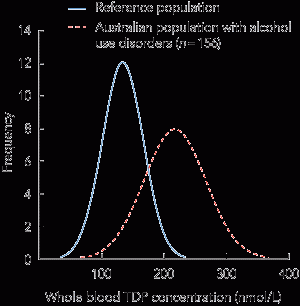
Of those tested, none had biochemical thiamine deficiency (defined as 2 standard deviations below the reference mean TDP concentration [< 66.5 nmol/L]). The lowest whole blood TDP concentration was 106 nmol/L. The highest concentration found was 362 nmol/L. The mean concentration was 217 nmol/L. This value is 2.5 standard deviations above the mean for the reference population (mean, 133 nmol/L; SD, 33 nmol/L).4,5 The reference range (66.5–200 nmol/L) was derived from a population that did not receive thiamine supplementation in foods. The characteristics of the distributions of thiamine concentrations in the Australian and reference populations are shown in the Box. The mean age of our population was 36 years, the youngest person was aged 19 years and the oldest, 73 years. The mean body mass index was 26.6 kg/m2 and the lowest was 18 kg/m2, so this group was not malnourished. The mean daily alcohol intake reported was 22 g/day but there was wide variation (range, 0–272 g/day; SD, 35 g/day).
The results from the population with alcohol use disorders show remarkably elevated thiamine concentrations and no evidence of thiamine deficiency. The very high mean concentration of thiamine shows that this population is not at immediate risk of thiamine deficiency. It also suggests that mandatory supplementation of flour with thiamine has raised the baseline concentration of thiamine in Australians.
Acknowledgements
We thank the staff and clients of the Driver Assessment Clinic, Drug and Alcohol Services South Australia.
References
- Harper CG, Sheedy DL, Lara AI, et al. Prevalence of Wernicke–Korsakoff syndrome in Australia: has thiamine fortification made a difference? Med J Aust 1998; 168: 542-545.
- Mancinelli R, Ceccanti M, Guiducci MS, et al. Simultaneous liquid chromatographic assessment of thiamine, thiamine monophosphate and thiamine diphosphate in human erythrocytes: a study on alcoholics. J Chromatogr B Analyt Technol Biomed Life Sci 2003; 789: 355-363. 0_CBBCHEGG
- American Psychiatric Association. Diagnostic and statistical manual of mental disorders, fourth edition, text revision. Washington, DC: APA, 2000. 0_i1095866
- Chromsystems Instruments and Chemicals. Instruction manual for the HPLC analysis of vitamin B1 in whole blood. Munich: Chromsystems Instruments and Chemicals GmbH, 2008. 0_i1095868
- Krapf FE, Bieger WP, Tiller FW. [Laboratory data book][German]. München: Urban and Shwarzenberg, 1995: 361. 0_i1095870
Gabapentinoid Poisoning Presentations to Victorian Emergency Departments: A 15-Year Trend Analysis
Bishaal Tej Gurung, Amy McNeilage, Angus Skeen, Tina Lam, Joanna F. Dipnall, Jane Hayman, Suzanne Nielsen, Ting Xia
Hospital-Admitted Injection-Related Infections Among Incarcerated People Who Inject Drugs in Australia: A Retrospective Cohort Study
Andrew Palmer, Matthew Carter, Jeremy Yeo, Cecilia Shim, Jason Connor, Jeremy Hayllar, Gerald Holtmann, Naomi Moy, Elliott G. Playford, Naomi Runnegar, Paul J. Clark
The Management of Withdrawal From Alcohol and Other Drugs in Australian Custodial Settings: A Consensus Statement
Grace FitzGerald, Jocelyn Chan, Jon Cook, Mark Stoove, Michael Curtis, Suzanne Nielsen, Rebecca J. Winter, Thileepan Naren
Impact of Prescription Drug Monitoring Program Implementation on Rates and Characteristics of People Seeing Multiple Prescribers in Primary Care: A Controlled Interrupted Time-Series Analysis
Louisa Picco, Monica Jung, Grant Russell, Samanta Lalic, Mahbod A. Fini, Dan I. Lubman, Rachelle Buchbinder, Ting Xia, Suzanne Nielsen
Early Cessation of Acetylcysteine Treatment After Paracetamol Overdose (NACSTOP 2): A Non-Inferiority Randomised Controlled Trial
Anselm Wong, Richard McNulty, Sarah E. Hodgson, Naren Gunja, Andis Graudins
The risk of death after hospitalisation following intentional self‐poisoning: a retrospective observational study (PAVLOVA‐2)
Firouzeh Noghrehchi, Nicholas A Buckley, Rose Cairns