




Volume 194 - Issue 5
Frequency of documentation of family communication in an Australian intensive care unit: a retrospective study
Authors: Riad L Silcock, Bala Venkatesh, Ranald L Pascoe and Dianne K Fisher
Med J Aust 2011; 194 (5): 271-272. || doi: 10.5694/j.1326-5377.2011.tb02969.x
Published online: 7 March 2011
Published online: 7 March 2011
To the Editor: While clinicians often communicate with patients and families, documentation of these conversations is inconsistent. Documentation is critical for continuity of patient care, medicolegal reasons and research,1 and is particularly important in the intensive care unit (ICU), where discussions regarding prognosis and withdrawal of care occur frequently. There are scant published data on documentation of conversations with patients in ICUs and their families.
We conducted a retrospective audit of patients admitted to the ICU of Wesley Hospital (a 500-bed private teaching hospital in Brisbane) between 1 January and 31 August 2009 to:
determine levels of documentation of communication with patients and their families by the ICU medical staff; and
compare this with documentation of communication by the primary physician before and after admission to the ICU.
After obtaining Wesley Hospital ethics committee approval, all patients who were cared for in the general ICU for more than 5 days were studied.
During the study period, there were 862 ICU admissions, 100 of which met our inclusion criteria. The charts of only 82 patients could be successfully retrieved and these were used for final analysis. These patients had a mean age of 64 years (SD, 14 years), and a mean Acute Physiology and Chronic Health Evaluation II (APACHE II) score of 17 (SD, 7). Sixty patients (73.1%) survived to hospital discharge.
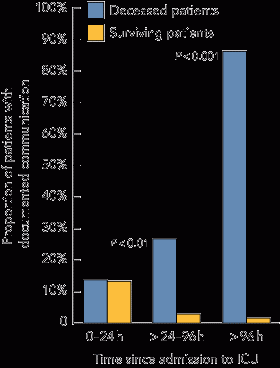
In the ICU, there were 39 family conferences at any stage between an ICU clinician and the families documented for 24 patients (29% of patients; 1.6 conferences per patient). Eleven of these conferences took place in the first 48 hours, eight between 2 and 4 days, and 20 beyond 96 hours of ICU admission. The Box shows that there was a greater proportion of documented family conferences for patients who died compared with those who survived at both 2–4 days (27% v 3%; P < 0.01) and beyond 96 hours (86% v 1.5%; P < 0.001). Of note, there was no documented communication between the hospital’s admitting physician and patients or families before ICU admission or after discharge from the ICU. Intensivists use any prior discussions to make decisions about continuing or withdrawing care.2 The absence of documentation before ICU admission is clinically relevant in this context.
Potential reasons for inadequate documentation include (i) discussions occurring informally at the bedside or outside of the ICU (corridor conversations) and (ii) nurses providing updates in the clinician’s absence. Better documentation in the charts of dying patients may reflect their longer ICU stays, which provide more opportunity for communication. Moreover, discussions on treatment withdrawal are more likely to be documented as they are often a shared decision-making process.
Globally, levels of documentation vary (10%–90%).3,4 Potential strategies to improve documentation include: bedside reminders (such as “have you documented family conferences?”); availability of a communications officer; an internal appointments system for formal discussions; and the use of communication kits.5 Despite being a retrospective study, our findings suggest a need to improve levels of documentation, and may prompt clinicians to examine their documentation practices and develop protocols to improve record keeping.
References
- Curtis JR, White DB. Practical guidance for evidence-based ICU family conferences. Chest 2008; 134: 835-843. 0_CBBIFBFE
- Cook D, Rocker G, Marshall J, et al. Withdrawal of mechanical ventilation in the intensive care unit. N Engl J Med 2003; 349: 1123-1132. 0_CBBBIBEB
- Ratnapalan M, Cooper AB, Scales DC, Pinto R. Documentation of best interest by intensivists: a retrospective study in an Ontario critical care unit. BMC Med Ethics 2010; 11: 1-7. 0_i1095854
- Bloomer MJ, Tiruvoipati R, Tsiripillis M, Botha JA. End of life management of adult patients in an Australian metropolitan intensive care unit: a retrospective observational study. Aust Crit Care 2010; 23: 13-19. 0_i1095856
- Nelson JE, Walker AS, Luhrs CA, et al. Family meetings made simpler: a toolkit for the intensive care unit. J Crit Care 2009; 24: 626.e7-626.e14. 0_pgfId-2277582
Reducing Nitrous Oxide Emissions Across the Melbourne Biomedical Precinct
Ross Robertson, Andrew Downey, Daryl Williams, Bjorn Makein, Ben Dunne, Tugce Ozturk, Ying Gu, Rebecca McIntyre
Greenhouse gas emissions associated with anaesthetic gases in Australia, 2002–2022: a retrospective descriptive analysis
Krista Verlis, Jessica F Davies, Forbes McGain, Hayden Burch, Alexandra L Barratt, Luise Kazda
Opioids and the challenges of managing chronic non‐cancer pain in rural Australia: a qualitative study
Jessica A Thomas, Jill Benson, Philip Davidson, Paul R Ward
Spinal cord stimulation patterns of care, re‐interventions, and costs for private health insurers, Australia, 2011–22: a retrospective observational study
Caitlin MP Jones, Christopher G Maher, Rachelle Buchbinder, Ian A Harris, Chung‐Wei Christine Lin, Christopher Hayes, Alexandra Gorelik