




Volume 194 - Issue 4
Occult lead poisoning from Ayurvedic medicine produced, prescribed and purchased in India
Authors: Nilika G Wijeratne, James C G Doery and Andis Graudins
Med J Aust 2011; 194 (4): 205-206. || doi: 10.5694/j.1326-5377.2011.tb03776.x
Published online: 21 February 2011
Published online: 21 February 2011
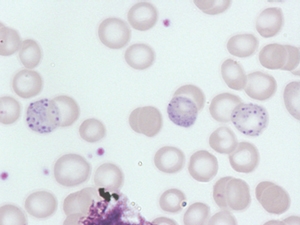
To the Editor: A 28-year-old man presented to his general practitioner with a history of epigastric pain and constipation over 1 month. In addition, he had a history of chronic low back pain. Findings on physical examination were unremarkable. Laboratory investigations showed normo-chromic, normocytic anaemia with basophilic stippling (Box 1). His whole-blood lead level was subsequently estimated to be 4.12 μmol/L (level recommended by the National Health and Medical Research Centre for all Australians, < 0.48 μmol/L). The patient was referred for toxicological review. Further questioning revealed he had used three Ayurvedic medicines (Vatyog [Arya Aushadhi Pharmaceutical Works, Indore, India], Sahacharadi [Arya Vaidya Nilayam, Madurai, India] and Gandharvahastadi [Arya Vaidya Nilayam, Madurai, India]) for back pain, dispensed to him 3 months earlier during a trip to India. He ceased taking the medications, and a 19-day course of oral chelation with succimer was administered. His blood lead concentration fell rapidly, with a moderate rebound 6 weeks after the completion of chelation therapy. A negative blood lead result for the patient’s pregnant partner excluded environmental exposure in the patient’s home.
Vatyog and Sahacharadi were analysed for heavy metals (Gandharvahastadi was not available for analysis). Sahacharadi was lead-free, but the Vatyog tablet tested contained 448 μg of lead. The patient had potentially ingested 896 μg of lead daily for 3 months. World Health Organization guidelines recommend daily lead intake should not exceed 3.5 μg/kg/day.1 Dietary intake of lead in developed nations has been reported to be about 0.1–0.7 μg/kg/day.1
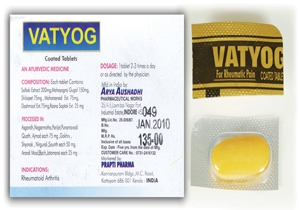
Ayurvedic medicine originated in India more than 2000 years ago and relies heavily on herbal products.2 Many people take Ayurvedic medicine without any problems. In some traditional remedies, salts of heavy metals are included as active ingredients.3 A study in the United States found that one-fifth of Ayurvedic herbal products manufactured in South India and sold in Boston contained potentially harmful concentrations of lead, mercury or arsenic, or combinations of these.2 In Australia, traditional Indian and Chinese medicines authorised for supply are regulated as complementary medicines and must meet manufacturing and quality standards that ensure the absence of contaminants.3 However, there is no quality control of medications imported for personal use or purchased over the internet. Importantly, this case involved tablets prepared by a registered pharmaceutical manufacturer and presented in sophisticated packaging (Box 2). Reports of lead contamination from traditional Indian and Chinese medicines have been intermittently publicised4,5 and include recent warnings from the New South Wales Health Department concerning Ayurvedic medicines.
Patients with lead toxicity commonly present with non-specific clinical features, and lead poisoning might only be suspected when a blood film shows anaemia with basophilic stippling. While enquiring about a patient’s environmental, occupational and social history is important for determining possible sources of lead exposure, clinicians should also ask patients if they have used alternative and complementary medicines and whether these were obtained in Australia or from overseas.
References
- Seifert M, Anke M. Alimentary lead intake of adults in Thuringia/Germany determined with the duplicate portion technique. Chemosphere 2000; 41: 1037-1043. 0_i1095866
- Saper RB, Kales SN, Paquin J, et al. Heavy metal content of Ayurvedic herbal medicine products. JAMA 2004; 292: 2868-2873. 0_CHDCBGCI
- Traditional Indian (Ayurvedic) and Chinese medicines associated with heavy metal poisoning. Aust Adv Drug Reactions Bull 2007; 26: 2. 0_i1095870
- Schalkwyk J, Davidson J, Palmer B, Hope V. Ayurvedic medicine: patients in peril from plumbism. N Z Med J 2006; 119: U1958. 0_i1095872
- NSW Health. Warning on lead poisoning from imported traditional Indian (Ayurvedic) medicine. 4 Aug 2010 [media release]. http://www.health.nsw.gov.au/news/2010/20100804_01.html (accessed Dec 2010).
Gabapentinoid Poisoning Presentations to Victorian Emergency Departments: A 15-Year Trend Analysis
Bishaal Tej Gurung, Amy McNeilage, Angus Skeen, Tina Lam, Joanna F. Dipnall, Jane Hayman, Suzanne Nielsen, Ting Xia
Self-Poisoning With Prazosin and Its Off-Label Use in Australia, 2014–2024: Analysis of NSW Poisons Information Centre Data
Olivia B. E. Lal, Nicholas A. Buckley, Rose Cairns
The risk of death after hospitalisation following intentional self‐poisoning: a retrospective observational study (PAVLOVA‐2)
Firouzeh Noghrehchi, Nicholas A Buckley, Rose Cairns
The public health impacts of mining in Australia
Javier Cortes‐Ramirez, Ruby N Michael, Leisa‐Maree Toms, Melissa Haswell
No silver lining with health misinformation: argyria caused by intentional silver consumption
Luke Collins, Logesh Palanikumar, Stephen Bacchi
Hyperkalaemic cardiac arrest due to cream of tartar ingestion
Daniel Yee Lee Ng, Laksmi Govindasamy, Andrew Hughes, Hwee Min Lee