




Volume 194 - Issue 12
How accurate are hospital scales?
Authors: Rimma Goldberg and Geoffrey Hebbard
Med J Aust 2011; 194 (12): 665. || doi: 10.5694/j.1326-5377.2011.tb03162.x
Published online: 20 June 2011
Published online: 20 June 2011
To the Editor: Weight fluctuations may lead to significant changes in a patient’s treatment, so it is vital that hospital scales are accurate. A literature review revealed that calibration,1 accuracy2 and centralised hospital quality control3 of hospital scales were issues that are being recognised and addressed around the world. We audited all scales at the Royal Melbourne Hospital, city campus, to assess their accuracy and identify the types of scales that are likely to be most accurate.
A preliminary survey identified all scales on the wards and in outpatient departments. On a single survey day, each scale was categorised and photographed. Scales were “zeroed” and standard weights of 5 kg, 10 kg, 15 kg and 20 kg, and a person whose weight had been established elsewhere as 106 kg, were then weighed on each scale. Our primary measure of accuracy was the difference between 106 kg and the recorded weight of the person, as this most closely approximated the weight of an average patient (rather than using the 5, 10, 15 and 20 kg weights).
Forty-three of 50 scales identified in the hospital were tested. Scales that were excluded were either not working or not able to be tested with the weights we used. All scales in the outpatients department were digital (22). On the wards, there was a mix of sit-on (6) and stand-on (15), and digital (9) and analogue (12) scales.
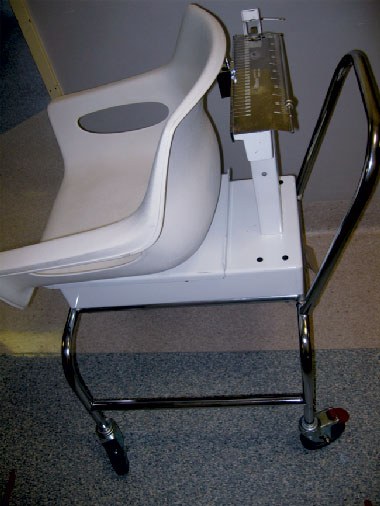
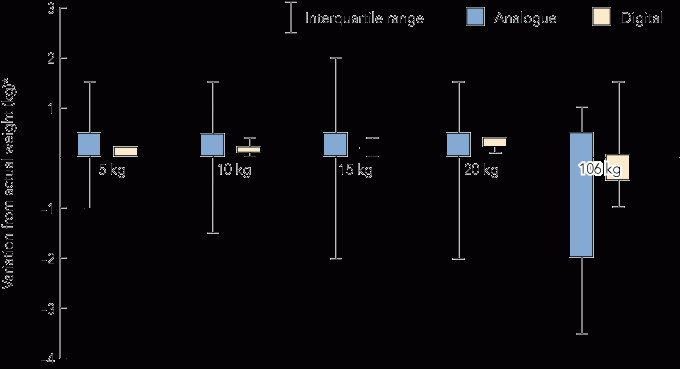
The digital scales had an accuracy (range around the standard weight) of − 1 kg to +1.5 kg, compared with an accuracy of − 3.5 kg to +1 kg for the analogue scales (P = 0.006; Wilcoxon signed rank test). Interquartile ranges were − 0.45 kg to +0.07 kg for digital scales and − 2 kg to +0.5 kg for analogue scales. The mean deviation from the correct weight was 0.06 kg for digital scales and 0.55 kg for analog scales. The most accurate scales were in the renal wards, used by dialysis outpatients and inpatients. Some areas had scales that were unusable by patients, such as sit-on scales in the geriatric ward (Box 1) that were difficult to mount. A haematology ward, where decisions are often made on the basis of changes in weight, had five sets of scales, with significant inaccuracies and differences between them. In one ward, no scales could be located, and five out of 23 outpatient rooms had no scales.
The digital scales were more accurate than the analogue scales (Box 2). In areas where treatment decisions are made on the basis of changes in weight, scales should regularly be checked for accuracy, and patients should be weighed on the same scales each time they are weighed. For greater accuracy and consistency in measuring patient weights, we recommend that all scales be upgraded to digital scales throughout the hospital.
References
- Pedrolli C, Cereda E, Costa A. Fighting hospital malnutrion: let’s start by calibrating hospital scales! Mediterr J Nutr Metab 2009; 2: 145-147. 0_CBBDCFJI
- O’Connor J, Youde LS, Allen JR, et al. Outcomes of a nutrition audit in a tertiary pediatric hospital: implications for service improvement. J Paediatr Child Health 2004; 40: 295-298. 0_CBBGFEEE
- Local Authorities Co-ordinators of Regulatory Services. The weight of the matter: final report of the LACORS national medical weighing project 2008/9. London: LACORS, 2009. http://www.lacors.gov.uk/lacors/upload/24951.pdf (accessed Apr 2011).
Shifting focus to adolescent wellbeing and inclusive participation in the digital age
Allyson R Todd, Elena Wang, Stephanie R Partridge
The clinical presentation, investigation, and management of women diagnosed with endometriosis in Australian general practices, 2011–2021: an open cohort study
Danielle Mazza, Kailash Thapaliya, Sharinne B Crawford, Alissia Hui, Maryam Moradi, Luke E Grzeskowiak
The impact of the Breast Screen NSW transition from film to digital mammography, 2002–2016: a linked population health data analysis
Rachel Farber, Nehmat Houssami, Katy J L Bell
Non‐technical errors associated with deaths in surgical care, Australia, 2012–2019, by surgical specialty (Australian and New Zealand Audit of Surgical Mortality): a retrospective cohort study
Jesse Ey, Victoria Kollias, Octavia Lee, Kelly Hou, Matheesha Herath, John B North, Ellie Treloar, Suzanne Edwards, Martin Bruening, Adam J Wells, Guy J Maddern
The CURE Asthma roadmap
Gary P Anderson, Anthony Flynn, Phil G Bardin, John D Blakey, Shyamali C Dharmage, Paul Foster, Peter G Gibson, Adam Jaffe, Alan James, Christine R Jenkins, Sundram Sivamalai, Peter D Sly, Guy B Marks, Vanessa M McDonald, Judy Wetttenhall
Evidence from Australian cohort studies about asthma trajectories and transitions across the life course: a narrative review
Caroline Lodge, Xin Dai, Ingrid A. Laing, Michael P Menden, Anthony Flynn, Gary P Anderson, Sarath Ranganathan, Shyamali C Dharmage