




Volume 193 - Issue 4
Atypical femur fractures: a complication of prolonged bisphosphonate therapy?
Authors: Christian M Girgis and Markus J Seibel
Med J Aust 2010; 193 (4): 196-198. || doi: 10.5694/j.1326-5377.2010.tb03865.x
Published online: 16 August 2010
Published online: 16 August 2010
Physicians need to be aware of this newly described complication
Every year, thousands of Australians are prescribed bisphosphonates for the treatment of osteoporosis. They are highly effective agents, with numerous large clinical trials demonstrating a significant reduction in the risk of osteoporotic fractures as early as 6 months after commencement of therapy. Bisphosphonates such as risedronate, alendronate, etidronate, pamidronate and zoledronic acid have an excellent safety profile, although gastro-oesophageal irritation or transient flu-like symptoms may occur in patients receiving oral or intravenous bisphosphonates, respectively. Other side effects, such as renal impairment, uveitis and osteonecrosis of the jaw, have been described but are extremely rare.
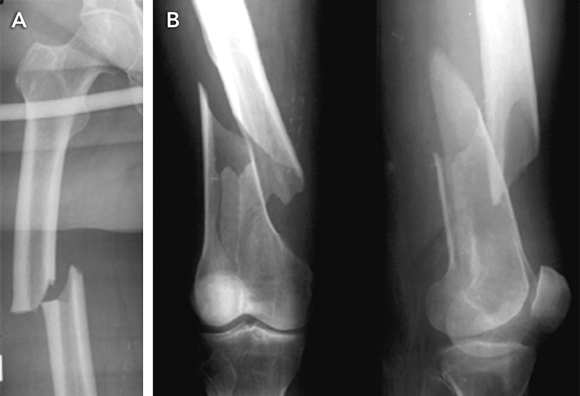
Since 2005, there have been several reports suggesting another potential side effect of long-term bisphosphonate therapy, namely the development of unusual fractures of the subtrochanteric or diaphyseal femur.1-4 Two initial case series described these femur fractures in a total of 12 patients (11 female) receiving current alendronate therapy. The mean age of these patients was 63 years and the mean treatment duration with alendronate was 6 years.2,4 The fracture pattern appeared morphologically distinct from the more common osteoporotic hip fracture and hence, in 2008, the term “atypical femur fracture” was introduced to describe a combination of three highly characteristic features: (i) a transverse or oblique fracture line occurring in (ii) an area of cortical thickening with (iii) a medial unicortical beak5 (Box). A further peculiar feature was the location of these atypical fractures in the subtrochanteric or mid-shaft femur, which is normally considered the strongest part of the femur.
In 2007–2008, three retrospective analyses confirmed the predominance of this particular fracture pattern among bisphosphonate users.6-8 The largest of these included a study of 70 patients with non-hip femoral fractures, of whom 25 were receiving alendronate.6 The atypical fracture pattern was strongly associated with alendronate use, with a reported odds ratio of 139 (95% CI, 19–939; P < 0.001). The authors again noted that these fractures were associated with a longer duration of alendronate use (on average 4.4 years longer than patients without atypical fractures) and appeared to affect younger rather than older women.
Most recently, a large 5-year retrospective study of non-hip femoral fractures found strong evidence supporting a potential association between oral bisphosphonate use and the occurrence of atypical fractures.9 Of 152 non-hip femoral fractures, 20 were classified as atypical following a detailed review of individual radiographs. Of the 20 patients, 17 had been receiving long-term therapy with either alendronate (n = 15) or risedronate (n = 2). According to this study, oral bisphosphonate use imparted a 37-fold increased risk of atypical versus typical osteoporotic fracture, with the atypical fracture pattern being 96% specific to oral bisphosphonate use.9
Other potential risk factors for developing atypical fractures include prolonged use of glucocorticoids,2,4,9,10 hormone replacement therapy,2 use of selective oestrogen receptor modulators,4 rheumatoid arthritis9,10 and vitamin D deficiency.9 The occurrence of groin or thigh pain, sometimes manifesting months before the acute fracture, has been described by several authors,1,4,7,8 with one group reporting its occurrence in 13 out of 17 (76%) atypical fracture cases.8 The pain is attributed to the development of unilateral stress fractures and should be viewed as an early warning sign in patients receiving bisphosphonate therapy. Several authors have also noted the occurrence of these fractures bilaterally.1-3,8-10
Attempts to elucidate the precise incidence of these fractures or to confirm their association with bisphosphonates on an epidemiological or observational scale have proved elusive. In 2009, a registry-based cross-sectional study of 11 944 patients failed to demonstrate a greater frequency of subtrochanteric or diaphyseal femoral fractures in patients receiving alendronate.11 Similarly, in 2010, a secondary analysis of three large randomised bisphosphonate trials including 14 195 patients concluded that subtrochanteric femoral fractures were very rare and statistically not associated with bisphosphonate use.12 However, these studies, did not assess individual fracture radiographs but, rather, relied on written reports, all of which were created many years before the recognition of the atypical fracture pattern as a distinct entity. Hence, although these studies indicate that subtrochanteric or diaphyseal femur fractures in patients receiving bisphosphonates are very rare, they do not provide definitive information on the potential association between bisphosphonate use and the occurrence of atypical fractures.
The subtrochanteric location of these femoral fractures may offer potential insight into their biomechanical evolution. The theory of bisphosphonate-related severe suppression of bone turnover, with the development of a transverse fracture in the area of maximal weight-related stress, is supported by a number of bone biopsy studies2,4,13 but remains controversial due to the lack of clear causal evidence.
In conclusion, the evidence supporting an association between bisphosphonate use and atypical fractures remains preliminary, with the failure of large epidemiological and observational studies to substantiate such an association. Certainly, these fractures are rare and their biomechanical evolution remains unclear.
With all of this in mind, physicians should remember that bisphosphonates are highly beneficial in the management of osteoporosis and that their anti-fracture effects by far outweigh the risks posed by this rare, potential reaction. However, they should also be aware of the possibility of atypical femur fractures in patients receiving prolonged oral bisphosphonate therapy, and maintain a low threshold for investigating those who report otherwise unexplained thigh or groin pain.
Atypical and typical osteoporotic fractures of the femur
 |
|
A: Radiograph demonstrating the characteristic appearance of an atypical femoral fracture: a transverse or oblique (< 30°) fracture line in an area of cortical thickening with a medial unicortical beak. The biomechanical theory of severe suppression of bone turnover with an insufficiency fracture and secondary cortical thickening at the area of maximal weight-related stress has been proposed. The patient had been receiving alendronate for 7 years before the spontaneous development of this fracture. B: Radiograph demonstrating a typical osteoporotic spiral fracture involving the diaphyseal femur. |
Competing interests
Markus Seibel is a member of advisory boards for Merck Sharp and Dohme, Novartis, Amgen and Sanofi-Aventis. He has also received funding from these companies for institutional research.
Acknowledgements
We acknowledge the assistance of Dr Monika Fazekas in data collection for our recent retrospective review.
References
- Lee P, van der Wall H, Seibel MJ. Looking beyond low bone mineral density: multiple insufficiency fractures in a woman with post-menopausal osteoporosis on alendronate therapy. J Endocrinol Invest 2007; 30: 590-597. i1093068
- Odvina C, Zerwekh J, Rao S, et al. Severely suppressed bone turnover: a potential complication of alendronate therapy. J Clin Endocrinol Metab 2005; 90; 1294-1301. i1093070
- Lee P, Seibel MJ. More on atypical fractures of the femoral diaphysis. N Engl J Med 2008; 359: 317. i1093072
- Visekruna M, Wilson D, McKiernan FE. Severely suppressed bone turnover and atypical skeletal fragility. J Clin Endocrinol Metab 2008; 93: 2948-2952. i1093074
- Lenart BA, Lorich DG, Lane JM. Atypical fractures of the femoral diaphysis in postmenopausal women taking alendronate. N Engl J Med 2008; 358: 1304-1306. i1093076
- Neviaser AS, Lane JM, Lenart BA, et al. Low-energy femoral shaft fractures associated with alendronate use. J Orthop Trauma 2008; 22: 346-350. i1093078
- Goh SK, Yang KY, Koh JS, et al. Subtrochanteric insufficiency fractures in patients on alendronate therapy: a caution. J Bone Joint Surg Br 2007; 89: 349-353. i1093080
- Kwek EB, Goh SK, Koh JS. An emerging pattern of subtrochanteric stress fractures: a long-term complication of alendronate therapy? Injury 2008; 39: 224-231. i1093082
- Girgis CM, Sher D, Seibel MJ. Atypical femoral fractures and bisphosphonate use. N Engl J Med 2010; 362: 1848. i1093084
- Somford MP, Draijer F, Thomassen BJ, et al. Bilateral fractures of the femoral diaphysis in a patient with rheumatoid arthritis on long term treatment with alendronate. J Bone Miner Res 2009; 24: 1736-1740. i1093086
- Abrahamsen B, Eiken P, Eastell R. Subtrochanteric and diaphyseal femur fractures in patients treated with alendronate: a register-based national cohort study. J Bone Miner Res 2009; 24: 1095-1102. i1093088
- Black D, Kelly M, Genant H, et al. Bisphosphonates and fractures of the subtrochanteric or diaphyseal femur. N Engl J Med 2010; 362: 1761-1771. i1093090
- Stepan JJ, Burr DB, Pavo I, et al. Low bone mineral density is associated with bone microdamage accumulation in postmenopausal women with osteoporosis. Bone 2007; 41: 378-385. i1093094
When ‘Liver Enzymes’ Are Not Hepatic: Late-Onset Pompe Disease
Shauna Madigan, Georgina England, Wayne Rankin
Primary Hyperparathyroidism in Adults: Recent Developments in Diagnosis and Management
Elizabeth Wootton, Sunita M. C. De Sousa, Richard L. Prince, Donald S. A. McLeod, David A. Pattison, Mathis Grossmann
Severe Hypoglycaemia Secondary to Chronic Opioid-Induced Hypothalamic–Pituitary–Adrenal Axis Suppression: An Under-Recognised Phenomenon
Michael Do, Annabelle Hayes, Malgorzata Brzozowska
Rethinking diabetes care for Indigenous Australians: the need for Indigenous‐codesigned and led diabetes models of care
Natalie Nanayakkara, Sharon Atkinson‐Briggs, Alicia J Jenkins, Neale D Cohen
The first Australian evidence‐based guidelines on male infertility
Darren J Katz, Liza O’Donnell, Robert I McLachlan, Tim J Moss, Clare V Boothroyd, Veena Jayadev, Sarah R Catford