




Volume 193 - Issue 2
The Australian Primary Care Collaboratives: an Australian general practice success story
Authors: Dale R Ford and Andrew W Knight
Med J Aust 2010; 193 (2): 90-91. || doi: 10.5694/j.1326-5377.2010.tb03809.x
Published online: 19 July 2010
Published online: 19 July 2010
The collaboratives approach to quality improvement has been popular with GPs and other practice staff
The Australian Primary Care Collaboratives (APCC) program has shown that Australian general practices can improve processes and outcomes in the treatment of diabetes, secondary prevention of coronary heart disease, and access to care in practices with long waits.
In the past, systems of general practice care have had an acute care bias, which has hampered patients with chronic illness in managing their conditions effectively. There is a mismatch between the needs of patients with chronic conditions and the capacity of our primary care delivery systems to meet those needs.1
Despite advances in Australian general practice, such as expanded roles for practice nurses, there is still no overall systematic approach to improving care for people with chronic disease through implementing evidence-based guidelines.
The collaborative model
For the past 5 years, the Australian Government Department of Health and Ageing has sponsored the APCC program. More than 1000 Australian general practices (12% of all practices) have participated. The program is based on the Institute for Healthcare Improvement’s “breakthrough collaborative” methodology,2 as modified by the National Primary Care Development Team in the United Kingdom. Large-scale system change in UK general practice resulted in a fourfold reduction in mortality from existing coronary heart disease and a 60% reduction in waiting times (determined by the number of days to the third next available appointment) in participating practices compared with other practices.3 In 2004, a team from Australia took part in an international training course in collaboratives run by the National Primary Care Collaborative in the UK. This was critical to the early successes of the Australian program, which showed that the same approach could apply to the Australian context.4
The APCC program is delivered by Improvement Foundation Australia, a not-for-profit organisation with expertise in quality improvement programs, including collaboratives. Organisations supporting the program include the Australian General Practice Network, the Royal Australian College of General Practitioners, the National Heart Foundation of Australia and Diabetes Australia.
What is a collaborative?
The aim of a collaborative is to improve health outcomes by closing the gap between best care and usual practice for a specific topic. Topics are the focus for quality improvement and can either be diseases (such as diabetes or chronic obstructive pulmonary disease) or care processes (such as improving access though improved care scheduling, or promoting self-management for chronic conditions).
The expert reference panel
Each topic has an expert reference panel that brings together experts in evidence application (those who have already achieved “breakthrough” results in their work) and quality improvement. The panel develops the aims of the collaborative, chooses a system of measurement, agrees to the change principles and collates change ideas that are known to achieve results.
The agreed change principles for chronic disease topics are:
build the practice team;
establish a register of people with the chronic disease, as well as a process for validating and updating the register;
be systematic and proactive in managing care;
involve patients in developing and delivering care; and
develop effective links with key local partners.
These principles broadly incorporate the features of the “chronic care model” described by Wagner and colleagues.1
The workshops
Participating practices send teams of clinicians and staff to three workshops, where they:
hear from topic and quality improvement experts;
listen to representatives of exemplar practices to learn what works;
use dedicated team time to plan for action after the workshop; and
share, debate and learn from each other.
Between each workshop there is an action period, during which practice teams apply what they have learned.
Practice teams learn the “model for improvement”5 and “plan, do, study, act” (PDSA) cycles.6 These small-scale tests of change can be challenging to incorporate into a busy work environment. The Improvement Foundation therefore provides trained facilitators to help practices in local general practice networks apply the tests to their daily work.
The collaboratives approach to quality improvement has been popular with GPs and other practice staff. “Ownership” of the changes and their implementation details, tested through PDSA cycles, increase practice enthusiasm. Similarly, “measures” that improve over short periods of time encourage practices to achieve positive results.
The measurements
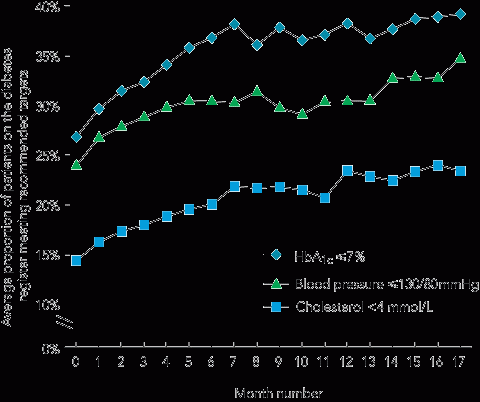
To monitor improvement, de-identified measures are collected monthly, usually directly from clinical software. Initial results are often surprising to practices and strongly motivate participants to improve their processes and levels of patient care. Examples of improved results for patients with diabetes from a 2009 wave in Victoria and Tasmania are shown in the Box. A “wave” is a singular collaborative, consisting of 20–200 practices that work together through an 18-month cycle of learning workshops, action periods and measurement. Practices in all state and nationally based waves (about 720) achieved similar improved outcomes for around 157 000 people with diabetes. By comparing outcomes at the end of a wave with those at the beginning, overall we found:
The future
We believe this approach to quality improvement can play a major role in improving the processes and experiences of care in general practice, primary care, and health care more broadly.7 It has been shown here and abroad that, with the right reach and policy levers, it is possible to effect large system change.3 It has also been argued that this is cost-effective.8
Early learnings from the APCC, including expanding the role of practice nurses, are now part of the existing service delivery system within general practice. The program has also identified other changes within collaborative practices, such as proactive and systematic care for patients with chronic disease, as suggested reforms that could be implemented through voluntary practice enrolment and expansion of team-based care. These policy initiatives, all elements of the chronic care model,1 support the collaboratives’ work and drive quality improvement at the practice level.
In 2009, the Australian Government expanded the scope of the APCC program to include two new topic areas: chronic obstructive pulmonary disease and prevention of chronic disease (including self-management). The program has already achieved significant results and should be an ongoing part of the regionalised primary care focus of the reformed Australian health system.
Competing interests
Dale Ford is principal clinical advisor for Improvement Foundation Australia. Andrew Knight is chair of the expert reference panel on access and care redesign for the Improvement Foundation’s APCC program.
References
- Wagner EH, Austin BT, Von Korff M. Organizing care for patients with chronic illness. Milbank Q 1996; 74: 511-544. 0_CHDDAGII
- The Breakthrough Series: IHI’s collaborative model for achieving breakthrough improvement. IHI Innovation Series white paper. Boston: Institute for Healthcare Improvement, 2003. http://www.ihi.org/IHI/Results/WhitePapers/TheBreakthroughSeriesIHIsCollaborativeModelforAchieving+BreakthroughImprovement.htm (accessed Jun 2010).
- Oldham J. Sic evenit ratio ut componitur: the small book about large system change. Chichester, UK: Kingsham Press, 2005. 0_i1093032
- Knight A. The collaborative method. A strategy for improving Australian general practice. Aust Fam Physician 2004; 33: 269-274. 0_i1093034
- Langley GJ, Moen R, Nolan KM, et al. The improvement guide: a practical approach to enhancing organizational performance. 2nd ed. San Francisco: Jossey-Bass, 2009. 0_i1093036
- Berwick D. Developing and testing changes in delivery of care. Ann Intern Med 1998; 128: 651-656. 0_i1093039
- Harris M, Zwar N. Effective management of chronic disease in primary health care. APHCRI Dialogue [internet] 2010; (1). http://www.anu.edu.au/aphcri/General/Dialogue_Issue_1_2010.pdf (accessed Jun 2010).
- Thurecht L, Armstrong A, Brown L. Bridging the gap in meeting clinical targets for the treatment of type 2 diabetes. Canberra: National Centre for Social and Economic Modelling, 2009. http://www.canberra.edu.au/centres/natsem/publicationns? sq_content_src=%2BdXJsPWh0dHAlM0ElMkYlMkZ6aWJvLndpbi5jYW5iZXJyYS5lZHUuYXUlMkZuYXRzZW0lMkZpbm RleC5waHAlM0Ztb2RlJTNEcHVibGljYXRpb24lMjZwdWJsaWNhdGlvbiUzRDEyNDcmYWxsPTE%3D (accessed Jun 2010).