




Volume 193 - Issue 11
Suffer the little children
Author: Jennifer M Fleming
Med J Aust 2010; 193 (11): 684. || doi: 10.5694/j.1326-5377.2010.tb04103.x
Published online: 6 December 2010
Published online: 6 December 2010
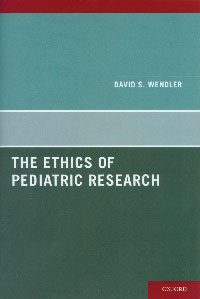
The ethics of pediatric research.
David S Wendler. Oxford: Oxford University Press, 2010 (337 pp). ISBN 9780199730087.
AS HEAD of the Unit on Vulnerable Populations, Department of Bioethics, NIH Clinical Center, in the United States, David Wendler continues to contribute to the rich debate on issues surrounding ethical research involving vulnerable populations, including children, who cannot give informed consent. This particular work was written while Wendler was a Faculty Fellow in Ethics at the Safra Center for Ethics at Harvard University, and is the result of over 10 years of research. A balanced and engaging analysis of the justifications for the ethical acceptability of non-beneficial paediatric research is critical, if we are to undertake ethically sound translational research in vulnerable populations to improve medical care.
Scholars in clinical research ethics and, potentially, clinicians engaged in paediatric research should find this book of interest and value. Each well structured chapter includes brief summaries of the arguments presented in the chapters immediately preceding and succeeding it. Wendler is particularly helpful when he explores the ways in which concepts such as “social value”, “human interests and causes”, “wellbeing” and a “better life” influence the moral status of non-beneficial paediatric research.
Additional diligence is called for by all parties where substitute consent is required. This topic could have received further critique as part of the two insightful and extended chapters on the contributions of participants. Acknowledging the shared responsibilities of clinicians, researchers, substitute decisionmakers, bioethicists, human research ethics committee members, regulators and publishers in ensuring good clinical research practice is essential for a sound examination of key issues.
The book is relevant to an Australian audience, with reference to comparative regulatory frameworks here, the US, Canada and elsewhere. The book is well within reach of most budgets and would be a worthwhile addition to medical and social science libraries.
Mending the Road: A Way Forward From Silence and Silencing
Ayman Hamdan, Anisa J. N. Jafar
Seven Vessel Spontaneous Coronary Artery Dissection and Concurrent Transient Global Amnesia After an Emotional Trigger
Michael J. Stewart, Tom R. Sutherland
Seven Vessel Spontaneous Coronary Artery Dissection and Concurrent Transient Global Amnesia After an Emotional Trigger
Virginia Barbour
Research Priority Setting Is Not Research: A Call for Ethical Clarity in Australia
Bec Jenkinson, Gordon McGurk, Jonathan Quicke, Janelle Bowden, Nadine E. Foster
Organ Donation After Oral Ingestion of a Voluntary Assisted Dying Substance
Joanne Kantianis, Helen I. Opdam, Rohit L. D'Costa
Equity, Diversity and Inclusion From the Start: Reforming Australia's Research Infrastructure for Inclusive Participation
Danielle M. Muscat, Kirsten J. McCaffery, Heather L. Shepherd, Marguerite Tracy