




Volume 193 - Issue 11
Obesity and global warming: are they similar “canaries” in the same “mineshaft”?
Authors: Garry J Egger and John B Dixon
Med J Aust 2010; 193 (11): 635-637. || doi: 10.5694/j.1326-5377.2010.tb04089.x
Published online: 6 December 2010
Published online: 6 December 2010
Obesity, linked to chronic disease, and global warming, linked to climate change, may be indicators of serious problems with our consumption-based economic system
About 15% of the world’s population are now overweight or obese, and this is considered to be a factor in the rising incidence of chronic diseases.1 Excessive carbon concentrations now also exist in the atmosphere (50% higher now than 50 years ago), with implications for the environment and climate disruption.2
Although it is not immediately obvious, there is a connection between these two phenomena, with energy being the common factor — excess energy intake over expenditure in the case of obesity, and excess carbon from energy sources over the capacity of environmental “sinks” (oceans, soil, plants) to absorb carbon in the case of the environment. This suggests there may be a common distal driver, in which case obesity and global warming could be symptoms of a broader environmental disorder — similar “canaries” in the same “mineshaft”.
Body fat in humans is essential for survival. Too little causes health problems (insulin resistance, type 2 diabetes, etc), as does too much. Unknown factors (probably genetic) seem to define a point — which may vary widely between individuals — beyond which further expansion of fat cells is limited, leading to a “spillover” of excess fat into ectopic stores (muscle, blood, viscera, etc). Before this point is reached, fat stores seem to be benign, or even healthy,3 even in some obese individuals. Beyond this, fat appears to become toxic, and to become linked to chronic disease,4 possibly through the medium of a form of low-grade systemic inflammation, or “metaflammation”.5
Metaflammation was shown over a decade ago to be distinct from classical inflammation. It seems to be caused not just by “spillover” fat, but also by lifestyle and environmental factors, some of which can cause obesity (poor diet, inactivity, inadequate sleep, etc), but many of which may not.6 Non-alcoholic fatty liver disease (NAFLD), often a precursor to chronic disease in the presence of such lifestyle behaviours without obesity7 or visceral fat,8 supports this idea, as does a reduction in NAFLD with exercise independent of weight loss.9 In this sense, obesity might be just a canary in a mineshaft, signalling bigger problems in the overall environment.
But if obesity is the canary, what constitutes the mineshaft? A clue can be gained from looking at pro- and anti-metaflammatory stimuli. We have suggested elsewhere10 that pro-inflammatory “inducers”11 are new, arising as a result of the industrial revolution of the late 19th century, whereas those that are anti-inflammatory (or neutral versions of those causing inflammation) have been familiar to humans for thousands of years. The hypothesis proposed from this is that the human immune system reacts (albeit at a lower level than to injury or microbial invasion) to stimuli to which it has not had time to adapt.12 Metaflammation is thus to chronic disease what inflammation is to injury and acute disease.
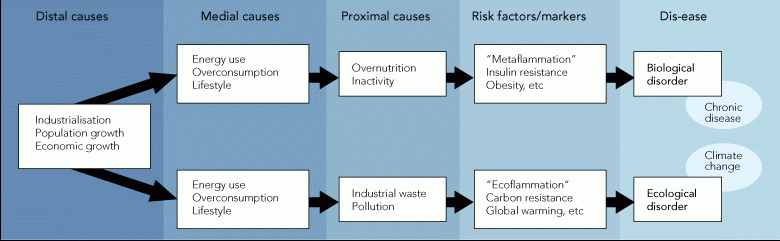
Inflammation normally relates to a physiological condition. However, it can apply, at least metaphorically, to the external (ecological), as well as the internal (biological) environment. The body is unable to “soak up” glucose as a result of insulin resistance, and this leads to metaflammation and biological abnormalities in the form of chronic diseases. In the broader ecological environment, the biosphere is unable to soak up or “sequester” carbon dioxide (and other greenhouse gases) because environmental sinks are overwhelmed by emissions from the oxidation of fossil fuels,2 resulting in a form of inflammation and “carbon resistance” in the ecosphere. This leads to potential ecological “abnormalities” that are metaphorically similar to the chronic diseases related to insulin resistance.
Our metaphorical mineshaft can be identified by tracking back the causes of both forms of “inflammation” in a classical epidemiological fashion, as shown in the Box. From this, it is clear that the mineshaft is the modern postindustrial environment, in which a principal driver has been the system of exponential economic growth, particularly that driven by the use of fossil fuels.
But how can something that has been so good for human health and wellbeing as economic growth be regarded as negative?
The answer lies in the inherent dynamism of any growth system. There is little doubt that growth has been the biggest single contributor to human health in history.13 However, any form of exponential growth must eventually meet its limits. Leading up to this, one might expect to see diminishing returns on investment.
In terms of health, this time may have arrived. Data from Sweden, the United Kingdom and other countries over the past 200 years show an initial close relationship between health and growth, but since the 1970s, a reversed relationship, in which further growth results in reduced progress in health.14 Increases in obesity, which follow from the consumption required to feed the growth system beyond the “epidemiological transition” (where the incidence of chronic diseases surpasses that of infectious diseases)15 in developing countries, is one consequence. Greenhouse gas emissions, which are related to the consumption driving obesity, also closely follow the business cycle at the micro level, as well as the growth in gross domestic product (GDP) at the macro level.16 A “sweet spot”17 in the material phase of growth therefore appears to have been reached and, in some aspects, overshot in developed countries, as reflected by the diminishing rate of return in health, as well as ecological wellbeing, from further growth.
Obesity (and greenhouse gases), within this framework, represents a canary. In times past, canaries were taken into mineshafts to warn of problems with air quality, indicated by their sudden collapse. The mineshaft in our metaphor is the economic system — specifically monetary growth, as measured in terms of GDP and its consequent consumption — that drives the modern industrial environment. To attribute the epidemic in chronic disease to this is not fanciful. It is clear from the lessons of developing countries like India and China that chronic diseases are related to changes that occur with economic development past a certain point — the epidemiological transition. The fact that chronic diseases begin to increase rapidly around the same time as a society’s carbon footprint begins to grow is not coincidental. Unsequestered greenhouse gas emissions are the manifestation of a mineshaft of growth beyond a threshold of positive returns. Obesity — and climate change — are merely “collateral damage in the struggle for modernity”.17
The dramatic worldwide increase in obesity is the most visible biological warning that our consumer-driven, macroeconomic environment (the mineshaft) is in need of an overhaul. While it is imperative for us to keep trying, attempts to reduce obesity at the population level, and to control climate change at the world level, without dealing with these broader economic and environmental issues, is like trying to resuscitate an asphyxiated canary while leaving untouched the mineshaft that caused the asphyxiation.
References
- James WPT. WHO recognition of the global obesity epidemic. Int J Obes 2008; 32 Suppl 7: S120-S126. 0_i1095466
- Intergovernmental Panel on Climate Change. Climate change 2001: synthesis report. New York: Cambridge University Press, 2001. http://www.ipcc.ch/ipccreports/tar/vol4/pdf/front.pdf (accessed Oct 2010).
- Kelishadi R, Cook SR, Motlagh ME, et al. Metabolically obese normal weight and phenotypically obese metabolically normal youths: the CASPIAN Study. J Am Diet Assoc 2008; 108: 82-90. 0_i1095470
- Unger RH, Scherer PE. Gluttony, sloth and the metabolic syndrome: a roadmap to lipotoxicity. Trends Endocrinol Metab 2010; 21: 345-352. 0_i1095472
- Hotamisligil GS. Inflammation and metabolic disease. Nature 2006; 444: 860-867. 0_i1095474
- Egger G, Dixon J. Should obesity be the main game? Or do we need an environmental makeover to combat the inflammatory and chronic disease epidemics? Obes Rev 2009; 10: 237-249. 0_i1095476
- Saremi A, Allison M, Ditomasso D, et al; Veterans Affairs Diabetes Trial. Preliminary report: hepatic fat and inflammation in type 2 diabetes mellitus. Metabolism 2010; 59: 430-432. 0_i1095478
- Speliotes EK, Masaro JM, Hoffman U, et al. Fatty liver is associated with dyslipiedemia and dysglycemia independent of visceral fat: the Framingham Heart Study. Hepatology 2010; 51: 1979-1987. 0_i1095480
- St George A, Bauman A, Johnston A, et al. Independent effects of physical activity in patients with nonalcoholic fatty liver disease. Hepatology 2009; 50: 68-76. 0_i1095482
- Egger G, Dixon J. Obesity and chronic disease: always offender or often just accomplice? Br J Nutr 2009; 102: 1238-1244. 0_i1095484
- Medzhitov R. Origin and physiological roles of inflammation. Nature 2008; 454: 428-435. 0_i1095486
- Egger G, Dixon J. Inflammatory effects of nutritional stimuli: further support for the need for a big picture approach to tackling obesity and chronic disease. Obes Rev 2010; 11: 137-145. 0_i1095488
- Riley JC. Rising life expectancy: a global history. New York: Cambridge University Press, 2001. 0_i1095490
- Tapia Granados JA, Ionides EL. The reversal of the relation between economic growth and health progress: Sweden in the 19th and 20th centuries. J Health Econ 2008; 27: 544-563. 0_i1095492
- Frenk J, Bobadilla JL, Sepúlveda J, López Cervantes M. Health transition in middle-income countries: new challenges for health care. Health Policy Plan 1989; 4: 29-39. 0_i1095494
- Tapia Granados J. Economic growth, business fluctuations and health progress. Int J Epidemiol 2005; 34: 1226-1233. 0_i1095497
- Egger G, Swinburn B. Planet obesity: how we are over-eating ourselves and our planet to death. Sydney: Allen and Unwin, 2010. 0_i1095499
Beyond Fibrosis Stratification: Integrating Behavioural, Metabolic and Policy-Level Interventions in Metabolic Dysfunction-Associated Steatotic Liver Disease
Yousef Hakimi, Prarthana Thiagarajan, Michael Braude
Fatty Liver Disease in Australia: A Narrative Review on the Epidemiology, Natural History, Prognostication and Management in People With Metabolic Dysfunction
Karl Vaz, Daniel Clayton-Chubb, William W. Kemp, Stuart K. Roberts, Ammar Majeed
When ‘Liver Enzymes’ Are Not Hepatic: Late-Onset Pompe Disease
Shauna Madigan, Georgina England, Wayne Rankin
Fatty Liver Disease in Australia: A Narrative Review on the Epidemiology, Natural History, Prognostication and Management in People With Metabolic Dysfunction
Karl Vaz, Daniel Clayton-Chubb, William W. Kemp, Stuart K. Roberts, Ammar Majeed
The early implementation phase of the Omega‐3 Test‐and‐Treat Program for reducing the risk of preterm birth, South Australia, 2021–22: an implementation evaluation study
Karen P Best, Celine Northcott, Lucy A Simmonds, Philippa Middleton, Lisa N Yelland, Vanessa Moffa, Khoa Lam, Penelope Coates, Cornelia Späth, Carol WK Siu, Karen Glover, Rhiannon Smith, Robert Gibson, Maria Makrides
Cause‐specific mortality among Queensland people with cirrhosis, by cirrhosis aetiology and decompensation status, 2007–22: a retrospective cohort study
Vikas Bhasker, Jessica R Fong, Paul J Clark, Gunter F Hartel, Richard Skoien, James O’Beirne, Elizabeth E Powell, Patricia C Valery