




Volume 193 - Issue 11
A foray for filaria
Author: John S Whitehall
Med J Aust 2010; 193 (11): 714-716. || doi: 10.5694/j.1326-5377.2010.tb04118.x
Published online: 6 December 2010
Published online: 6 December 2010
We reached the Zambezi escarpment after dark, unable to appreciate the panorama of wilderness that extended 50 or more kilometres to the opposing heights in Zambia, on the other side of the great river that was heading into Mozambique on its way to the Indian Ocean. It was 1972 and we were on our way to collect samples of blood from villagers who shared the Rhodesian (now Zimbabwean) side of the valley with all kinds of wild animals, vectors and parasites. On the top of the escarpment, as we were about to wind our way down into the darkness in our Land Rover, we learned of the return of another violent species to the valley — the freedom fighters from across the border.
In what the military wing of the African National Congress of South Africa referred to as the Sipolilo campaign (after a town on the plateau near the escarpment), their soldiers had crossed the river in 1968 in the hope of recruiting villagers for revolution, but they had been discovered by local forces and then dispersed in a process that took lives on both sides, as well as in the hapless middle. As our headlights probed the bush, a camouflaged patrol of Rhodesian infantry appeared and signalled us down. “You should not go any further”, their officer advised, “the terrs are back and the roads might be booby trapped or mined”.
I was with Michael Gelfand, Professor of Medicine at the University of Rhodesia, whose lined face, thin body and wispy, grey hair suggested enormous age to my youthful mind, though he was only 60. He was already a legend — son of Lithuanian refugees to South Africa, he had graduated from the University of Cape Town and made his way north to Rhodesia to be fundamental in developing the multiracial medical school in the capital, Salisbury. He was founder and editor of the Central African Journal of Medicine and a prolific writer on tropical diseases.
Gelfand was also an observer and recorder of local Shona customs and appeared to be above the racial conflict that was emerging in his country. Though his registrar, I had never spoken to him about race. Perhaps strangely, it had never seemed to be an issue in the “black” Harare hospital in which the University was based. Gelfand, I reflect, set an unspoken standard — he was a kind man, knowledgeable and respectful of local traditions but, above all, absorbed in African medicine with a boyish enthusiasm that simply could not understand preferences for other branches of the profession.
When he suggested I join him and the provincial doctor on a research foray, I thought I was made, and although it was a bit of a shock to come across the soldiers and their warning, there was never any question of our turning back. Our lust was up for blood and, I suspect, the old man believed he knew enough about the locals to be able to negotiate any difficulties. Nevertheless, as we descended into the valley in a lighted cocoon of tall grass that bowed before our bumper bar, we knew our wheels would be exerting pressure on the track and whatever might be primed beneath it, and we remained silent.
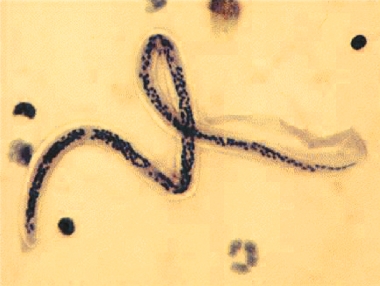
We were going to survey the incidence of the nematode Wuchereria bancrofti by collecting blood samples from villagers. The samples would be examined back in Salisbury for the worm’s larval forms, known as microfilariae (Box 1). First observed by Otto Wucherer in Brazil in 1866, these larvae are released in their thousands from each female adult worm and can be observed wriggling among the blood cells of infected people. The larvae are the width of a white cell but 40–50 times the length.
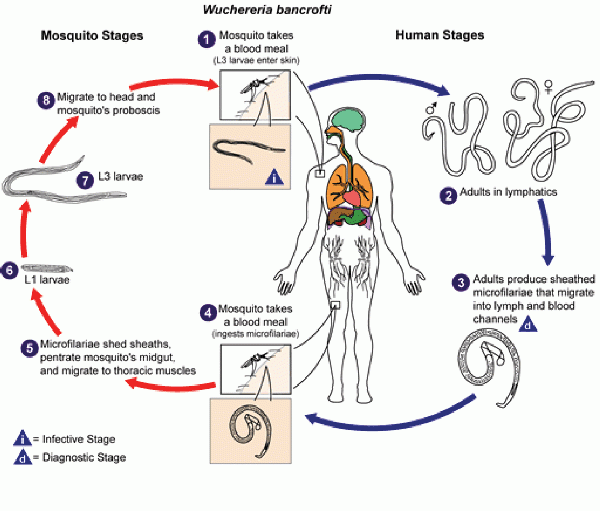
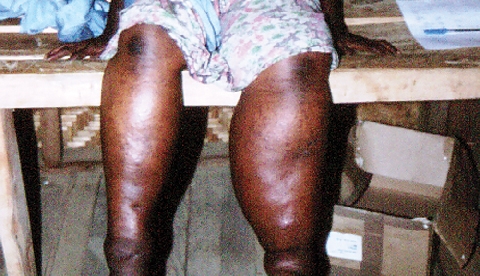
The long (4–10 cm), hair-thin adult worms, discovered by the English physician Joseph Bancroft in Queensland in 1876, live in the lymph vessels of victims, from where the females release the larvae, which make their way to the peripheral blood (Box 2). The adults particularly enjoy the comforts of the lymph vessels in the pelvis and groin, but when these vessels become blocked, the victim’s legs may swell with elephantine disfigurement (Box 3). The blocked vessels can also affect the scrota of the unfortunate, demanding an unusual service from a wheelbarrow.
Our hunt was to take place at night because of the still unexplained phenomenon in which the microfilariae appear in the bloodstream after dark to rendezvous with their night-biting mosquito vectors. How they know when to emerge is as much a mystery today as it was in 1877 when first observed by Scottish physician Patrick Manson in China.
The allied question of where they go during the day has no better answer than Manson’s original postmortem examinations, which revealed the “majority to be lodged in the blood vessels of the lungs”.1 How they know the time of day and their location, and how they maintain their position in the flow (given that they have no suckers) remains as unanswered as the question of why they feel the need to hide and waste so much energy doing it.
The people in our first village had heard us coming long before we had noticed their cooking fires and they surrounded our vehicle with interest when they learned we were doctors and, I suppose, not soldiers. We explained our business and called for volunteers and soon had a long line waiting in the lights of the Land Rover, where we had established our “laboratory”.
We took samples and looked for oedema in legs but had concluded that requests to bathe scrota in the limelight might be counterproductive. We did, however, assess the size of spleens as an indication of the prevalence of chronic malaria.
All went well for an hour or more, until sudden screeching in the bush around us caused our line to disintegrate in pandemonium. People started yelling and ran to their huts to arm themselves with pots and pans, which they banged together as they disappeared clamorously into the bush.
We three doctors were abandoned — immobilised and silhouetted in the lights of the vehicle. “We’re dead”, I thought, “the terrs have arrived”. I looked around for somewhere to run, but Gelfand held his ground. “Settle down. They’re not terrs, they are just elephants who have come after the grain stores in the village”, he explained to the naive Australian.
Sure enough, his diagnosis was confirmed by trumpeting and crashing through the undergrowth as the herd surged for the corn. “Stay where you are”, advised the Professor, but the young registrar was consumed by stupidity and went to find an elephant for himself. It did not take long. A huge black shape crashed before his widened eyes.
With the villagers in sustained conflict with the marauders, there seemed little prospect of controlled bloodletting, so we decided to pursue our research further down the track. An hour later, we arrived at the next village.
The first village had been welcoming. The second was sullen. It was surrounded by a high brush fence and, in the moonless darkness, we heard it before we saw it. We heard the rhythm of drums: a mysterious, exciting, but ominous syncopation; an almost supernatural throbbing bass to the higher pitched cries of birds and monkeys.
We drove up to the entrance to the compound and stopped the car, now to be more unnerved by silence. The drumming had stopped and all of nature seemed to be holding its breath.
The villagers surrounded us in the darkness and the mood was unpleasant. Gelfand tried to communicate in Shona, but there was little reply. Something was going on in that village. Was it some kind of ancient animistic ritual? Was it some kind of new political ritual? Were there terrs in the village? In the crowd? The Professor was squeezing charm from inner reserves as he slowly backed us to the car. It was plain he was making a retreat, rather than an entreaty for participation in our worthy research, and we wasted no time piling in and waving farewell with ersatz cheer.
We were very glad to get away and to be heading for the ranger’s hut on the river bank some kilometres distant, where we were going to spend the night. Relief, however, was limited by the realisation that there was only one track to the one white man’s hut in that direction and it was well known to everyone.
The hut was on a grassy clearing about 25 metres back from the Zambezi River, opposite the entrance of the Luangwa River, which rises in northern Zambia. The water was black, wide and fast, but you could not meditate on it in the open. Although the sounds of the nightlife were enticing and the river bewitching, there were lions seeking dinner, hippos waiting to be annoyed and snakes to be insulted, not to mention the mosquito vectors of filariasis and the future prospect of needing a wheelbarrow.
We retired to the hut, set up our screens and, in memory of our friends up the track, made sure the doors were locked, for whatever difference that might have made, then tried to go to sleep. We were glad to see the morning.
Unanimously, we decided to curtail our field work that week-end and concentrate on our specimens back in the capital, but we did stop at a couple of villages on the top of the escarpment. We looked for clinical signs of filariasis but found none, although previous surveys had confirmed a high prevalence of microfilariae in that area.
Relaxed in the open savannah of the plateau, we mused on the disease we had gone to survey. We would have been surprised to know that basic questions would remain unanswered 40 years later, despite an explosion of research of unimagined sophistication.2
Immunology was taking off in those days, and we might have expected an answer to why the microfilariae are able to nullify immune defences to the extent that millions of these motile, burrowing worms can be born, live and die in an infected person’s system for decades without causing much damage. A hundred years earlier, an editorial in the British Medical Journal had wondered that these “swarm(s)” of worms “should produce such a comparatively trivial amount of inconvenience”, but even today we are not much closer to the truth.3
We already knew adult worms had proven resistant to the one hopeful drug, diethylcarbamazine, since its discovery in 1947, but we expected a breakthrough. We would have been disappointed by the lack of any significant challenge to the adult worms in the next 40 years, apart from the extraordinary concept of perhaps being able to affect the adult by damaging bacteria that live symbiotically within it.4 Who would have thought each adult had its own dairy farm?
In the 1970s, emphasis was on treatment of individual cases of elephantiasis. How do you manage the grotesque leg? We looked forward to the development of new drugs, but might have done better looking backwards. Considered a “new insight”, it is now believed that “basic hygiene, antibiotics and physiotherapy can slow, prevent, or in some cases reverse elephantiasis”.2 In 1846, however, even before the discovery of the worm, the English surgeon E Bascome had argued that elephantiasis was the result of repeated attacks of erysipelas.5 It now seems that reaction to secondary infection may be more important in blocking the lymph vessels than reaction to the worm.
Prevention in the 1970s meant not being bitten by mosquitoes. We could not have foreseen the discovery that semiannual treatment of whole populations with our old friend diethylcarbamazine, and some newer drugs, can so markedly reduce the number of microfilariae that propagation is limited.6 Nor could we have anticipated the ease of diagnosis by measurement of filarial antigen in drops of blood on blotting paper.2
Had we known of these advances, it would have been surprising to know that, despite them, the prevalence of the disease is increasing in some parts of the world, thwarting the concept of eradication. Indeed, the World Health Organization now maintains that over 120 million people are affected worldwide.7 The battle is being lost, not only because of interruption to prevention programs by civil strife but also because of the proliferation of breeding sites resulting from inadequate sewerage in the sprawling suburbs of the developing world.
Musing on the complexities of tropical disease, we were enjoying our journey across the plateau on the way back to Salisbury when one of the plateau’s residents invaded our cabin. I had no idea the wasp-like insect was a tsetse fly or I might have better understood Gelfand’s eagerness to dispatch it.
Alas, the fly was undeterred by his flailings, and dived on his jaw, provoking a physical response almost as quickly as the emotional. The whole side of the Professor’s face reddened and swelled, from ear to mouth and brow to mandible.
Fortunately there were no further anaphylactoid reactions, as we had no medicines, but when the Professor announced it was a tsetse fly I really began to worry. I had driven through Mozambique earlier that year and been intrigued by the Portuguese attempts to limit the spread of the fly by disinfecting vehicles in sheds of corrugated iron. Why? To limit the spread of sleeping sickness. Oh my goodness, there was no effective treatment for that disease either, so I watched the Professor all the way back to Salisbury, hoping his drowsiness was not significant.
The Professor recovered, and now that I am almost 10 years older than he was then, I really do understand the physiological rather than pathological attributes of an afternoon nap. As I finish writing this reminiscence in Papua New Guinea as a leader of a team of young postgraduates from James Cook University who are as fascinated as I was by the mysteries of tropical medicine, I remember Michael Gelfand with great fondness. I am sure he enjoyed sharing these mysteries with the young as much as I am doing today.
Acknowledgements
I would like to thank Wayne Melrose, Professor of the School of Public Health and Tropical Medicine at James Cook University in Townsville, for reviewing this article and providing the photographs.
References
- Manson P. On filarial periodicity. Br Med J 1899; 2: 644-646. 0_i1095464
- Melrose WD. Lymphatic filariasis: new insights into an old disease. Int J Parasitol 2002; 32: 947-960. 0_i1095466
- Haematozoa and chyluria [editorial]. Br Med J 1873; 1: 147-148. 0_i1095468
- Taylor MJ, Bandi C, Hoerauf A. Wolbachia bacterial endosymbionts of filarial nematodes. Adv Parasitol 2005; 60: 245-284. 0_i1095470
- Bascome E. On elephantiasis. Lancet 1846; 47: 435-436. 0_i1095472
- Bockarie MJ, Taylor MJ, Gyapong JO. Current practices in the management of lymphatic filariasis. Expert Rev Anti Infect Ther 2009; 7: 595-605. 0_i1095475
- World Health Organization. Action against worms. Jul 2010, Issue 14. http://www.who.int/neglecte (accessed Nov 2010).
Costs of Delivering the Hep B PAST Model of Care in Remote Australia: A Retrospective Pre–Post Study
Hoa Nguyen, Anh Le Tuan Nguyen, Paula Binks, Melita McKinnon, Emily Vintour-Cesar, Karen Wills, Nicola Stephens, Benjamin Cowie, Joshua S. Davis, Yuejen Zhao, Peter Nihill, Julie A. Campbell, Andrew J. Palmer, Jane Davies, Barbara de Graaff
Buruli Ulcer Acquired From Ringtail Possum Rescue
Daniel P. O'Brien, Naomi Clarke, Sara Bonnici, Mohammad A. Hussain
Q Fever Visceral Abscesses After Contact With Native Australian Marsupials
Samantha J. Laws, Enzo Binotto, James Stewart, Jennifer Ho, Trent Yarwood, Josh Hanson, Simon Smith
Hospital-Admitted Injection-Related Infections Among Incarcerated People Who Inject Drugs in Australia: A Retrospective Cohort Study
Andrew Palmer, Matthew Carter, Jeremy Yeo, Cecilia Shim, Jason Connor, Jeremy Hayllar, Gerald Holtmann, Naomi Moy, Elliott G. Playford, Naomi Runnegar, Paul J. Clark
The Live Attenuated Influenza Vaccine in Australia: An Additional Tool for Influenza Prevention
Cyra Patel, Alexis Pillsbury, Tran Nguyen, Xia Wang, Helen E. Quinn, Clayton K. Chiu, Allen C. Cheng, Katie L. Flanagan, Zhicheng Wang
Reflex Testing for Hepatitis D Infection: A Unique Opportunity to Reduce Hepatitis D-Related Chronic Liver Disease Deaths in Australia
Jessica Howell, Lauren Andersson, Miriam T. Levy, James O'Beirne, Leon Adams, Katharine Irvine, Avik Majumdar, Golo Ahlenstiel, Kathy Jackson, Krispin Hajkowicz, Joseph Doyle, Jane Davies, Sarah Cherian, Wayne Dimech, Alexander J. Thompson