




Volume 193 - Issue 11
The delight that work alone can give
Author: Michael Sorokin
Med J Aust 2010; 193 (11): 718-719. || doi: 10.5694/j.1326-5377.2010.tb04120.x
Published online: 6 December 2010
Published online: 6 December 2010
Robert “The Prof” Bedford provided medical services in South Australia for over 20 years, despite having no medical qualifications
In the early 1980s, a national newspaper ran a feature soliciting nominations for “the most boring town in your state”. The winner for South Australia was the Eyre Peninsula township of Kyancutta. This generated the expected reaction from parochial inhabitants, who came up with a long list of interesting aspects of the district, including the notable and exciting fact that the township straddles the Eyre Highway, that great semitrailer-populated road connecting the west of the Australian continent with the east. Doubtless much of this list was facetious, but Kyancutta does in fact have a fascinating history, however dull it might have seemed by the end of the 20th century. It was the home of one of the earliest inland meteorological reporting stations; it had Australia’s fifth officially recognised aerodrome; and it housed an outstanding and unique natural history museum. All this, and much more, was the work of one man, Robert Bedford, who was known to three or more generations of farming families as “Beddie” and “The Prof”.
Thirty or so years ago, when the boring town award arrived, there were still many older people in the central Eyre Peninsula who could recount stories of treatment, operations and consultations by “The Prof”. Once it was known that he had medical skills and was prepared to use them to assist his farming neighbours, he dealt with a never-ending stream of broken bones, dislocations, gunshot wounds, boils, carbuncles, scalds and burns, snakebites and fevers. He is even recorded as having treated burns with skin grafts. So many medical problems came his way that, with the aid of his wife, Hilda, he eventually set up a cottage hospital. The tyranny of distance ensured that he remained the first choice for local medical problems and emergencies, but Bedford was conscious of his limitations, and communicated frequently with nearby practitioners and metropolitan specialists. He referred patients whenever it was practicable; this being a term to be interpreted with regard to the sometimes vast distances involved, the vagaries of the weather, the primitive vehicles traversing equally primitive roads, and a rattly train service whose main function was to transfer wheat and barley, with passengers being of secondary importance. Such conditions meant that the transfer of patients did not occur very frequently in the earlier years.
Like many other rural medicos then and now, he had a veterinary practice as well. It might have been assumed that he was medically qualified, even if not of professorial status, but simple enquiries reveal that, though widely consulted for injuries, illnesses and even obstetrics (he is recorded as having successfully delivered 99 infants from 98 confinements), Robert Bedford was not a doctor. Nor was his original name Bedford; he was born Robert Arthur Buddicom and changed his name to Bedford when he left England for Australia in 1914. In some accounts, his departure is described as “hasty”, implying a scandal, but all that could be found to support a scandal was a court case for alleged misrepresentation on a prospectus for a proposed telephone company. It is just as likely that his widely expressed pessimism about the future of England motivated his move.
Bedford was born in Shropshire, in 1874, to a landowner family. He was educated at Charterhouse School and was a science scholar at Oxford University, where he qualified with a Bachelor of Arts degree in 1897. After this, he worked in marine biology in Naples, Italy, and then served as a curator of the Plymouth City Museum and Art Gallery, where he founded and edited a journal, Life. From 1906 to the time of his migration, he worked as a demonstrator and lecturer at the London Hospital Medical College (now Barts and The London School of Medicine and Dentistry). He was clearly a talented, cultured and widely educated man when he took up wheat farming in the remote district of South Australia where he was to spend the rest of his incredibly active and productive life.
In 1919, he attempted to enrol as a medical student at the University of Adelaide, but he wanted to attend courses at the Royal Adelaide Hospital on his own terms and according to his own timetable. Not surprisingly, this was unacceptable to the medical faculty, and Bedford returned home disappointed, but with as good a collection of up-to-date textbooks purchased in Adelaide as would have graced the shelves of any reputable practitioner of the time. As long as anyone needed him, he was prepared to help, even when a full-time doctor set up practice in the nearby town of Wudinna. In fact, he remained on good terms with that doctor, and they frequently assisted each other and enjoyed games of bridge and musical evenings together with their wives.
Farming, operating a flour mill, running a general store and acting as the local doctor and vet should have been enough to occupy anyone; but not so for this restless renaissance man. Radio station 5RB took to the airwaves in 1924, a railway refreshment room was opened in 1925, and in 1928, the Bedford store also became the official post office. In 1929, he decided it was important to set up an inland weather reporting station as an aid for the airlines, which were by then flying across the country from coast to coast. He bought his own barometers and wind gauges, but his observations were so accurate that the Bureau of Meteorology supplied further instruments and set up Kyancutta as an official weather station. His inspiring personality drew in neighbours to help build an all-weather aerodrome, which became an essential refuelling point for east–west flights across the country. In the 1930s, Robert’s interest in aviation was continued by his son, Bill Bedford, who continued to evacuate medical patients from areas as distant as Coober Pedy in the north of South Australia and Cook on the trans-Australia railway line, until an ambulance plane was stationed at Whyalla in 1965.
Robert Bedford and one of his fossil fish
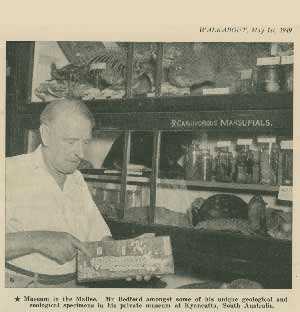
In 1929, among his many interests and occupations, Bedford opened the Kyancutta Museum and Library to house his personal geological and palaeontological specimens, which he had collected locally and interstate on numerous self-funded trips, as well as specimens sent from collectors elsewhere in Australia. He examined and excavated meteorite craters in southern and central Australia, and published descriptions of these meteorites and tektites, mainly in his own Memoirs of the Kyancutta Museum. In 1939, he sent five specimens of fossil fish collected from early Devonian limestones in New South Wales to the Natural History Museum in London. These specimens formed the basis of an article published by Dr Errol White, then the fossil fish expert at the British Museum, who named one of the newly described fossils Williamsaspis bedfordi in Robert’s honour. Unfortunately, because of wartime disruptions at the Museum, the article was not published until after Bedford’s death. Other fossils on which Bedford worked included the ancient Cambrian archaeocyathid sponges from the Flinders Ranges.
Described by his daughter as quietly spoken and peaceable, but capable of flying into a sudden rage, Bedford must have been a difficult man to argue with. The “establishment” certainly did not like him. He engaged in an acrimonious debate on geological matters with Sir Douglas Mawson (Newton Luscombe, personal communication), and the South Australian Museum opposed his admission to the Museums Association of Australia and New Zealand. His action in sending meteorite and fossil specimens to the British Museum may have been a reaction to the ill feeling that existed towards him among local geologists, and it certainly did nothing to ameliorate that antipathy. He was a prolific correspondent with dignitaries, scientists and institutions in Australia and abroad. His mind was constantly active and he involved himself wholeheartedly in local politics and as a member of the Australian Wheatgrowers Federation, for whom he drafted a constitution. He had visions of his little town of Kyancutta becoming a major regional centre, but this was not to be. The weather reporting station continued to function and, now operated by his grandson, is still an official Bureau of Meteorology observation and reporting station. The cottage hospital has long gone, its function being taken over by a hospital at Wudinna, established by the Bush Nursing Society, and which later became the Central Eyre Peninsula Hospital. The museum was closed shortly after World War II and its contents were dispersed. A series of models of his ingenious mechanical inventions ended up as toys for his grandchildren. Some of his medical books have been donated to a project for a museum at the University of Adelaide Medical School, which has still to see the light of day.
Robert Arthur Bedford died on 14 February 1951. His contributions to geology and palaeontology have now been recognised by the scientific world, and his museum is named in historical studies. He was well aware of his limitations and did not publish any medical articles, so his legend as a medical practitioner remains only in the memories of those he helped. Such memories are mostly now extinct, but they are still, no doubt, associated with the inherited possessions of his descendants and with the folklore of the region. There is talk of a biography to expand on the memoir published by his daughter, Sylvia Laube, but, until then, this note may serve as a tribute to an amazing man, scientist, inventor, entrepreneur and original thinker, and a well loved bush doctor.
He is buried in the Kyancutta cemetery, and his epitaph reads: “He laboured in his sphere as those who live in the delight that work alone can give”.
Acknowledgements
I thank Mr Newton Luscombe, grandson of Robert Bedford, for his amendments to this article.
References
- Brett-Crowther MR. Buddicom, Robert Arthur (1874–1951), scientist and local entrepreneur. In: Nairn B, Serle G, editors. Australian Dictionary of Biography. Volume 7, Melbourne: Melbourne University Press, 1979: 475-476. 0_pgfId-1096368
- Cooper BJ. Historical perspective: the Kyancutta Museum. Geological Survey South Australia, 1987. Quarterly Geological Notes 103: 2-3. 0_pgfId-1096372
- Laube S. Robert Bedford of Kyancutta. Adelaide: The Wednesday Press, 1990. 0_DCCBJCJJ
Prisoner of war pathology in Changi, 1942–1945
Kate Ariotti, Elizabeth Roberts‐Pedersen
Should medical eponyms continue to be used in everyday practice?
Leya Nedumannil, Diana Lewis
100 years on: the first use of insulin in Australia
Sophie Templer
Reflections on the life and career of Professor Dame Valerie Beral AC DBE FRS FRCOG FMedSci (1943–2022)
Karen Canfell, Bette Liu, Emily Banks
The Honourable Dr Donald James Grimes AO
Michael Kirby, Patti Warn
From wipeout to drill out: a history of exostosis management and Australian surfing
Alon Taylor, Hannah North, Narinder P Singh, Paul A Fagan