




Volume 193 - Issue 11
Crossing over to the other side
Author: Michael J Mackay
Med J Aust 2010; 193 (11): 711-713. || doi: 10.5694/j.1326-5377.2010.tb04115.x
Published online: 6 December 2010
Published online: 6 December 2010
What happened when a doctor on duty in the emergency department suddenly made the transition to “patient in Resus 2”?
“I am not sure exactly why you would want to put your coronary arteries through a full day of paediatric anaesthetics ...” a colleague had written in an email I was perusing in the emergency department on the morning of New Years Day. Suddenly, and unrelated to the contents of the email, I developed extreme anxiety. Recalling that, years ago, frequent irregular ectopic heartbeats had created similar, less severe anxiety, I felt my pulse, expecting to find it irregular. My pulse was regular, but the rate was 120 beats/min. I walked to the tearoom, hoping that whatever it was would go away. Although I had no chest pain, the short walk convinced me I could not ignore the symptoms. I told a colleague I thought I had SVT. In seconds, I made the transition from “doctor on duty in the emergency department” to “patient in Resus 2”.
The anxiety worsened, which I attributed to my changed status. Unhelpfully, my ECG showed a left bundle branch block. I began to sweat, and developed mild chest discomfort. I also began to show signs of being a difficult patient. I insisted on having local anaesthetic for my IV line insertion (which is something I do for all my patients). My anxiety was far worse than the pain. I wanted midazolam, but received 5 mg morphine. We compromised about the benzodiazepines and I accepted 2.5 mg diazepam orally, though I knew that this would take 30 minutes to work. I took aspirin, glyceryl trinitrate and later enoxaparin without complaint.
The oxygen mask caused claustrophobia and I insisted on nasal prongs. But as my discomfort and restlessness increased, the mask was put back in place — whether I liked it or not. I have seen many an anxious, restless, sweaty patient pull away at their oxygen mask shortly before their cardiac arrest and death, and it began to dawn on me that I might have something nasty going on. But the prospect of sudden death was not my main concern — what I wanted was treatment for my anxiety, which was far worse than my chest discomfort.
Mobile phones are wonderful things. My brother chose this moment to phone from New Zealand to ask me if he should double his dose of sotalol to control his paroxysmal atrial fibrillation. (I’m not sure what advice I gave him, but I gather he is still alive.) Then my wife arrived, and best of all, she wheedled a further 5 mg of diazepam for me from some kind soul. The ambulance transfer to a city hospital was a bit of a blur — and that was just the way I wanted it.
The city hospital was familiar, as 2 years earlier I had organised an attachment to see what went on in its cardiac catheter laboratory. My cardiologist wanted me in there again. I was not thrilled, but I felt I was on an unstoppable train. I was not particularly interested in hearing about the bad things that could happen there (which included death), and I signed the consent form without reading it. What I really wanted to know was how much midazolam I could have during the procedure. I was assured I could have “some”. A wardsman came to shave an area around the femoral artery and beyond. This also did not appeal. Being allowed midazolam before the shave seemed unlikely, so I closed my eyes, lay back and “thought of England”. Later, a sheepish and apologetic wardsman returned to tell me he had shaved the wrong side. (It was not as if he had chopped off the wrong leg, as some doctors have done.) More thinking of England. A nurse popped in during the procedure. I was to go to the cath lab immediately, and she had 5 mg diazepam for me. I tried to point out that, if I was going immediately, the diazepam wouldn’t have time to work. But I swallowed it anyway, bringing the total diazepam for the day to 12.5 mg. And I was counting.
A small crowd had gathered at the cath lab, including a radiographer I had worked with elsewhere. Chlorhexidine in alcohol was used to paint my groin. The nurse doing the painting warned me that I would feel a burning pain if any of the solution reached sensitive parts of my nether regions. She was right! And she was ready! A syringe of sterile water was squirted on the affected area to relieve the burning. (I categorically deny that my continued complaints about the burning were because I liked having a woman squirt sterile water there — although I have considered having the procedure repeated, just in case.)
After I had been draped — which restored some dignity to the proceedings — my cardiologist began to infiltrate local anaesthetic. I reminded him about the midazolam. He assumed that I was unhappy about the pain from the local, but I just wanted to be “out of it” while tubes were being put inside my heart. A milligram of midazolam and 25 μg of fentanyl were given intravenously. The fentanyl made me vomit. The benzodiazepines were working better than I thought, as the nausea and vomiting were not unpleasant — just embarrassing in front of an audience. And then I was dreaming. Not of angels greeting me at the pearly gates, not of a welcome from 30 naked virgins — my dream was all about shoes. As the beginnings of consciousness materialised, I seemed to be in two places at once. In one, there was this thing going on with the shoes; in the other, I was lying flat on my back surrounded by machines and people dressed in blue, one of whom was mucking around in my groin. It was a very strange dream indeed. I tried to will myself awake to get the business with the shoes sorted out. But as I awoke, it was the shoes that faded away and the people in blue who became more real. And I noticed that I had a fat lower lip.
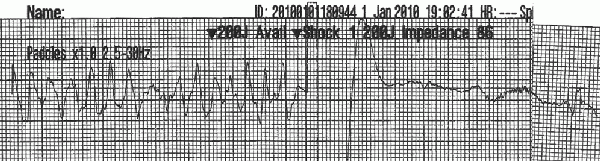
What had happened was this. The catheter placed in my femoral artery was fed into my left ventricle. Here, tickling an already irritable myocardium, it provoked ventricular fibrillation. During the 40 seconds it took to organise the defibrillator to shock me (Box 1), I presumably did what I have seen patients do as they have a cardiac arrest — I went into spasm similar to the tonic stage of an epileptic seizure. The seizure caused me to bite my lower lip. In 2004, in the columns of the MJA, I had indicated that if I had a cardiac arrest close to a defibrillator, I expected to survive.1 Nice to be proved right.
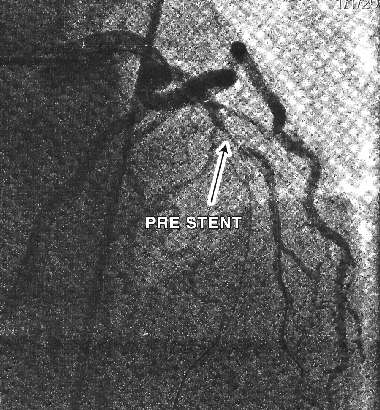
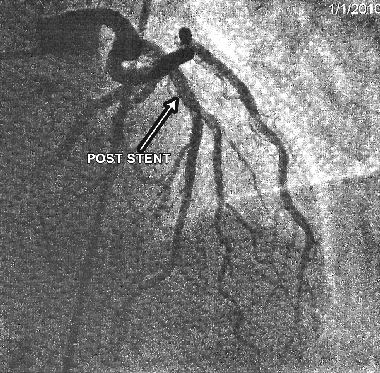
The angiogram showed a single blockage of a coronary artery at a bifurcation (Box 2, A), which I was told might make stent placement difficult. I was also told I could expect to experience some (presumably ischaemic) pain during the procedure. My benzodiazepine level was such that I accepted this information with equanimity. I dozed as they fiddled; the procedure appeared to be a success (Box 2, B), and soon after nightfall I was back in the coronary care unit.
I had received aspirin, clopidogrel, enoxaparin, heparin and abciximab, all to stop my blood clotting. A large hole had then been made in my femoral artery, from which I slowly and steadily bled. I was instructed to lie flat and not move my right leg. After replacing the saturated pressure dressing, the nurse applied pressure to the area for 10 minutes. Blood collected in various places. Those with knowledge of anatomy can imagine where these places were. For those without, they were around where the nurse had been squirting sterile water earlier in the evening. Cleaning up had to be done without my moving much. Periodically my bits and pieces got in the way and had to be flicked aside. (I closed my eyes, but I was no longer capable of thinking of England.) This cycle was repeated every hour for 8 hours. Finally, at 4 am, the bleeding stopped. I have never before had a nurse pay so much sustained attention to my groin — not even when I was a junior doctor.
As day broke, I noted that I was alive. The previous day’s medication had worn off and I was fully awake. The groin pain was not sufficient to need treatment. All things considered, I was feeling pretty good. But that was easily fixed — I was given drugs: atenolol to slow the heart beat without actually stopping it; perindopril to lower the blood pressure while still keeping it measurable (a chronic cough allows the cardiologist to know that blood is still flowing); aspirin and clopidogrel (cardiologists feel sorry for gastroenterologists and try to add rare excitement to their lives — a patient with a dodgy heart and a stomach full of blood will do the trick); rosuvastatin (cardiologists favour functioning cardiac muscle over functioning skeletal muscle); and isosorbide mononitrate (the highlight of my hospital stay!).
After swallowing the handful of pills, I was expecting indigestion, but what I got was a headache. I soon became a clock-watcher. I ensured I was given paracetamol every 4 hours. The headache sometimes became just bearable, but would not go away. I became aware of every beep, bang and noise in and around the CCU — and there were many. (Why is it that when I am giving anaesthetics, I can set the monitor alarms so that they go off only rarely, they mean something when they do, and I take notice of them — but when I’m in other hospital environments, alarms go off all the time, they mean nothing, and no one takes any notice?) The patient in the bed opposite commiserated — the racket coming from the nursing station at the change of shift reminded him of the noise made when he fed his raucous chooks.
The next morning, full of nausea and headache, and with my heart being monitored by telemetry, I was moved from the CCU to an empty double room. Having a shower was my next big adventure. I had my left hand in a glove covering my IV line, I couldn’t flex my right leg at the hip, and I had ECG leads and wires going to a battery-operated telemetry box. I couldn’t find any soap. As I was not exactly dressed to go out looking for a nurse, I pressed a call button. I didn’t have my glasses on, and the button turned out to be for “emergency assistance”. Anyway, I was told that the only soap was in the liquid soap dispenser above the sink, some distance away from where I was supposed to be having a shower. A series of prolonged, complex, awkward and repetitive manoeuvres were required to get soap and water together where they were needed (which was pretty well everywhere). Sadly, there is no video clip of this dance.
As the headache from my second isosorbide tablet was kicking in, a middle-aged man with chest pain was put in the next bed. I had to be careful what I said to him. He spent a good part of the time talking on his mobile phone. He was certain that his pain had nothing to do with his heart and said he was only there to keep his wife happy. I did not share his certainty as, through the curtains, I overheard him telling his story to his doctor. Later, he told me his pain was returning. I suggested that he press the call button, but it became evident that he was not going to do this. So I told him I needed some more paracetamol for my headache, and pressed my call button. Soon the nurses were taking ECGs and giving him glyceryl trinitrate.
As night fell, I plotted how to organise sleep. Nothing seemed likely to happen in my room after 9.30 pm. After taking paracetamol and temazepam, I eventually drifted off.
But before midnight, a nurse woke me. “Are you all right?” she asked.
“No! I have a bloody headache and you have just woken me up”, I thought. “Yes”, I said.
“Your heart rate is 140 on the monitor”, she said.
The cause turned out to be a loose monitor lead. After this intrusion, I was unable to get back to sleep. I knew I could not have any more drugs until 1.30 am, so I asked if I could get out of bed. After wandering around in circles for a while, I came across a large bank of screens showing CCU and ward telemetry tracings. There were heart blocks, bradycardias, tachycardias, paced rhythms and evolving infarcts. I noted that I was alive and ticking, although that seemed a mixed blessing at the time. But what was my trace doing up there along with all the others? Were the gods punishing me for something I had written more than 20 years ago?2
So, what did I learn from being “on the other side”? Doctors are not immune from illness. Hospitals are dangerous places — avoid them if possible. Selected patients should be given benzodiazepines the moment they walk through the door. Those responsible for unnecessary hospital noise should be taken out and shot. And, after considering the alternatives, I can highly recommend ventricular fibrillation as a way of leaving this world.
References
- Mackay MJ. A time to die. Med J Aust 2004; 181: 667-668. 0_i1095452
- Mackay M. Chocolate biscuits are poisonous and should be banned by the year 2000. N Z Med J 1988; 101: 804. 0_i1095454
Fatty Liver Disease in Australia: A Narrative Review on the Epidemiology, Natural History, Prognostication and Management in People With Metabolic Dysfunction
Karl Vaz, Daniel Clayton-Chubb, William W. Kemp, Stuart K. Roberts, Ammar Majeed
Sex Differences in Management and Outcomes of People With ST-Elevation Myocardial Infarction, New South Wales, 2011–2020: A Retrospective Cohort Study
Adam C. Livori, Jedidiah I. Morton, Dianna J. Magliano, Jonathan E. Shaw
Rethinking Rheumatic Fever Diagnosis: Progress, Pitfalls and the Path Towards a Definitive Test
Anna P. Ralph, Rachel Webb, Tom Parks, Nicole J. Moreland, Asha C. Bowen, Benjamin Jones, Emma Ndagire, Andrea Z. Beaton
Sex Differences in Management and Outcomes of People With ST-Elevation Myocardial Infarction, New South Wales, 2011–2020: A Retrospective Cohort Study
Samia Kazi, Simone Marschner, Clara K. Chow
Distribution of Cardiovascular Disease Risk Based on the Updated 2023 Guideline-Recommended Australian Cardiovascular Disease Risk Algorithm and Comparison With the 2012 Algorithm: An Observational Study
Nina Lazarevic, Meghana Bhat, Grace Joshy, Danielle C. Butler, Mark Woodward, Anushka Patel, Rod T. Jackson, Garry Jennings, Rosemary Wyber, Ellie Paige, Emily Banks
They Brought the Hospital to Me
Hugh N. Burrill